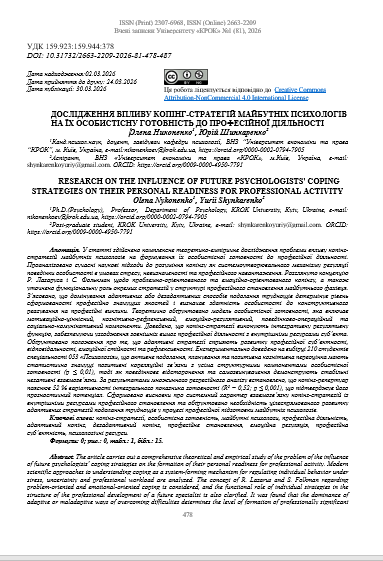
ДОСЛІДЖЕННЯ ВПЛИВУ КОПІНГ-СТРАТЕГІЙ МАЙБУТНІХ ПСИХОЛОГІВ НА ЇХ ОСОБИСТІСНУ ГОТОВНІСТЬ ДО ПРОФЕСІЙНОЇ ДІЯЛЬНОСТІ
DOI:
https://doi.org/10.31732/2663-2209-2026-81-478-487Ключові слова:
копінг-стратегії, особистісна готовність, майбутні психологи, професійна діяльність, адаптивний копінг, дезадаптивний копінг, професійне становлення, емоційна регуляція, професійна суб’єктність, психологічні ресурсиАнотація
У статті здійснено комплексне теоретико-емпіричне дослідження проблеми впливу копінг-стратегій майбутніх психологів на формування їх особистісної готовності до професійної діяльності. Проаналізовано сучасні наукові підходи до розуміння копінгу як системоутворювального механізму регуляції поведінки особистості в умовах стресу, невизначеності та професійного навантаження. Розглянуто концепцію Р. Лазаруса і С. Фолькман щодо проблемно-орієнтованого та емоційно-орієнтованого копінгу, а також уточнено функціональну роль окремих стратегій у структурі професійного становлення майбутнього фахівця. З’ясовано, що домінування адаптивних або дезадаптивних способів подолання труднощів детермінує рівень сформованості професійно значущих якостей і визначає здатність особистості до конструктивного реагування на професійні виклики. Теоретично обґрунтовано модель особистісної готовності, яка включає мотиваційно-ціннісний, когнітивно-рефлексивний, емоційно-регулятивний, поведінково-операційний та соціально-комунікативний компоненти. Доведено, що копінг-стратегії виконують інтегративну регулятивну функцію, забезпечуючи узгодження зовнішніх вимог професійної діяльності з внутрішніми ресурсами суб’єкта. Обґрунтовано положення про те, що адаптивні стратегії сприяють розвитку професійної суб’єктності, відповідальності, емоційної стійкості та рефлексивності. Експериментально доведено на вибірці 210 студентів спеціальності 053 «Психологія», що активне подолання, планування та позитивна когнітивна переоцінка мають статистично значущі позитивні кореляційні зв’язки з усіма структурними компонентами особистісної готовності (p ≤ 0,01), тоді як поведінкове відсторонення та самозвинувачення демонструють стабільні негативні взаємозв’язки. За результатами множинного регресійного аналізу встановлено, що копінг-репертуар пояснює 52 % варіативності інтегрального показника готовності (R² = 0,52; p ≤ 0,001), що підтверджує його прогностичний потенціал. Сформовано висновки про системний характер взаємозв’язку копінг-стратегій із внутрішніми ресурсами професійного становлення та обґрунтовано необхідність цілеспрямованого розвитку адаптивних стратегій подолання труднощів у процесі професійної підготовки майбутніх психологів.
Завантаження
Посилання
Володарська, Н. (2024). Розгляд копінг-стратегій як фактор розвитку внутрішніх ресурсів студентів в умовах війни. Наукові інновації та передові технології, 4(32), 1269–1282. DOI: https://doi.org/10.52058/2786-5274-2024-4(32)-1269-1282
Карамушка, Л., & Снігур, Ю. (2020). Копінг-стратегії: сутність, підходи до класифікації, значення для психологічного здоров’я особистості та організації. Актуальні проблеми психології: зб. наук. праць Інституту психології імені Г. С. Костюка НАПН України, Т.1, 55, 15–21.
Никоненко, О., & Козачук, В. (2025). Теоретико-методологічні аспекти дослідження копінгу як психологічної стратегії подолання стресу. Вчені записки Університету "КРОК", 3(79), 429-436. DOI: https://doi.org/10.31732/2663-2209-2025-79-429-436. https://dspace.krok.edu.ua/handle/krok/8307
Сорока, І., & Сингаївська, І. (2022). Управління міжособистісними конфліктами у студентському середовищі: результати впровадження навчального курсу. Рsychological journal, Т. 8, 1(57), 18–31. DOI: https://doi.org/10.31108/1.2022.8.1.2.https://apsijournal.com/index.php/psyjournal/article/view/1410/841
Харченко, Н., & Дудник, О. (2023). Особливості я-концепції майбутніх психологів. Вчені записки Університету «КРОК», 4(72), 228–234. DOI: https://doi.org/10.31732/2663-2209-2023-72-228-234
Черкашин, А. (2021). Стресостійкість та копінг-стратегії поведінки студентів під час освітнього процесу у закладах вищої освіти. Теорія і практика управління соціальними системами, 1, 98–107.
Шеленкова, Н. (2019). Дослідження копінг-стратегій в процесі адаптації студентів першого року навчання. Науковий вісник Херсонського державного університету, 1, 72–77. DOI: https://doi.org/10.32999/ksu2312-3206/2019-1-11
Шинкаренко, Ю. (2024). Методологічні підходи до вивчення розвитку копінг-стратегій у майбутніх психологів. Вчені записки Університету «КРОК», 3(75), 286–294. DOI: https://doi.org/10.31732/2663-2209-2024-75-286-294
Cornett, M., Palermo, C., & Ash, S. (2022). Professional identity research in the health professions – a scoping review. Advances in Health Sciences Education, 28(2), 589–642. https://doi.org/10.1007/s10459-022-10171-1
Freire, C., Ferradás, M. del M., Regueiro, B., Rodríguez, S., Valle, A., & Núñez, J. C. (2020). Coping strategies and self-efficacy in university students: A person-centered approach. Frontiers in Psychology, 11. https://doi.org/10.3389/fpsyg.2020.00841
Freire, C., Ferradás, M. del M., Valle, A., Núñez, J. C., & Vallejo, G. (2016). Profiles of psychological well-being and coping strategies among university students. Frontiers in Psychology, 7. https://doi.org/10.3389/fpsyg.2016.015546
Lazarus, R. S., & Folkman, S. (1984). Stress, appraisal, and coping. New York: Springer.
Mytnyk, A., Ivashkevych, E., Chanchykov, I., Predko, V., & Stakhova, O. (2023). Professional training of future psychologists in the information space in higher education institutions. Amazonia Investiga, 12(61), 112–121.
https://doi.org/10.34069/AI/2023.61.01.12
Suprun, D. (2017). Professional training of psychologists in the field of special education. IJPINT, 4(2), 90–96. https://doi.org/10.5604/01.3001.0011.5918
Yablonska, T., Vernyk, O., & Haivoronskyi, H. (2023). Ukrainian adaptation of the Brief-COPE questionnaire. Insight: The Psychological Dimensions of Society, 10, 66–89. https://doi.org/10.32999/2663-970X/2023-10-4
Downloads
Опубліковано
Як цитувати
Номер
Розділ
Ліцензія

Ця робота ліцензується відповідно до Creative Commons Attribution-NonCommercial 4.0 International License.