DETERMINATION OF PRIORITY DIRECTIONS FOR THE IMPLEMENTATION OF THE LOGISTICS POTENTIAL OF ELECTRICITY TRANSMISSION COMPANIES
DOI:
https://doi.org/10.31732/2663-2209-2026-82-155-166Keywords:
energy transmission companies, logistics potential, priority, management, efficiency, effectiveness, optimizationAbstract
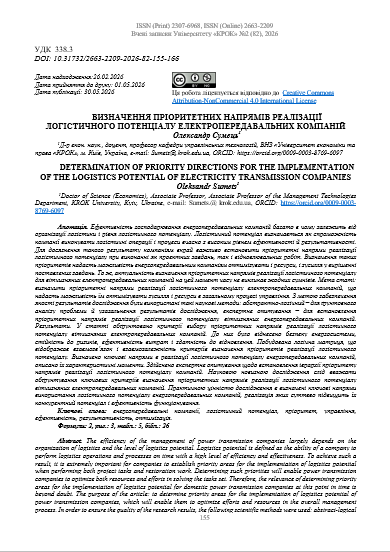
The efficiency of the management of power transmission companies largely depends on the organization of logistics and the level of logistics potential. Logistics potential is defined as the ability of a company to perform logistics operations and processes on time with a high level of efficiency and effectiveness. To achieve such a result, it is extremely important for companies to establish priority areas for the implementation of logistics potential when performing both project tasks and restoration work. Determining such priorities will enable power transmission companies to optimize both resources and efforts in solving the tasks set. Therefore, the relevance of determining priority areas for the implementation of logistics potential for domestic power transmission companies at this point in time is beyond doubt. The purpose of the article: to determine priority areas for the implementation of logistics potential of power transmission companies, which will enable them to optimize efforts and resources in the overall management process. In order to ensure the quality of the research results, the following scientific methods were used: abstract-logical - for a thorough analysis of the problem and generalization of the research results, expert survey - to establish priority areas for the implementation of the logistics potential of domestic power transmission companies. Results. The article substantiates the criteria for choosing priority areas for the implementation of the logistics potential of domestic power transmission companies. These include power system security, risk resistance, cost efficiency and recovery ability. A logical matrix was constructed that reflects the relationship and interdependence of the criteria for determining priorities for the implementation of the logistics potential. Key areas in the implementation of the logistics potential of power transmission companies were identified, their characteristic points were described. An expert survey was conducted to establish a hierarchy of priority areas for the implementation of the logistics potential of companies. The scientific novelty of the study should be considered the justification of the key criteria for determining priority areas for the implementation of the logistics potential of domestic power transmission companies. The practical value of the study is the identified key areas of use of the logistics potential of energy transmission companies, the implementation of which will significantly increase their competitive potential and operational efficiency.
Downloads
References
Гнатуш, Б. П. (2024). Оцінка сучасних тенденцій в управлінні логістичним потенціалом електропередавальних компаній. Вісник ОНУ імені І. І. Мечникова. Т. 29. Вип. 4(102). DOI: https://doi.org/10.32782/2304-0920/4-102-7
Гурій, Н. М., Оверченко, А. І. (2016). Оцінка логістичного потенціалу підприємства як основа вибору його логістичної стратегії. Економіка та управління підприємствами. 13. 244–48. Доступ через : http://global-national.in.ua/archive/13-2016/50.pdf
Дудко, В. Б., Шевченко, О. М. (2011). Енергетичний аспект логістичної системи. Чернігівський науковий часопис. Серія 1. Економіка і управління. 1(1). 129–134. Доступ через : http://nbuv.gov.ua/UJRN/Chnch_ekon_2011_1_19
Зборовська, О. М. (2011). Системне управління потоковими процесами промислового підприємства на підставі логістичного підходу : монографія. Дніпропетровськ : Дніпропетровський ун-т імені Альфреда Нобеля. 312.
Мігай, Н. (2022). Логістичний потенціал як рушійна сила інноваційного розвитку регіону. Економіка та суспіль¬ство. 36. DOI: https://doi.org/10.32782/2524-0072/2022-36-18
Крутогорський, Я. В. (2021). Перспективи логістики енергопостачання з альтернативних джерел. Ефективна економіка. 8. Доступ через : http://www.economy.nayka.com.ua/pdf/8_2021/86.pdf
Пудичева, Г.О. (2017). Передумови розвитку енергетичної логістики в Україні. Вісник соціально-економічних досліджень. № 1 (62). 128-134. Доступ через : http://nbuv.gov.ua/UJRN/Vsed_2017_1_16
Пудичева, Г. О. (2019). Логістичні потоки в енергетичному господарстві підприємства. Економіка та підприєм¬ництво. 4(109). Доступ через : http://nbuv.gov.ua/UJRN/drep_2019_4_22
Пудичева, Г. О. (2021). Прийняття логістичних рішень в енергозабезпеченні підприємств. Зб. наук. праць «Вісник соціально-еко¬номічних досліджень». 1(76). 176–189. DOI: https://doi.org/10.33987/vsed.1(76).2021.176-189
Рудень, В. В., Гутор, Т. Г. Методика проведення та оцінки результатів експертних оцінок. Доступ через : www.umj.com.ua/uk/publikatsia-9571-metodika-provedennya-ta-ocinki-rezultativ-ekspertnix-ocinok-na-prikladi-vprovadzhennya-sistemi-monitoringu-zdorov-ya-naselennya-na-rivni-pervinnoi-mediko-sanitarnoi-dopomogi)
Русин-Гриник, Р., Гнатуш, П., Борсук, О. (2023). Сутність і види логістичного потенціалу електропередавальних компаній. Економіка та суспільство. 57. DOI: https://doi.org/10.32782/2524-0072/2023-57-64
Сумець, О. М. (2025). Комунікативний менеджмент: чинники впливу на появу організаційних бар’єрів у комунікаціях персоналу вітчизняних підприємств, фірм і компаній. Вчені записки Університету «КРОК». 3(79). 174-184. DOI: 10.31732/2663-2209-2025-79-174-184
Сумець, О.М., Догадіна, В.Ю. (2026). Систематизація чинників впливу на логістичний потенціал електропередавальних компаній. Економіка та суспільство. № 83. DOI: https://doi.org/10.32782/2524-0072/2026-83-154
Сумець, О.М., Співакова, Н.О. (2026). Напрями посилення логістичного потенціалу енергопередавальних компаній. Наук.-вироб. журнал «Бізнес-навігатор». Вип. 2(85). С. 353-358. DOI: https://doi.org/10.32782/business-navigator.85-15
Хмарська, І., Сігаєва, Т., Бачинська, О. (2023). Оцінки ефективності та якості управління логістичним потенціа¬лом. Економіка та суспільство. 49. DOI: https://doi.org/10.32782/2524-0072/2023-49-19
Чорнописька, Н. В., Стасюк, К. З. (2021). Логістичний потенціал: до питання термінології. Менеджмент та підпри¬ємництво в Україні: етапи становлення та проблеми розвитку. 2(6). Доступ через : https://science.lpnu.ua/sites/default/files/journal-paper/2021/nov/25521/nzmened-121-126.pdf
Garbaccio, R.F., M.S. Ho, and D.W. Jorgenson (1999). Why has the Energy-Output Ratio Fallen in China? Energy Journal. 20 (3). 63-91. Access via : https://munho.scholars.harvard.edu/publications/why-has-energy-output-ratio-fallen-china
Fisher-Vanden, K., Jefferson, G. H., Liu, H. M. et al. (2004). What is driving China's decline in energy intensity? LIU Hongmei and TAO Quan National Bureau of Statistics, People’s Republic of China. 26 р. Access via : https://people.brandeis.edu/~jefferso/DOE%201,%20July%2024,%2003.pdf
Kang, Y.B. (2007). China’s energy-saving forms, potential and measures research report. Access via : http://www.eri.org.cn/manage/englishfile/51-2007-7-5-517174.pdf
He, Y., X., Tao, W., J., Zhang, S., L., Li, Y., Li, F., R. (2007). Factors Decomposition of Energy Intensity: The case of Liaoning province in China. International journal of systems applications, engineering & development. Issue 3. Vol. 1. Access via : https://www.naun.org/main/UPress/saed/saed-9.pdf
Park, C. W., Kwon, K. S., Kim, W. B., Min, B. K., Park, S. J., Sung, I. H., Yoon, Y. S., Lee, K. S., Lee, O. H., & Seok, J. (2009). Energy consumption reduction technology in manufacturing. A selective review of policies, standards, and research. International Journal of Precision Engineering and Manufacturing, 10(5), 151-173. https://doi.org/10.1007/s12541-009-0107-z
Cantore, N. (2011). Factors affecting energy efficiency adoption in the manufacturing sector in developing countries. United Nations industrial development organization working paper, 15. 105-117. Access via : https://downloads.unido.org/ot/99/23/9923947/WP15.pdf?_ga=2.261753037.1983739083.1777906148-848765451.1777906148
Cantore, N, Dirk, W. (2011). Promoting energy efficiency in developing countries – new evidence based on firm analysis. United Nations industrial development organization working paper, 15. 23-39. Access via : https://downloads.unido.org/ot/99/23/9923947/WP15.pdf?_ga=2.261753037.1983739083.1777906148-848765451.1777906148
Tso, G. KF, Liu, F., Liu, K. (2013). The influence factor analysis of comprehensive energy consumption in manufactur¬ing enterprises. Procedia Computer Science. Vol. 17. 752‒758. Access via : https://www.sciencedirect.com/science/article/pii/S1877050913002305
Kareko, N. N., Odari, S. (2018). Factors influencing logistics management in the energy sector in kenya (a case study of KENYA POWER, NAIROBI). The strategic journal. Issue 3. Vol. 5. 1179-1194. DOI:10.61426/sjbcm.v5i3.876
Downloads
Published
How to Cite
Issue
Section
License

This work is licensed under a Creative Commons Attribution-NonCommercial 4.0 International License.