COMPETITIVE STRATEGIES IN INTERNATIONAL SERVICE MARKETS: EVIDENCE FROM THE PASSENGER AIR TRANSPORT INDUSTRY
DOI:
https://doi.org/10.31732/2663-2209-2026-81-69-77Keywords:
сompetitive strategy, International service markets, airline industry, cost leadership, differentiation, Ryanair, Lufthansa Group, network configuration, service unbundlingAbstract
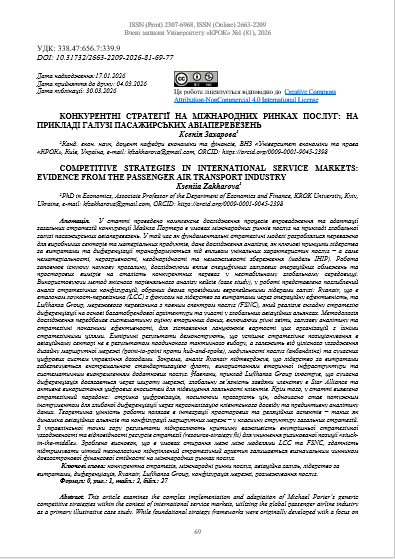
This article examines the complex implementation and adaptation of Michael Porter’s generic competitive strategies within the context of international service markets, utilizing the global passenger airline industry as a primary illustrative case study. While foundational strategy frameworks were originally developed with a focus on manufacturing sectors and tangible products, this research explores how the core pillars of cost leadership and differentiation are fundamentally redefined when applied to the unique characteristics of services – specifically intangibility, inseparability, heterogeneity, and perishability (the IHIP model). The study addresses a critical research gap by analyzing how service-specific operational constraints and spatial dimensions influence the sustainability of competitive advantage in a volatile global environment. Using a rigorous qualitative comparative case study approach, the paper provides an in-depth analysis of the strategic configurations adopted by two prominent European industry leaders: Ryanair, representing a prototypical low-cost carrier (LCC) strictly focused on cost leadership through operational efficiency, and Lufthansa Group, a premier full-service network carrier (FSNC) pursuing a sophisticated differentiation strategy based on a multi-brand architecture and global alliance participation. The methodology involves a systematic evaluation of secondary data, including annual reports, industry analytics, and strategic performance indicators, to map these organizations' value chains against their stated strategic objectives. The empirical findings reveal that successful strategic positioning in the international airline sector is not a result of a single tactical choice but depends on the holistic alignment of network design, service modularity (unbundling), and advanced digital revenue management systems. Specifically, the analysis of Ryanair demonstrates that cost leadership is sustained through extreme standardization, the use of secondary infrastructure, and the systematic unbundling of ancillary services. Conversely, the Lufthansa Group case illustrates that differentiation in the modern era is achieved through network breadth, global connectivity via the Star Alliance, and the leveraging of digital ecosystems to enhance customer loyalty. Furthermore, the study demonstrates a significant strategic paradox: while rapid digitalization intensifies price transparency and commoditization, it simultaneously serves as a powerful enabler for sophisticated differentiation through personalized customer experiences and predictive data analytics. Theoretically, the paper contributes to the field of strategic management by integrating spatial and relational dimensions – such as hub-and-spoke vs. point-to-point configurations and airline alliance dynamics – into the classical generic strategies framework. From a managerial perspective, the results underscore the vital importance of internal strategic consistency and "resource-strategy fit" to avoid the precarious "stuck-in-the-middle" positions. The article concludes that as the boundaries between LCC and FSNC models continue to blur, the ability to maintain a clear and technologically-supported strategic archetype remains the primary determinant of long-term financial sustainability in international service markets.
Downloads
References
Accelingo. (2023). Competitive strategies in international business. https://www.accelingo.com/competitive-strategies-in-international-business/
Akram, M. U., & Hanif, M. S. (2021). Competitive strategies in international service markets: Evidence from the passenger air transport industry. Social Sciences Studies Journal, 7(85), 3121–3132. https://doi.org/10.26733/sssj.v7i85.4190
Camphouse. (2022). International marketing strategy: How to expand your business globally. https://camphouse.io/blog/international-marketing-strategy
Desklib. (2021). Ryanair competitive strategy. https://desklib.com/study-documents/ryanair-competitive-strategy/
Francis, G., Humphreys, I., Ison, S., & Aicken, M. (2007). Where next for low cost airlines? A spatial and temporal comparative study. Journal of Transport Geography, 15(3), 168–177. https://doi.org/10.1016/j.jtrangeo.2006.02.012
Henault, J. (2023, April 14). International marketing: Definition, strategies, and examples. Shopify. https://www.shopify.com/blog/international-marketing
Indeed Editorial Team. (2023, July 21). Market entry strategies: Definition and 10 types. Indeed. https://www.indeed.com/career-advice/career-development/market-entry-strategies
Institute for Manufacturing. (2020). Porter's generic competitive strategies. University of Cambridge. https://www.ifm.eng.cam.ac.uk/research/dstools/porters-generic-competitive-strategies/
Kharazishvili, Y., Kwilinski, A., Bugayko, D., Hryhorak, M., Butorina, V., & Yashchyshyna, I. (2022). Strategic scenarios of the post-war recovery of the aviation transport sustainable development: The case of Ukraine. Virtual Economics, 5(3), 7–30. https://doi.org/10.34021/ve.2022.05.03
Karsbergen, K. (2024). Airlines: Aviation strategy and competitive strategy [Post]. LinkedIn. https://www.linkedin.com/posts/koenkarsbergen_airlines-aviationstrategy-competitivestrategy-activity-7382048445328490496-VQmz
Latticework. (2024, April 19). Ryanair: Capital efficiency and the low-cost model. https://www.latticework.com/p/ryanair-capital-efficiency-low-cost
LIGS University. (2022). Comparison between low-cost and traditional airlines: Case study of British Airways and easyJet. https://ligsuniversity.com/comparison-between-low-cost-traditional-airlines-case-study-of-british-airways-and-easyjet/
Lokalise. (2023, March 23). International pricing strategies: Key types and how to choose one. https://lokalise.com/blog/international-pricing-strategies/
Luo, X. (2024). The development strategy for airlines: A case study of Lufthansa Group [Bachelor’s thesis, Haaga-Helia University of Applied Sciences]. Theseus. https://www.theseus.fi/bitstream/10024/885130/2/Luo_Xinrui.pdf
MatrixBCG. (2023). Lufthansa competitors analysis. https://matrixbcg.com/blogs/competitors/lufthansa
Nguyen Rose, T. (2023, November 7). Strategies for competing in international markets. LinkedIn. https://www.linkedin.com/pulse/strategies-competing-international-markets-tuoi-nguyen-rose--vniic/
O’Connell, J. F., & Williams, G. (2005). Passengers’ perceptions of low-cost airlines and full service carriers: A case study involving Ryanair, Aer Lingus, Air Asia and Malaysia Airlines. Journal of Air Transport Management, 11(4), 259–272. https://doi.org/10.1016/j.jairtraman.2005.01.007
One IBC. (2023). Unlocking global success by international market entry strategies. https://www.oneibc.com/en-us/insights/unlocking-global-success-by-international-market-entry-strategies
PESTEL Analysis. (2023). Lufthansa competitors analysis. https://pestel-analysis.com/blogs/competitors/lufthansa
Porter, M. E. (1985). Competitive advantage: Creating and sustaining superior performance. Free Press.
Quartr. (2023). How Ryanair’s relentless cost-cutting redefined the airline industry. https://quartr.com/insights/edge/how-ryanairs-relentless-cost-cutting-redefined-the-airline-industry
Ranganathan, P., & Aggarwal, R. (2018). Study designs: Part 1 - An overview and classification. Perspectives in Clinical Research, 9(4), 184–186. https://doi.org/10.4103/picr.PICR_124_18
Smerichevskyi, S. F., & Hura, S. M. (2021). Systemic economic dynamics of passenger aviation transport and institutional mechanisms of its regulation. Problems of Systemic Approach in the Economy, 2(82), 46–54. https://doi.org/10.32782/2520-2200/2021-2-7
StudyMoose. (2022). Ryanair’s business level strategy. https://studymoose.com/ryanairs-business-level-strategy-essay
SWOT Analysis Example. (2023). Lufthansa Group competitors. https://swotanalysisexample.com/blogs/competitors/lufthansagroup-competitors
Wittman, M. D., & Belobaba, P. P. (2018). Evolving competition between low-cost carriers and full-service airlines. Journal of Air Transport Management, 71, 1–11. https://doi.org/10.1016/j.jairtraman.2018.05.011
Wood, G. (2009). The welfare state and the cultural reproduction of purity: The case of Bangladesh. International Journal of Educational Development, 29(5), 530–539. https://doi.org/10.1016/j.ijedudev.2009.04.007
Downloads
Published
How to Cite
Issue
Section
License

This work is licensed under a Creative Commons Attribution-NonCommercial 4.0 International License.