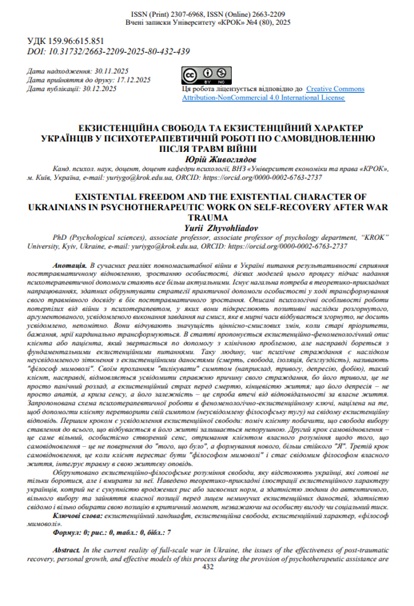
EXISTENTIAL FREEDOM AND THE EXISTENTIAL CHARACTER OF UKRAINIANS IN PSYCHOTHERAPEUTIC WORK ON SELF-RECOVERY AFTER WAR TRAUMA
DOI:
https://doi.org/10.31732/2663-2209-2025-80-432-439Keywords:
existential landscape, existential freedom, existential character, ‘unwitting philosopher’Abstract
In the current reality of full-scale war in Ukraine, the issues of the effectiveness of post-traumatic recovery, personal growth, and effective models of this process during the provision of psychotherapeutic assistance are becoming increasingly relevant. There is an urgent need for theoretical and practical developments capable of substantiating strategies for practical assistance to individuals in transforming their traumatic experiences into post-traumatic growth. The psychological characteristics of working with war victims described by psychotherapists emphasise the positive effects of a detailed, reasoned, conscious approach to the task at hand, which in peacetime is carried out in a condensed, not sufficiently conscious, and inconspicuous manner. They feel the significance of value-meaningful changes when old priorities, desires, and dreams are radically transformed.The article offers an existential-phenomenological description of a client or patient who seeks help with a clinical problem but is actually struggling with fundamental existential questions. Such a person, whose mental suffering is the result of an unconscious collision with existential givens (death, freedom, isolation, meaninglessness), is called an ‘involuntary philosopher.’ By asking to ‘cure’ a symptom (e.g., anxiety, depression, phobia), such a client actually refuses to acknowledge the real cause of their suffering, because their anxiety is not just a panic disorder, but an existential fear of death, of the finitude of life; that their depression is not just apathy, but a crisis of meaning, and his dependence is an attempt to escape responsibility for his own life. The proposed scheme of psychotherapeutic work in a phenomenological-existential key is aimed at helping the client transform their symptom (unconscious philosophical longing) into a conscious existential response. The first step is to realise existential freedom: to help the client see that the freedom to choose their attitude to everything that happens in their life remains inviolable. The second step of self-healing is precisely this free, personally created meaning, the client's own understanding that self-healing is not a return to ‘what was,’ but the formation of a new, more stable ‘I.’ The third step of self-restoration is when the client ceases to be an ‘involuntary philosopher’ and becomes a conscious philosopher of their own life, integrating trauma into their life story.
The arguments for the existential-philosophical understanding of freedom defended by Ukrainians, who are ready not only to fight but also to die for it, are well-founded. Theoretical and practical illustrations of the existential nature of Ukrainians are given, which is not a set of innate traits or acquired norms, but rather a person's ability to make authentic, free choices and take their own position in the face of inevitable existential realities, the ability to consciously and freely choose their position at a critical moment, regardless of personal gain or social pressure.
Downloads
References
Климчук, В. О. (2016). Посттравматичне зростання та як йому можна сприяти у психотерапії. Наука і освіта, (5), 46–52. https://scienceandeducation.pdpu.edu.ua/doc/2016/5_2016/6.pdf
Погорільська, Н. І., Найдьонова, Г. О., & Карпюк, А. В. (2024). Ресурси посттравматичного зростання українців в умовах війни. Вчені записки ТНУ імені В.І. Вернадського. Серія: Психологія, 35(4), 57–62. https://psych.vernadskyjournals.in.ua/journal/4_2024/4_2024.pdf
Сингаївська І., & Берестовська А. (2024). Особливості надання психологічної допомоги жінкам, які переживають втрату близької людини під час війни. Вчені записки Університету «КРОК», 1(73), 214–226. - DOI https://doi.org/10.31732/2663-2209-2024-73-214-226
Титаренко, Т. М. (2017). Стратегії сприяння посттравматичному зростанню особистості. Психологічні науки: проблеми і здобутки, (1), 217–232. https://lib.iitta.gov.ua/id/eprint/709888/1/Tytarenko%20T.M.%20Strategies%20to%20promote%20post-traumatic%20personality%20development.pdf
Титаренко, Т. М. (2019). Екзистенційний ландшафт посттравматичного життєтворення особистості. Наукові студії із соціальної та політичної психології, 44(47), 7–15.
Чемодурова, Ю. М. (2024). Психологічні моделі феномену посттравматичного зростання особистості. Вчені записки ТНУ імені В.І. Вернадського. Серія: Психологія, 35(4). https://doi.org/10.32782/2709-3093/2024.4/05
Holzhey-Kunz, A. (2025). Freedom Is More Than Just Freedom. On different notions of freedom and their relation to existential freedom. EXISTENTIA: психологія и психотерапія, (18), 259–261. https://www.existentialtherapy.eu/wp-content/uploads/2025/10/Existentia_18_2025.pdf
Holzhey-Kunz, A., & Längle, A. (2008). Existenzanalyse und Daseinsanalyse. UTB. Wien - Stuttgart 2008 ISBN 9783825229665 Kartoniert, 356 Seiten, https://www.perlentaucher.de/buch/alice-holzhey-kunz-alfried-laengle/existenzanalyse-und-daseinsanalyse.html
Downloads
Published
How to Cite
Issue
Section
License

This work is licensed under a Creative Commons Attribution-NonCommercial 4.0 International License.