ANALYSIS OF MODERN AI TECHNOLOGIES IN BUSINESS: ALGORITHMS AND OPTIMIZATION METHODS, ADVANTAGES AND RISKS OF APPLICATION
DOI:
https://doi.org/10.31732/2663-2209-2026-81-88-94Keywords:
artificial intelligence, business process optimization, digitalization, machine learning algorithms and methods, predictive analytics, risk managementAbstract
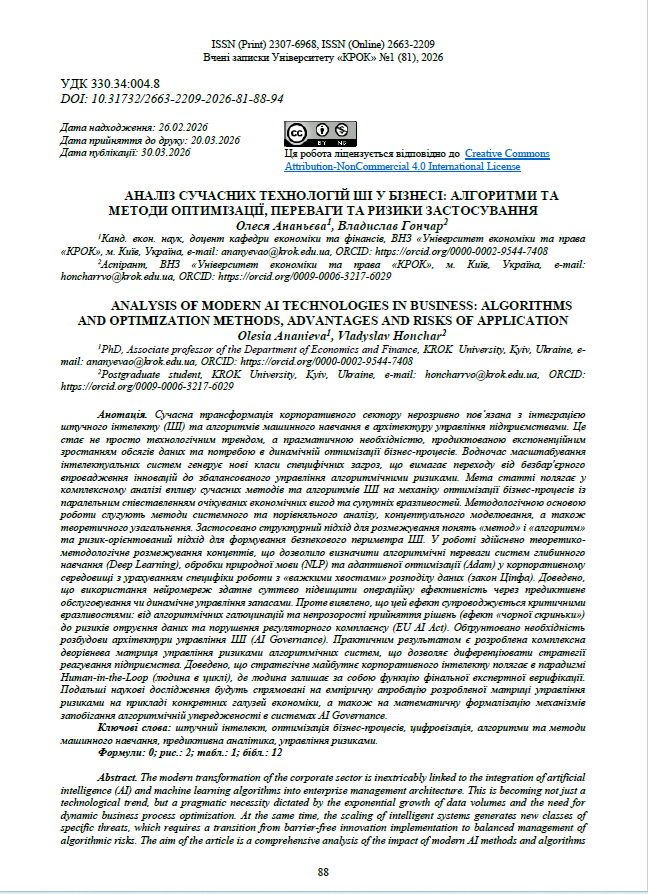
The modern transformation of the corporate sector is inextricably linked to the integration of artificial intelligence (AI) and machine learning algorithms into enterprise management architecture. This is becoming not just a technological trend, but a pragmatic necessity dictated by the exponential growth of data volumes and the need for dynamic business process optimization. At the same time, the scaling of intelligent systems generates new classes of specific threats, which requires a transition from barrier-free innovation implementation to balanced management of algorithmic risks. The aim of the article is a comprehensive analysis of the impact of modern AI methods and algorithms on the mechanics of business process optimization, with a parallel comparison of expected economic benefits and associated vulnerabilities. The methodological basis of the work includes methods of system and comparative analysis, conceptual modeling, and theoretical generalization. A structural approach was applied to distinguish between the concepts of "method" and "algorithm", as well as a risk-oriented approach to form the AI security perimeter. The paper carries out a theoretical and methodological differentiation of concepts, which allowed identifying the algorithmic advantages of deep learning systems, natural language processing (NLP), and adaptive optimization (Adam) in the corporate environment, taking into account the specifics of working with heavy-tailed data distributions (Zipf's law). It is proven that the use of neural networks can significantly increase operational efficiency (through predictive maintenance or dynamic inventory management). However, it was found that this effect is accompanied by critical vulnerabilities: from algorithmic hallucinations and opacity of decision-making (the "black box" effect) to the risks of data poisoning and violation of regulatory compliance (EU AI Act). The necessity of building an AI Governance architecture is substantiated. The practical result is the developed comprehensive two-level risk management matrix of algorithmic systems, which allows differentiating the enterprise's response strategies. It is proven that the strategic future of corporate intelligence lies in the Human-in-the-Loop paradigm, where humans retain the function of final expert verification. Further scientific research will be aimed at empirical validation of the developed risk management matrix on the example of specific sectors of the economy, as well as on the mathematical formalization of mechanisms for preventing algorithmic bias in AI Governance systems.
Downloads
References
Kourkoumelis, N., Anastasopoulou, E. E., Deirmentzoglou, G. A., & Masouras, A. (2024). Artificial Intelligence and Managerial Decision-Making in International Business. European Conference on Innovation and Entrepreneurship, 19(1), 386-393. DOI: https://doi.org/10.34190/ecie.19.1.2573
Фостолович, В. А. (2022). Штучний інтелект в сучасному бізнесі: потенціал та сучасні тренди. Ефективна економіка, (7). DOI: https://doi.org/10.32702/2307-2105.2022.7.4
Барабась, Д., Ільницький, Д., & Андрусик, В. (2024). Штучний інтелект в системі детермінант конкурентоспроможності сучасного бізнесу. Herald of Khmelnytskyi National University. Economic Sciences, 336(6), 454-460. URL: https://heraldes.khmnu.edu.ua/index.php/heraldes/article/view/1278
Ананьєва, О.О. (2025). Діагностика ефективності впровадження штучного інтелекту в діяльність підприємств ІТ-сектору. Вісник Академії праці, соціальних відносин і туризму. Серія: Економіка, психологія та управління, (5). DOI: https://doi.org/10.54929/3041-2390-2025-05-01-11.
McKinsey & Company. (2025). The State of AI in 2025. McKinsey Global Institute. URL: https://www.mckinsey.com/capabilities/quantumblack/our-insights/the-state-of-ai#/
Capgemini. (2025). Top Tech Trends of 2025: AI-powered everything. Capgemini Research Institute. URL: https://www.capgemini.com/insights/research-library/top-tech-trends-2025/
World Economic Forum. (2025). The Global Risks Report 2025. WEF. URL: https://reports.weforum.org/docs/WEF_Global_Risks_Report_2025.pdf
Ernst & Young. (2025). EY survey: companies advancing responsible AI governance linked to better business outcomes. EY Global. URL: https://www.ey.com/en_gl/newsroom/2025/10/ey-survey-companies-advancing-responsible-ai-governance-linked-to-better-business-outcomes
Veena, S., & Aravindhar, J. (2024). Challenges of Machine Learning Algorithms Used in Business for Decision-Making. SSRN Electronic Journal. DOI: http://dx.doi.org/10.2139/ssrn.5066812
Kalogiannidis, S., Kalfas, D., Papaevangelou, O., & Chatzitheodoridis, F. (2024). The Role of Artificial Intelligence Technology in Predictive Risk Assessment for Business Continuity. Risks, 12(2), 19. DOI: https://doi.org/10.3390/risks12020019
Kunstner, F., Milligan, A., Yadav, R., Schmidt, M., & Bietti, A. (2024). Heavy-Tailed Class Imbalance and Why Adam Outperforms Gradient Descent on Language Models. NeurIPS 2024 Proceedings, 37, 1240-1258. URL: https://arxiv.org/abs/2402.19449
Ананьєва О.О., & Гончар В.О. (2025). Штучний інтелект як новий інструмент формування економічного середовища підприємства. Актуальні проблеми економіки. № 3 (285), 175-184. DOI: https://10.32752/1993-6788-2025-1-285-175-184
Downloads
Published
How to Cite
Issue
Section
License

This work is licensed under a Creative Commons Attribution-NonCommercial 4.0 International License.