FORECASTING THE PROBABILITY OF BANKRUPTCY IN THE FINANCIAL STABILITY MANAGEMENT SYSTEM OF SMALL ENTERPRISES
DOI:
https://doi.org/10.31732/2663-2209-2025-80-81-90Keywords:
bankruptcy, financial stability, crisis, solvency, bankruptcy forecasting, methods of bankruptcy diagnosis, small enterprisesAbstract
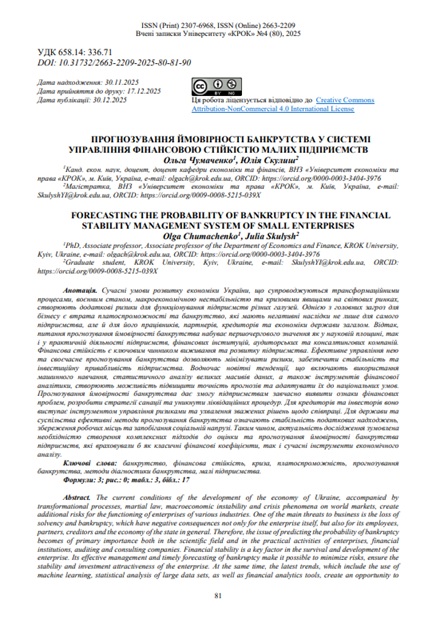
The current conditions of the development of the economy of Ukraine, accompanied by transformational processes, martial law, macroeconomic instability and crisis phenomena on world markets, create additional risks for the functioning of enterprises of various industries. One of the main threats to business is the loss of solvency and bankruptcy, which have negative consequences not only for the enterprise itself, but also for its employees, partners, creditors and the economy of the state in general. Therefore, the issue of predicting the probability of bankruptcy becomes of primary importance both in the scientific field and in the practical activities of enterprises, financial institutions, auditing and consulting companies. Financial stability is a key factor in the survival and development of the enterprise. Its effective management and timely forecasting of bankruptcy make it possible to minimize risks, ensure the stability and investment attractiveness of the enterprise. At the same time, the latest trends, which include the use of machine learning, statistical analysis of large data sets, as well as financial analytics tools, create an opportunity to increase the accuracy of forecasts and adapt them to national conditions. Forecasting the probability of bankruptcy enables enterprises to detect early signs of financial problems, develop rehabilitation strategies and avoid liquidation procedures. For creditors and investors, it acts as a tool for risk management and making informed decisions about cooperation. For the state and society, effective bankruptcy forecasting methods mean the stability of tax revenues, the preservation of jobs and the prevention of social tension. Thus, the relevance of the study is determined by the need to create complex approaches to assessing and forecasting the probability of bankruptcy of enterprises, which would take into account both classical financial ratios and modern tools of economic analysis.
Downloads
References
Бірюков, О.М. (2008). Банкрутство у глобальному світі. Держава і право, 42, 336-340. URL: http://www.apdp.in.ua/v41/04.pdf
Гапак, Н.М., & Капштан, С.А. (2014). Особливості визначення фінансової стійкості підприємства. Науковий вісник Ужгородського університету. Серія Економіка, 1(42), 191-196. URL: http://www.visnyk-ekonold.uzhnu.edu.ua/images/pubs/42/42_39.pdf
Гелетій, М. (2013). Банкрутство фізичної особи. Юридична газета, 13(355). URL: https://yur-gazeta.com/publications/practice/gospodarske-pravo/bankrutstvo-fizichnoyi-osobi.html
Грек, Б.М. (2006). Банкрутство: цивільний та кримінально-правовий аспекти: монографія. Київ: Прецедент.
Домінова, І.В. (2021). Прогнозування оцінки ймовірності банкрутства банківських установ на основі адаптованої нормативно-індексної моделі. Ефективна економіка, 1. DOI: 10.32702/2307-2105-2021.1.99
Єпіфанова, І.М. (2017). Банкрутство підприємств: спектр невирішених проблем. ЕКОНОМІКА: реалії часу, 1(29). URL: https://economics.net.ua/files/archive/2017/No1/55.pdf
Кіщак, Д.С. (2023). Банкрутство в Україні: сутнісні виміри. DOI: https://doi.org/10.36059/978-966-397-293-0-7
Кодекс України з процедур банкрутства. (2019). Всі документи. Офіційний портал Верховної Ради України. URL: https://zakon.rada.gov.ua/laws/show/2597-19#Text
Левкович, О.В., & Калашнікова, Ю.М. (2021). Фінансова стійкість як передумова інноваційного розвитку підприємства. Ефективна економіка, 4. DOI: 10.32702/2307-2105-2021.4.76
Mihus, I., Denysenko, M., Rumyk, I., Pletenetska, S., Laptiev, M., & Kupriichuk, V. (2021). Methodology of corporate financial diagnostics in the period of a crisis. Journal of Interdisciplinary Research, 11(1), 52-55. URL: https://er.knutd.edu.ua/bitstream/123456789/18302/1/AD_ALTA_2021_11_1_XV_P052-055.pdf8
Положій, С.А., & Коваль, В.О. (2010). Банкрутство та ліквідація підприємств. Економічні проблеми сталого розвитку: тези доповідей науково-технічної конференції викладачів, співробітників, аспірантів та студентів факультету економіки та менеджменту присвяченої дню науки в Україні (19-23 квітня 2010 р.) / Відп. за вип. А.Ю. Жулавський. Суми : СумДУ, Ч.І, 188-189. URL: http://essuir.sumdu.edu.ua/handle/123456789/14911
Румик, І.І,, & Мельніченко, І.В. (2025). Методика наукового дослідження фінансової стійкості в системі економічного механізму малих підприємств: принципи управління та діагностика рівня Ефективна економіка, 5. DOI: https://doi.org/10.32702/2307-2105.2025.5.21
Румик, І., & Пилипенко, О. (2021). Антикризове управління при реалізації санаційних заходів підприємства. Вчені записки Університету «КРОК», 3(63), 51-60. DOI: https://doi.org/10.31732/2663-2209-2021-63-51-60
Сак, Т.В., & Шепелюк, Н.П. (2023). Діагностика фінансової стійкості підприємства: методологія та практика застосування. Економічний журнал Одеського політехнічного університету, 4(26). DOI: https://doi.org/10.15276/ej.04.2023.5
Цвєткова, К. (2024). Банкрутство в період дії воєнного стану: що встановлено новими законами. GOLAW. URL: https://golaw.ua/ua/insights/publication/bankrutstvo-v-period-diyi-voyennogo-stanu-shho-vstanovleno-novimi-zakonami
Чумак, В.Д., & Гвіздзжинська, І.Ю. (2021). Прогнозування можливого банкрутства підприємств на основі дискримінантного аналізу. Економіка та суспільство, 29. DOI: https://doi.org/10.32782/2524-0072/2021-29-25
Downloads
Published
How to Cite
Issue
Section
License

This work is licensed under a Creative Commons Attribution-NonCommercial 4.0 International License.