DEVELOPMENT OF AN ASSESSMENT TOOLKIT FOR ENTERPRISE VIABILITY UNDER CONDITIONS OF UNCERTAINTY
DOI:
https://doi.org/10.31732/2663-2209-2026-82-196-203Keywords:
enterprise viability, adaptive management, resilience, sustainability, crisis management, strategic management, uncertaintyAbstract
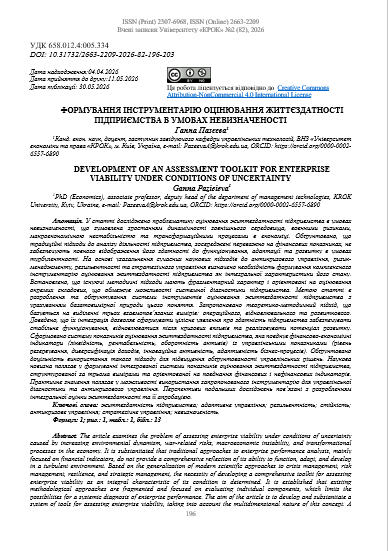
The article examines the problem of assessing enterprise viability under conditions of uncertainty caused by increasing environmental dynamism, war-related risks, macroeconomic instability, and transformational processes in the economy. It is substantiated that traditional approaches to enterprise performance analysis, mainly focused on financial indicators, do not provide a comprehensive reflection of its ability to function, adapt, and develop in a turbulent environment. Based on the generalization of modern scientific approaches to crisis management, risk management, resilience, and strategic management, the necessity of developing a comprehensive toolkit for assessing enterprise viability as an integral characteristic of its condition is determined. It is established that existing methodological approaches are fragmented and focused on evaluating individual components, which limits the possibilities for a systemic diagnosis of enterprise performance. The aim of the article is to develop and substantiate a system of tools for assessing enterprise viability, taking into account the multidimensional nature of this concept. A theoretical and methodological approach is proposed, based on the identification of three interrelated dimensions: operational, recovery, and developmental. It is proved that their integration makes it possible to form a holistic view of the enterprise’s ability to ensure stable functioning, recover from crisis impacts, and realize its development potential. A system of indicators for assessing enterprise viability has been developed, combining financial and economic indicators (liquidity, profitability, asset turnover) with managerial indicators (level of reserves, revenue diversification, innovation activity, adaptability of business processes). The expediency of using such an approach to improve the validity of managerial decision-making is substantiated. The scientific novelty lies in the formation of an integrated system of indicators for assessing enterprise viability, structured according to three dimensions and focused on combining financial and non-financial indicators. The practical significance consists in the possibility of applying the proposed toolkit for managerial diagnostics and crisis management. Prospects for further research are associated with the development of an integral assessment of viability and its empirical testing.
Downloads
References
Насад Н., Терещук С. Антикризове управління ризиками підприємств в період війни. Український економічний часопис. 2025. № 8. С. 68–70. DOI: https://doi.org/10.32782/2786-8273/2025-8-12.
Нестеренко В. Ю., Прокопенко М. В., Коваль І. Б. Антикризове управління в системах ризик-менеджменту та управління економічною безпекою підприємства. Проблеми та перспективи розвитку підприємництва. 2024. № 32. С. 136–143. DOI: https://doi.org/10.30977/PPB.2226-8820.2024.32.136.
Турило А. М., Турило А. А., Короленко Р., Тіщенко С. Антикризове управління через призму стратегічного управління і балансового розвитку підприємства. Соціально-економічні проблеми і держава. 2024. Вип. 2 (31). С. 44–51. DOI: https://doi.org/10.33108/sepd2024.02.044. URL: http://sepd.tntu.edu.ua/images/stories/pdf/2024/24tambrp.pdf.
Roik O., Zanevych D. Anti-Crisis Management in Tourism Enterprises: Theoretical and Methodological Foundations and Practical Recommendations. Economics and Region. 2024. № 4 (95). P. 40–47. DOI: https://doi.org/10.26906/EiR.2024.4(95).3605.
Райко Д. Маркетингові стратегії як інструмент підвищення фінансово-економічної безпеки підприємства у періоди криз. Економіка та суспільство. 2024. № 67. DOI: https://doi.org/10.32782/2524-0072/2024-67-45.
Бланк І. О., Ситник Г. В., Андрієць В. С. Управління фінансами підприємств : підручник. 2-ге вид., перероб. і допов. Київ : КНТЕУ, 2018. 791 с. DOI: https://doi.org/10.31617/p.knute.2017-1378.
Поддєрьогін А. М., Білик М. Д., Буряк Л. Д., Булгакова С. О. та ін. Фінанси підприємств : підручник / кер. кол. авт. і наук. ред. проф. А. М. Поддєрьогін. 7-ме вид., перероб. та допов. Київ : КНЕУ, 2008. 552 с.
Поддєрьогін А. М., Вівсяна І. В. Фінансовий менеджмент капіталу. Збірник наукових праць Університету державної фіскальної служби України. 2018. № 1. С. 136–149. URL: http://nbuv.gov.ua/UJRN/znpnudps_2018_1_12.
Кузьмін О. Є., Подольчак Н. Ю., Подольчак Н. І. Управління ризиками в інноваційній діяльності : навч.-метод. посібник. Львів : Вид-во Нац. ун-ту «Львівська політехніка», 2009. 175 с.
Teece D. J. Explicating dynamic capabilities: the nature and microfoundations of (sustainable) enterprise performance. Strategic Management Journal. 2007. Vol. 28, № 13. P. 1319–1350. DOI: https://doi.org/10.1002/smj.640.
Савицька Н. Л., Пахуча Е. В. Ринкова резильєнтність бізнесу: теоретичний конструкт. Бізнес Інформ. 2024. № 2. С. 244–257. DOI: https://doi.org/10.32983/2222-4459-2024-2-244-257.
Бойко М., Лісний М. Проактивні стратегії забезпечення резильєнтності бізнесу. Scientia Fructuosa. 2025. Т. 164, № 6. С. 64–82. DOI: https://doi.org/10.31617/1.2025(164)05. URL: https://journals.knute.edu.ua/scientia-fructuosa/article/view/2391.
Шульга О. А. Сучасна парадигма антикризового менеджменту: від фінансової стабілізації до стратегічної адаптації бізнес-систем. Економічний вісник Національного технічного університету України «Київський політехнічний інститут». 2025. № 35. С. 183–188. DOI: https://doi.org/10.20535/2307-5651.35.2025.352400.
Downloads
Published
How to Cite
Issue
Section
License

This work is licensed under a Creative Commons Attribution-NonCommercial 4.0 International License.