INVESTMENT POLICY AND ITS ROLE IN OPTIMIZATION OF THE BANK'S ASSET STRUCTURE AND MANAGEMENT OF NON-PERFORMING ASSETS
DOI:
https://doi.org/10.31732/2663-2209-2026-81-318-326Keywords:
investment policy;, investment strategy;, asset structure optimization;, asset–liability management (ALM);, securities portfolio;, non-performing assets (NPA);, non-performing loans (NPL);Abstract
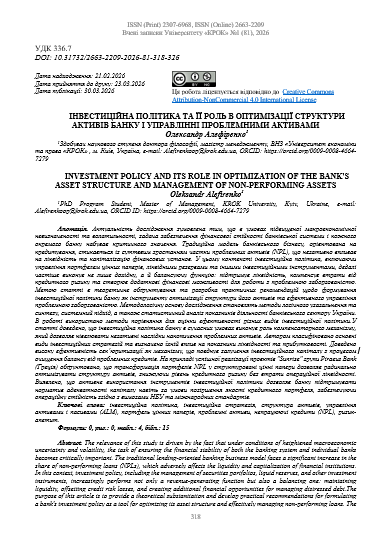
The relevance of this study is driven by the fact that under conditions of heightened macroeconomic uncertainty and volatility, the task of ensuring the financial stability of both the banking system and individual banks becomes critically important. The traditional lending-oriented banking business model faces a significant increase in the share of non-performing loans (NPLs), which adversely affects the liquidity and capitalization of financial institutions. In this context, investment policy, including the management of securities portfolios, liquid reserves, and other investment instruments, increasingly performs not only a revenue-generating function but also a balancing one: maintaining liquidity, offsetting credit risk losses, and creating additional financial opportunities for managing distressed debt.The purpose of this article is to provide a theoretical substantiation and develop practical recommendations for formulating a bank's investment policy as a tool for optimizing its asset structure and effectively managing non-performing loans. The methodological framework of the study comprises methods of logical generalization and synthesis, a systems approach, as well as statistical analysis of the Ukrainian banking sector's performance indicators. The paper utilizes comparative methods to evaluate the effectiveness of various investment policy types.The article demonstrates that under modern conditions, a bank's investment policy functions as a compensatory mechanism, allowing for the mitigation of negative consequences arising from the accumulation of distressed assets. The author classifies the main types of investment strategies and determines their impact on liquidity and profitability ratios. The high efficiency of securitization is proven as a mechanism that integrates the attraction of investment capital with the process of cleaning the balance sheet of non-performing loans. Drawing on the successful implementation of the "Sunrise" projects by the Piraeus Bank Group (Greece), it is substantiated that transforming NPL portfolios into structured securities allows for a radical optimization of the asset structure, reducing credit risk exposure without sacrificing operational liquidity.It is revealed that the active utilization of investment policy instruments enables a bank to maintain its capital adequacy ratio even amidst deteriorating credit portfolio quality, thereby ensuring operational resilience in compliance with NBU requirements and international standards.
Downloads
References
Примостка, Л. О. (2012). Фінансовий менеджмент у банку (3-тє вид.). КНЕУ.
Basel Committee on Banking Supervision. (2013). Basel III: The Liquidity Coverage Ratio and liquidity risk monitoring tools. Bank for International Settlements.
https://www.bis.org/publ/bcbs238.htm
Basel Committee on Banking Supervision. (2016). Interest rate risk in the banking book. Bank for International Settlements.
https://www.bis.org/bcbs/publ/d368.htm
European Banking Authority. (2025). Guidelines on management of ESG risks. https://www.eba.europa.eu
European Central Bank. (2017). Guidance to banks on non-performing loans. ECB Banking Supervision.
https://www.bankingsupervision.europa.eu/ecb/pub/pdf/guidance_on_npl.en.pdf
European Parliament & Council. (2017). Regulation (EU) 2017/2402 laying down a general framework for securitisation. Official Journal of the European Union.
https://eur-lex.europa.eu/eli/reg/2017/2402/oj/eng
Federal Deposit Insurance Corporation. (1998). Securities and Derivatives Investment Policy. Financial Institution Letters.
https://www.fdic.gov/news/financial-institution-letters/1998/fil9845.html
Hull, J. C. (2018). Risk management and financial institutions (5th ed.). Wiley.
https://books.google.com/books/about/Risk_Management_and_Financial_Institutio.html?id=1J1QDwAAQBAJ
IFRS Foundation. (n.d.). IFRS 9 Financial Instruments. https://www.ifrs.org
Koch, T. W., & MacDonald, S. S. (2014). Bank management (8th ed.). Cengage Learning.
https://books.google.com/books/about/Bank_Management.html?id=YzG32Wa3e3gC
NBU. (2025). Звіт про фінансову стабільність. Національний банк України.
https://bank.gov.ua/ua/stability/report
Office of the Comptroller of the Currency. (2023). Liquidity: Comptroller's Handbook. OCC.
https://www.occ.treas.gov/news-issuances/bulletins/2023/bulletin-2023-15.html
Piraeus Bank Ukraine. (2024). Annual Financial Report 2023-2024. https://www.piraeusbank.ua
Piraeus Financial Holdings. (2022). Annual Financial Report 2021. https://www.piraeusholdings.gr
Rose, P. S., & Hudgins, S. C. (2012). Bank management & financial services (9th ed.). McGraw-Hill Education.
Downloads
Published
How to Cite
Issue
Section
License

This work is licensed under a Creative Commons Attribution-NonCommercial 4.0 International License.