DESIGN THINKING METHODOLOGY IN ADAPTIVE BUSINESS PROCESS OPTIMIZATION
DOI:
https://doi.org/10.31732/2663-2209-2026-81-243-251Keywords:
business process optimization, digital transformation, design thinking, business process management, conceptual model, human-centered approachAbstract
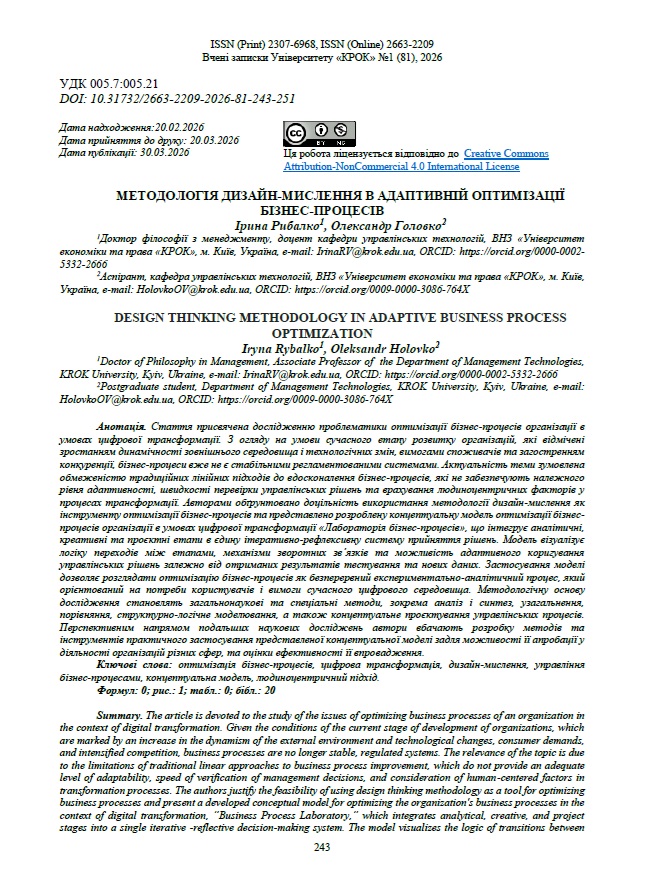
The article is devoted to the study of the issues of optimizing business processes of an organization in the context of digital transformation. Given the conditions of the current stage of development of organizations, which are marked by an increase in the dynamism of the external environment and technological changes, consumer demands, and intensified competition, business processes are no longer stable, regulated systems. The relevance of the topic is due to the limitations of traditional linear approaches to business process improvement, which do not provide an adequate level of adaptability, speed of verification of management decisions, and consideration of human-centered factors in transformation processes. The authors justify the feasibility of using design thinking methodology as a tool for optimizing business processes and present a developed conceptual model for optimizing the organization's business processes in the context of digital transformation, “Business Process Laboratory,” which integrates analytical, creative, and project stages into a single iterative -reflective decision-making system. The model visualizes the logic of transitions between stages, feedback mechanisms, and the possibility of adaptive adjustment of management decisions depending on the results of testing and new data. The application of the model allows us to consider business process optimization as a continuous experimental and analytical process focused on user needs and the requirements of the modern digital environment. The methodological basis of the study consists of general scientific and special methods, in particular analysis and synthesis, generalization, comparison, structural-logical modeling, as well as conceptual design of management processes. The authors see the development of methods and tools for the practical application of the presented conceptual model as a promising direction for further scientific research in order to test it in the activities of organizations in various fields and evaluate the effectiveness of its implementation.
Downloads
References
Беспалюк, Х. М., & Процак, К.В. (2021). Дизайн-мислення як ефективний метод адаптації до змін. Вісник Львівського політехнічного національного університету. Серія «Проблеми економіки та управління», 5(1), 121- 131.
Варава, Л. М., & Данілова, А. А. (2021). Дизайн-мислення як компонент інноваційного менеджменту. У Сучасний менеджмент: проблеми теорії та практики, (с. 83-85). Кривий Ріг.
Вербовська, Л. (2021, 30 вересня). Теоретичні аспекти використання дизайн мислення організаціями в умовах змін. У Розвиток компетентності в публічному секторі: європейські стандарти та перспективи (с. 134-135). Івано-Франківськ.
Головко, О., & Ткаченко, Ф. (2025). Цифровізація бізнес-процесів: передумови та тенденції. Управління розвитком складних систем, (62), 62–71. https://doi.org/10.32347/2412-9933.2025.62.62-71
Головко, О.В., & Данченко, О.Б. (2024, 06-07 грудня). Моделі та методи оптимізації бізнес процесів організації в умовах цифрової трансформації. У Project, Program, Portfolio Management. P3M-2024, (с. 151-155). Одеса: ІШІР. https://drive.google.com/file/d/1cUh29AiOfhFiFK7QqvmZ0XM4doV8k8Ed/view?usp=drive_link.
Головко, О.В., & Рибалко, І.В. (2025, 28-29 листопада). Дизайн-мислення у менеджменті бізнес-процесів. У Project, Program, Portfolio Management. P3M-2025, (с. 91-95). Одеса: ІШІР.
Головко, О.О. (2025, 15–20 вересня). Сучасні підходи до проєктування бізнес-процесів. У Інформаційні системи та інноваційні технології управління проєктами і програмами (с. 102-106). Харків: ХНУРЕ. https://mmp-conf.org/documents/archive/proceedings2025.pdf
Голубчак, К. (2021). Методика дизайн-мислення в архітектурній освіті як інноваційний засіб формування креативності майбутніх архітекторів. Містобудування та територіальне планування, (76), 63–70. https://doi.org/10.32347/2076-815x.2021.76.63-70
Губинський, А. (2020, 25 жовтня). Навіщо дизайн-мислення бізнесу? CRAFT INNOVATIONS https://www.craftinnovations.com.ua/post/design-thinking-for-business
Захарченко, Н.В. (2022). Перспективи розвитку дизайн-мислення в управлінні бізнесом та інноваціями. Академічний огляд, 1(56), 53-60.
Косенко, Д.Ю., Вишневська, О.В., & Остапик, С.В. (2022). Дизайн-мислення: теоретичні підстави та критика. Art and Design, (4), 43–50. https://doi.org/10.30857/2617-0272.2022.4.4
Орлів, М.С. (2020). Розвиток людських ресурсів та організаційної культури в державних органах: використання методології дизайн-мислення. Публічне управління та адміністрування в Україні, 19, 76-81.
Ситник, Н.І., Пермінова, С.А., & Воржакова, Ю.П. (2022). Дизайн-стратегія як інструмент розроблення нових продуктів. Scientific Bulletin of Kherson State University. Series Economic Sciences, (45), 42-49.
Ткаченко, А.М., & Плинокос, Д.Д. (2021). Дизайн-мислення, як нова парадигма розвитку стартапу. Центральноукраїнський науковий вісник. Економічні науки, 6(39), 238-246.
Шаров, В. (2024). Дизайн-мислення: концепція та ключові етапи. Development Service Industry Management, (2), 259-264.
Шуть, О.Ю. (2022). Дизайн-мислення в управлінні сучасними компаніями. У Національний фармацевтичний університет, (с. 153-155). Харків. https://dspace.nuph.edu.ua/bitstream/123456789/28808/1/153-155.pdf
Blyznyukova, I., Teslenko, P., Danchenko, О., & Melenchuk, V. (2021). The concept of creating a minimum viable product and design-thinking in the it-project team management. Bulletin of NTU "KhPI". Series: Strategic management, portfolio, program and project management, 2(4), 11-17. https://doi.org/10.20998/2413-3000.2021.4.2
Borynskyi, T. (2025). Design thinking methodology: theory and practice. Coordinates of Public Administration. https://doi.org/10.62664/cpa.2025.01.04
Brown, T. (2008). Design Thinking. Harvard Business Review, 86(6), 84–92.
Kolesnikov, O.E., Lukianov, D.V., Gogunskii, V.D., & Sherstyuk, O.I. (2018). The Use of the “designthinking” and “seven hats” Methods at the Project Initiation and Planning Stage. Herald of Advanced Information Technology. Publ. Nauka i Tekhnika, 1(1), 62-68.
Downloads
Published
How to Cite
Issue
Section
License

This work is licensed under a Creative Commons Attribution-NonCommercial 4.0 International License.