FEATURES OF IMPLEMENTING THE AGILE METHODOLOGY TO INCREASE THE EFFICIENCY OF IT TEAMS
DOI:
https://doi.org/10.31732/2663-2209-2026-81-209-215Keywords:
Agile methods, Agile manifesto, project management, SDLC, IT team, IT efficiencyAbstract
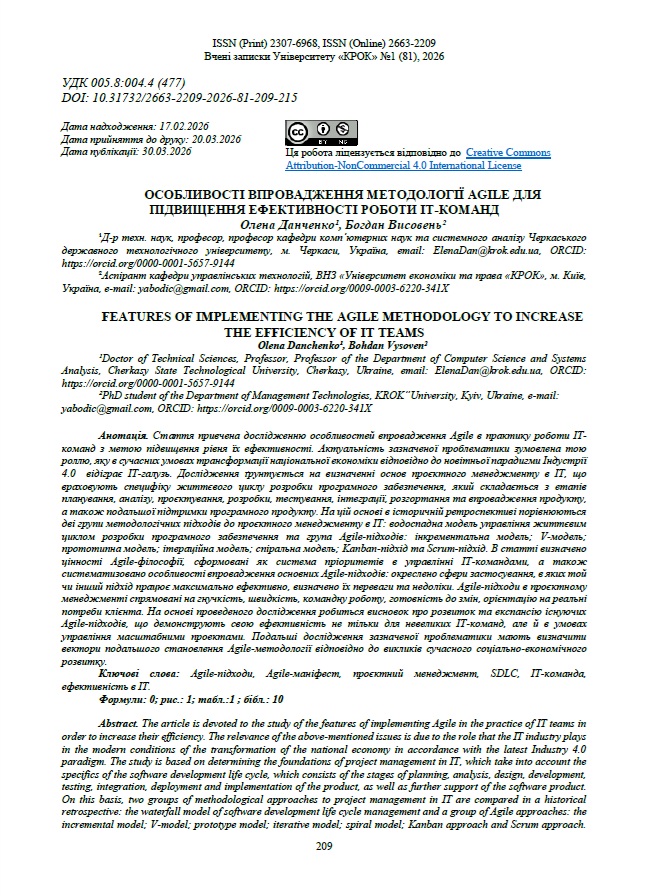
The article is devoted to the study of the features of implementing Agile in the practice of IT teams in order to increase their efficiency. The relevance of the above-mentioned issues is due to the role that the IT industry plays in the modern conditions of the transformation of the national economy in accordance with the latest Industry 4.0 paradigm. The study is based on determining the foundations of project management in IT, which take into account the specifics of the software development life cycle, which consists of the stages of planning, analysis, design, development, testing, integration, deployment and implementation of the product, as well as further support of the software product. On this basis, two groups of methodological approaches to project management in IT are compared in a historical retrospective: the waterfall model of software development life cycle management and a group of Agile approaches: the incremental model; V-model; prototype model; iterative model; spiral model; Kanban approach and Scrum approach. The article defines the values of the Agile philosophy, formed as a system of priorities in the management of IT teams, and also systematizes the features of the implementation of the main Agile approaches: outlines the areas of application in which one or another approach works most effectively, identifies their advantages and disadvantages. Agile approaches in project management are aimed at flexibility, speed, teamwork, readiness for change, and orientation to the real needs of the client. Based on the research conducted, a conclusion is drawn about the development and expansion of existing Agile approaches, which demonstrate their effectiveness not only for small IT teams, but also in the management of large-scale projects. Further research into the above issues should determine the vectors for the further development of the Agile methodology in accordance with the challenges of modern socio-economic development.
Downloads
References
Другов, О. О., & Терзян, Р. Г. (2024). Agile для міжнаціональних ІТ-проектів: продуктивність та ризики. Економіка та суспільство, (63). doi: 10.32782/2524-0072/2024-63-17
Ковальчук, Н. В., & Комарова, К. В. (2023). Гнучкі підходи в управлінні командами. Економіка та суспільство, (47). doi: 10.32782/2524-0072/2023-47-20
Марченко, В. М., & Мезенцева, О. О. (2020). Оптимізація застосування гнучких методик менеджменту в ІТ-проектах. Ефективна економіка, (1). doi: 10.32702/2307-2105-2020.1.8
Павлюк, Т. С., & Полусмяк, Л. Л. (2024). Розробка універсальних заходів для підвищення ефективності системи управління персоналом підприємства шляхом впровадження SCRUM-технологій. Management and Entrepreneurship: Trends of Development, 3(29), 94-102.
Радченко, Г. А., Левковська, Т. А., & Соболєва, А. В. (2023). Особливості методології KANBAN та SCRUM при реалізації принципів agile-маркетингу. Економіка та суспільство, (50). doi: 10.32782/2524-0072/2023-50-24
Temole, F., & Atanasova, D. (2025). Agile integration in software development: Principles, practices, and challenges. Software Engineering, 11(1), 18–29.
Cohen, D., Lindvall, M., & Costa, P., (2004). An Introduction To Agile Methods. Advances in Computers, (62), 1-66.
Dingsoyr, T., Dyba, T., & Moe, N.B. (2010). Agile Software Development: Current Research and Future Directions. Springer-Verlag, Heidelberg.
Ghimire, D., & Charters, S. (2022). The Impact of Agile Development Practices on Project Outcomes. Software, 1(3), 265-275.
Schwaber K. (2004). Agile Project Management with Scrum. Microsoft Press.
Downloads
Published
How to Cite
Issue
Section
License

This work is licensed under a Creative Commons Attribution-NonCommercial 4.0 International License.