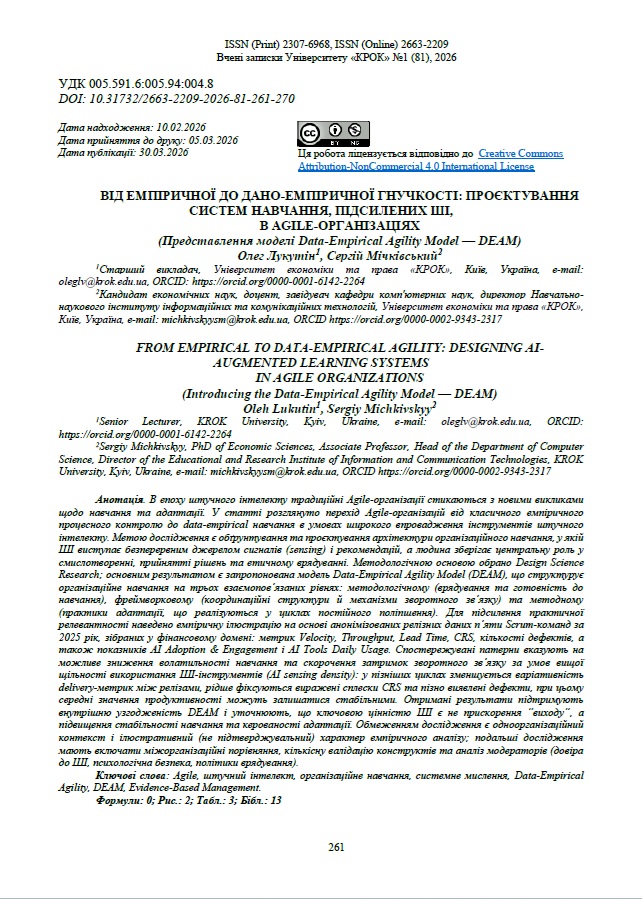
FROM EMPIRICAL TO DATA-EMPIRICAL AGILITY: DESIGNING AI-AUGMENTED LEARNING SYSTEMS IN AGILE ORGANIZATIONS (Introducing the Data-Empirical Agility Model — DEAM)
DOI:
https://doi.org/10.31732/2663-2209-2026-81-261-270Keywords:
Agile, Artificial Intelligence, Organizational Learning, Systems Thinking, Data-Empirical Agility, DEAM, Evidence-Based ManagementAbstract
In the age of artificial intelligence, traditional Agile organizations face new challenges in learning and adaptation. This paper examines how Agile organizations transition from traditional empirical process control toward data-empirical learning under the growing adoption of artificial intelligence tools. The study aims to justify and design a learning architecture in which AI provides continuous sensing signals and recommendations, while humans retain the central role in sense-making, decision-making, and ethical governance. Using a Design Science Research approach, the paper’s main result is the Data-Empirical Agility Model (DEAM), which conceptualizes AI-augmented organizational learning across three interrelated layers: the methodology layer (learning governance and organizational readiness), the framework layer (coordination structures and feedback mechanisms) and the method layer (adaptive practices enacted through continuous improvement cycles). To strengthen practical relevance, the paper provides an exploratory empirical illustration based on anonymized release-level data from five Scrum teams collected across 2025 in a financial domain, including Velocity, Throughput, Lead Time, CRS, defects (bugs) and complementary AI Adoption & Engagement and AI Tools Daily Usage indicators. The observed patterns suggest reduced learning volatility and shorter feedback delays in contexts with higher AI sensing density: across later release cycles, delivery metrics display lower variance between releases, pronounced CRS spikes occur less frequently and late-discovered defects become rarer, even when average throughput remains relatively stable. These findings support the internal coherence of DEAM and indicate that the primary value of AI in Agile learning systems is not merely output acceleration but improved learning stability and more manageable adaptation. Limitations include a single-organization context and the illustrative (non-confirmatory) nature of the empirical component; future research should extend the study through multi-organizational comparisons, quantitative construct validation and examination of moderators such as AI trust, psychological safety and governance policies.
Downloads
References
Argyris, C., & Schön, D. A. (1996). Organizational learning II: Theory, method, and practice. Addison-Wesley.
Cui, Z., Li, Z., Wang, Y., & Yang, F. (2025). The effects of generative AI on workplace productivity: Evidence from field experiments. Working paper. MIT.
Dellermann, D., Ebel, P., Söllner, M., & Leimeister, J. M. (2019). Hybrid intelligence. Business & Information Systems Engineering, 61(5), 637–643. https://doi.org/10.1007/s12599-019-00595-2
Hevner, A. R., & Chatterjee, S. (2010). Design research in information systems: Theory and practice. Springer.
Highsmith, J. (2009). Agile project management: Creating innovative products (2nd ed.). Addison-Wesley.
Krancher, O., Luther, P., & Jost, M. (2018). Key affordances of platform-as-a-service: Self-organization and continuous feedback. Journal of Management Information Systems, 35(3), 776–812. https://doi.org/10.1080/07421222.2018.1481636
Larman, C., & Vodde, B. (2016). Large-scale Scrum: More with LeSS. Addison-Wesley.
Lukutin, O. (2024). Agile maturity assessment as an important part of organizational transformation. Держава, регіони, підприємництво: інформаційні, суспільно-правові, соціально-економічні аспекти розвитку: матеріали VI Міжнародної конференції (5-6 грудня 2024 р., м. Київ). Київ: Університет "КРОК", 2024.
https://conf.krok.edu.ua/SRE/SRE-2024/paper/view/2645.
Lukutin, O. (2025a). AI and organizational agility: Can AI overcome Larman’s laws of resistance? Scientific Notes of «KROK» University “KROK”, 3(79), 370–376. https://doi.org/10.31732/2663-2209-2025-79-370-376
Lukutin, O. (2025b). Pattern-based framework for managing artificial intelligence innovation in scaled Agile environments. International Scientific and Practical Conference "Information Systems in Project and Program Management", September 15–20, 2025, Koblevo: (Mykolaiv region), Ukraine. 2025. https://mmp-conf.org/documents/archive/proceedings2025.pdf.
Lukutin, O., & Michkivskyy, V. (2025c). AI as a catalyst of organizational agility. Науково-практична конференція «Лідерство, бізнес-процеси та стале майбутнє», Університет «КРОК» та Бізнес Школа КРОК, Україна, Київ, 27 вересня 2025 року https://dspace.krok.edu.ua/items/262c8a7d-2c4e-49a5-8a18-003dbb43eaf6
Meadows, D. H. (2008). Thinking in systems: A primer. Chelsea Green Publishing.
Peng, S., Kalliamvakou, E., Cihon, P., & Demirer, M. (2023). The impact of AI on developer productivity: Evidence from GitHub Copilot. arXiv preprint. https://arxiv.org/abs/2302.06590
Schwaber, K., & Sutherland, J. (2020). The Scrum Guide: The definitive guide to Scrum. Scrum.org. https://scrumguides.org
Zhang, X., & Venkatesh, V. (2025). Human–AI collaboration in software development: Implications for productivity and coordination. ACM Transactions on Software Engineering and Methodology.
Downloads
Published
How to Cite
Issue
Section
License

This work is licensed under a Creative Commons Attribution-NonCommercial 4.0 International License.