FORMATION OF AN ADAPTIVE ECONOMIC SECURITY SYSTEM FOR A LOGISTICS ENTERPRISE UNDER CONDITIONS OF DIGITALIZATION AND CRISIS PHENOMENA
DOI:
https://doi.org/10.31732/2663-2209-2026-81-105-115Keywords:
economic security, logistics enterprise, adaptive system, digitalization, personnel security, crisis conditions, integral assessmentAbstract
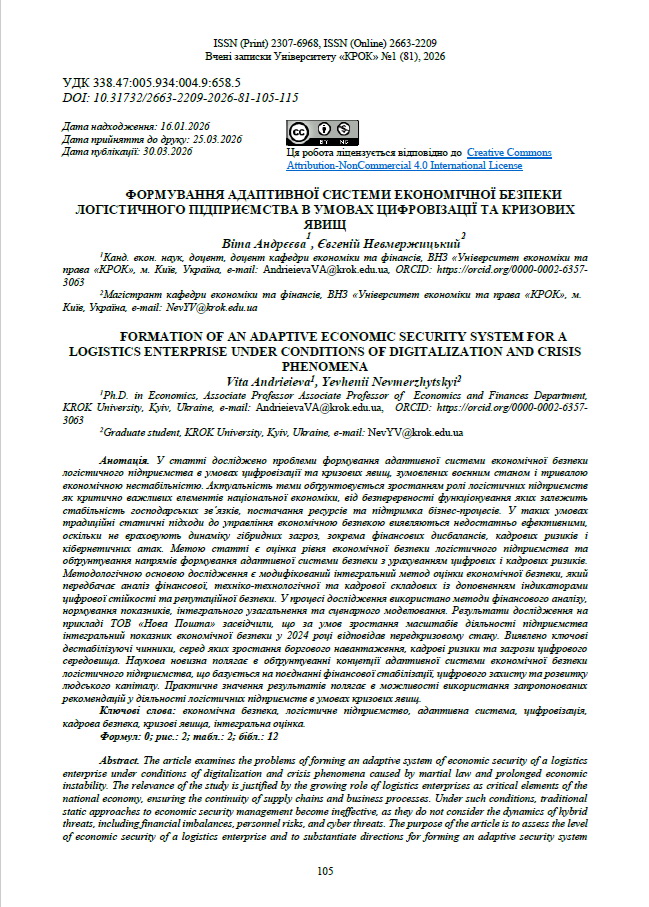
The article examines the problems of forming an adaptive system of economic security of a logistics enterprise under conditions of digitalization and crisis phenomena caused by martial law and prolonged economic instability. The relevance of the study is justified by the growing role of logistics enterprises as critical elements of the national economy, ensuring the continuity of supply chains and business processes. Under such conditions, traditional static approaches to economic security management become ineffective, as they do not consider the dynamics of hybrid threats, including financial imbalances, personnel risks, and cyber threats. The purpose of the article is to assess the level of economic security of a logistics enterprise and to substantiate directions for forming an adaptive security system considering digital and personnel risks. The methodological basis of the research is a modified integral method for assessing economic security, which includes the analysis of financial, technological, and personnel components supplemented by indicators of digital resilience and reputational security. The research uses methods of financial analysis, normalization of indicators, integral generalization, and scenario modeling.
The results of the study based on LLC “Nova Poshta” show that despite the growth of business activity, the integral indicator of economic security in 2024 corresponded to a pre-crisis state. Key destabilizing factors were identified, including financial imbalances, personnel risks, and threats of the digital environment. The scientific novelty lies in substantiating the concept of an adaptive system of economic security of a logistics enterprise based on the combination of financial stabilization, digital protection, and human capital development. The practical significance of the results lies in the possibility of applying the proposed recommendations in the activities of logistics enterprises under crisis conditions.
Keywords: economic security, logistics enterprise, adaptive system, digitalization, personnel security, crisis conditions, integral assessment.
Formulas: 0; fig.: 3, tab.: 2, bibl.: 12
Downloads
References
Vasyltsiv, T. G., Mulska, O. P., & Panchenko, V. S. (2023). Economic potential vs economic security of the enterprise: points of convergence and divergence. Financial and Credit Activity: Problems of Theory and Practice, 1(48), 288–299. URL: https://doi.org/10.55643/fcaptp.1.48.2023.3957
Вoratyn, D., Maniek, M., Kędra, A., & Sroślak, G. (2024). Logistics as a key element of crisis management. Scientific Journal of Bielsko-Biala School of Finance and Law, 28(1), 124–127. URL: https://asej.eu/index.php/asej/article/view/783
Kalinin, O., Gonchar, V., Abliazova, N., Filipishyna, L., Onofriichuk, O., & Maltsev, M. (2024). Enhancing Economic Security through Digital Transformation in Investment Processes: Theoretical Perspectives and Methodological Approaches Integrating Environmental Sustainability. Natural and Engineering Sciences, 9(1), 26–45. URL: https://doi.org/10.28978/nesciences.1469858
Kukhar, O., Kravchyk, Y., & Brechko, O. (2023). Digital transformation as a factor in ensuring economic security of enterprises. Baltic Journal of Economic Studies, 9(5), 143–152. URL: https://doi.org/10.30525/2256-0742/2023-9-5-143-152
Milka, A., Artyukh-Pasiuta, O., & Kononenko, Z. (2023). Methodological approaches to assessing the level of economic security of the enterprise. Economics, Finance and Management Review, 4(16), 20–30. URL: https://public.scnchub.com/efmr/index.php/efmr/article/view/264
Shumilo, O., Babenko, V., Liubokhynets, L., Volovelska, I., & Arefieva, O. (2021). Method of Enterprise Economic Security Evaluation. Estudios de Economía Aplicada, 39(7). URL: https://ojs.ual.es/ojs/index.php/eea/article/view/4998
Пілецька, С. Т., Коритько, Т. Ю., & Ткаченко, Є. В. (2021). Модель інтегральної оцінки економічної безпеки підприємства. Економічний вісник Донбасу, 3(65), 56–65. URL: http://evd.luguniv.edu.ua/index.php/evd/article/view/275
Алькема, В. Г. (2024). Методичні підходи до оцінки ділової репутації підприємства. Вчені записки Університету «КРОК», 4(76), 90–95. URL: https://snku.krok.edu.ua/index.php/vcheni-zapiski-universitetu-krok/article/view/868
Марухненко, К. Д. (2024). Формування кадрової політики підприємства ТОВ «Нова пошта» (Кваліфікаційна робота). Запоріжжя: ЗНУ. URL: http://dspace.znu.edu.ua/
Shumilo, O., Babenko, V., Liubokhynets, L., Volovelska, I., & Arefieva, O. (2021). Method of Enterprise Economic Security Evaluation. Estudios de Economía Aplicada, 39(7). URL: https://ojs.ual.es/ojs/index.php/eea/article/view/4998
Проскура В. Ф., Черничко Т. В., Верецький Д. Сучасні підходи до визначення рівня економічної безпеки підприємства в умовах цифровізації. Цифрова економіка та економічна безпека. 2024. № 13. URL: https://repository.sspu.edu.ua/items/668d6448-4bbb-4fab-bfc0-5108729d04a7
Фінансова звітність та звіти про управління Групи «Нова Пошта» за 2021–2024 роки. URL: https://novaposhta.ua/more/for-investors/
Downloads
Published
How to Cite
Issue
Section
License

This work is licensed under a Creative Commons Attribution-NonCommercial 4.0 International License.