METHODOLOGICAL APPROACH TO ASSESSING THE MATURITY LEVEL OF DIGITAL TRANSFORMATION OF ENTERPRISE LOGISTICS
DOI:
https://doi.org/10.31732/2663-2209-2026-81-370-378Keywords:
digital transformation, maturity model, logistics processes, ERP system, WMS, TMS, SaaS solutions, integrated indexAbstract
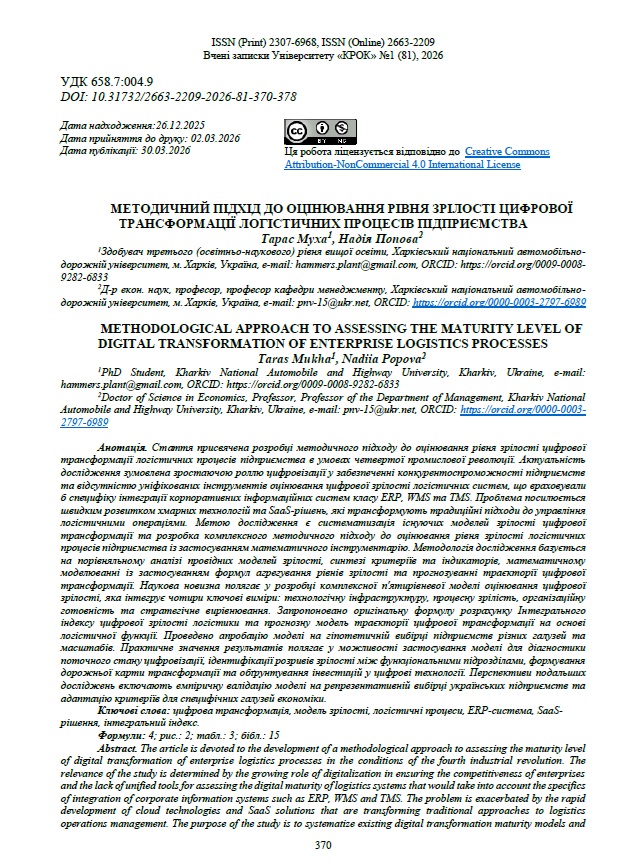
The article is devoted to the development of a methodological approach to assessing the maturity level of digital transformation of enterprise logistics processes in the conditions of the fourth industrial revolution. The relevance of the study is determined by the growing role of digitalization in ensuring the competitiveness of enterprises and the lack of unified tools for assessing the digital maturity of logistics systems that would take into account the specifics of integration of corporate information systems such as ERP, WMS and TMS. The problem is exacerbated by the rapid development of cloud technologies and SaaS solutions that are transforming traditional approaches to logistics operations management. The purpose of the study is to systematize existing digital transformation maturity models and develop the original LOGDIM model with verified criteria and mathematical tools for quantitative assessment. The research methodology is based on a systematic literature review using Scopus and Web of Science databases for the period 2020-2025, comparative analysis of leading maturity models, synthesis of criteria and indicators, mathematical modeling using maturity level aggregation formulas, and forecasting the trajectory of digital transformation. The scientific novelty lies in the development of a comprehensive five-level digital maturity assessment model that integrates four key dimensions: technological infrastructure, process maturity, organizational readiness, and strategic alignment. An original formula for calculating the Integrated Digital Maturity Index of Logistics and a predictive model of digital transformation trajectory based on the logistic function are proposed. The model was tested on a hypothetical sample of enterprises from different industries and scales. The practical significance of the results lies in the possibility of applying the model for diagnosing the current state of digitalization, identifying maturity gaps between functional units, forming a transformation roadmap, and justifying investments in digital technologies. Prospects for further research include empirical validation of the model on a representative sample of Ukrainian enterprises and adaptation of criteria for specific economic sectors.
Downloads
References
Caiado, R. G. G., Scavarda, L. F., Gavião, L. O., Ivson, P., de Mattos Nascimento, D. L., & Garza-Reyes, J. A. (2021). A fuzzy rule-based Industry 4.0 maturity model for operations and supply chain management. International Journal of Production Economics, 231, 107883. https://doi.org/10.1016/j.ijpe.2020.107883
Facchini, F., Oleśków-Szłapka, J., Ranieri, L., & Urbinati, A. (2020). A maturity model for logistics 4.0: An empirical analysis and a roadmap for future research. Sustainability, 12(1), 86. https://doi.org/10.3390/su12010086
Frederico, G. F., Garza-Reyes, J. A., Anosike, A., & Kumar, V. (2020). Supply Chain 4.0: Concepts, maturity and research agenda. Supply Chain Management: An International Journal, 25(2), 262–282. https://doi.org/10.1108/SCM-09-2018-0339
Golinska-Dawson, P., Werner-Lewandowska, K., Kolinska, K., & Kolinski, A. (2023). Impact of market drivers on the digital maturity of logistics processes in a supply chain. Sustainability, 15(4), 3120. https://doi.org/10.3390/su15043120
Hellweg, F., Janhofer, D., & Hellingrath, B. (2023). Towards a maturity model for digital supply chains. Logistics Research, 16(1), Article 5, 1–35. https://doi.org/10.23773/2023_5
Kolinski, A., Golinska-Dawson, P., Werner-Lewandowska, K., & Kolinska, K. (2024). Digital maturity of logistics processes assessed in the areas of technological support for performance measurement, employees, and process management. Applied Sciences, 14(17), 7893. https://doi.org/10.3390/app14177893
Liu, K. P., & Chiu, W. (2021). Supply Chain 4.0: The impact of supply chain digitalization and integration on firm performance. Asian Journal of Business Ethics, 10(2), 371–389. https://doi.org/10.1007/s13520-021-00137-8
Llivisaca-Villazhañay, J., Flores-Siguenza, P., Guamán, R., Urdiales, C., & Gento-Municio, Á. M. (2025). Key drivers of ERP implementation in digital transformation: Evidence from Austro-Ecuadorian SMEs. Administrative Sciences, 15(6), 196. https://doi.org/10.3390/admsci15060196
Mukha, T. (2025). The role of Software-as-a-Service solutions in advancing sustainability in supply chain operations. Business Navigator, 81, 18–27. https://doi.org/10.32782/business-navigator.81-18
Mukha, T., & Popova, N. (2025). Fostering sustainable development through SaaS adoption in logistics management. European Scientific Journal of Economic and Financial Innovation, 17(3), 60–69. https://doi.org/10.32750/2025-0305
Pessini, R., Ferro, M., & Correia, A. (2023). Trends and recommendations for enhancing maturity models in supply chain management and logistics. Applied Sciences, 13(17), 9724. https://doi.org/10.3390/app13179724
Pirola, F., Cimini, C., & Pinto, R. (2023). Development of a digital maturity model for Industry 4.0 based on the technology-organization-environment framework. Computers & Industrial Engineering, 186, 109691. https://doi.org/10.1016/j.cie.2023.109691
Schumacher, A., Erol, S., & Sihn, W. (2020). A maturity model for assessing Industry 4.0 readiness and maturity of manufacturing enterprises. Procedia CIRP, 88, 161–166. https://doi.org/10.1016/j.procir.2020.05.029
Tubis, A. A. (2023). Digital maturity assessment model for the organizational and process dimensions. Sustainability, 15(20), 15122. https://doi.org/10.3390/su152015122
Zhyvko, Z., Zhyvko, M., & Shehynska, A. (2024). The problem of business reputation as an indicator of economic security of business. Scientific Papers of the University «KROK», 2(64), 45–55. https://doi.org/10.31732/2663-2209-2024-74-45-55
Downloads
Published
How to Cite
Issue
Section
License

This work is licensed under a Creative Commons Attribution-NonCommercial 4.0 International License.