The NEUROBIOLOGY AND THE EXISTENTIAL CHALLENGE IN THE PHENOMENON OF THE "LOST IDEA"
DOI:
https://doi.org/10.31732/2663-2209-2025-80-422-431Keywords:
the phenomenon of the “lost idea”, recollection, awareness, re-interpretation, transformationAbstract
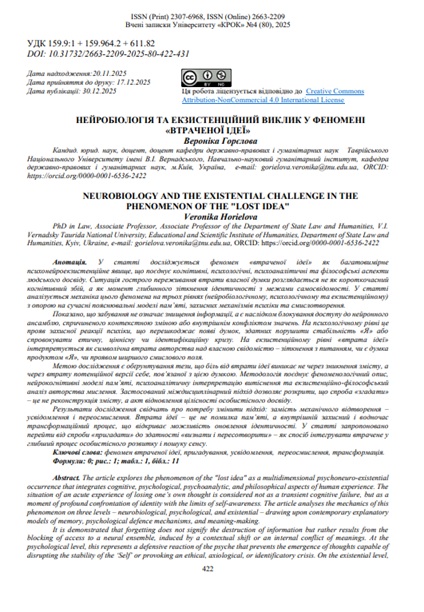
The article explores the phenomenon of the "lost idea" as a multidimensional psychoneuro-existential occurrence that integrates cognitive, psychological, psychoanalytic, and philosophical aspects of human experience. The situation of an acute experience of losing one’s own thought is considered not as a transient cognitive failure, but as a moment of profound confrontation of identity with the limits of self-awareness. The article analyses the mechanics of this phenomenon on three levels – neurobiological, psychological, and existential – drawing upon contemporary explanatory models of memory, psychological defence mechanisms, and meaning-making.
It is demonstrated that forgetting does not signify the destruction of information but rather results from the blocking of access to a neural ensemble, induced by a contextual shift or an internal conflict of meanings. At the psychological level, this represents a defensive reaction of the psyche that prevents the emergence of thoughts capable of disrupting the stability of the ‘Self’ or provoking an ethical, axiological, or identificatory crisis. On the existential level, the “loss of an idea” is interpreted as a symbolic loss of authorship over one’s own consciousness – a confrontation with the question of whether thought is a product of the ‘Self’ or a manifestation of a broader semantic field.
The aim of the study is to substantiate the thesis that the pain of losing an idea arises not from the disappearance of its content, but from the loss of a potential version of the self associated with that thought. The methodology combines phenomenological description, neurocognitive models of memory, psychoanalytic interpretation of repression, and existential-philosophical analysis of the authorship of thinking. The applied interdisciplinary approach reveals that the attempt to “remember” is not a reconstruction of content, but an act of restoring the integrity of personal experience.
The findings of the study indicate the necessity of a shift in approach: from mechanical reproduction to awareness and re-interpretation. The loss of an idea is not a failure of memory but an internal defensive and, at the same time, transformative process that opens the possibility of renewing one’s identity. The article proposes a transition from the attempt to “recall” to the capacity to “acknowledge and re-create” – as a means of integrating what has been lost into a deeper process of personal development and the search for meaning.
Downloads
References
Collins, A. M., & Loftus, E. F. (1975). A spreading-activation theory of semantic processing. Psychological Review, 82(6), 407–428. https://doi.org/10.1037/0033-295X.82.6.407
Frankl, V. E. (1946). Man’s search for meaning. Beacon Press.
Freud, S. (1959). Inhibitions, symptoms and anxiety (J. Strachey, Trans.). Hogarth Press. (Original work published 1926)
Heidegger, M. (1954). Was heißt Denken? Max Niemeyer Verlag.
Jung, C. G. (1971). Psychological types (H. G. Baynes, Trans.; R. F. C. Hull, Ed.). Princeton University Press. (Original work published 1921)
Jung, C. G. (1979). Aion: Researches into the phenomenology of the self (R. F. C. Hull, Trans.). Princeton University Press. (Original work published 1951)
Jung, C. G. (1954b). The relations between the ego and the unconscious (R. F. C. Hull, Trans.). Princeton University Press. (Original work published 1928)
Lacan, J. (1966). Écrits. Éditions du Seuil.
Rogers, C. R. (1961). On becoming a person: A therapist's view of psychotherapy. Houghton Mifflin.
Synhaivska, I., & Sokur, I. (2025). Psychological rehabilitation of soldiers after returning to civilian life. Scientific Notes of KROK University, 79(3), 421–428. https://doi.org/10.31732/2663-2209-2025-79-421-428
Yalom, I. D. (1980). Existential psychotherapy. Basic Books.
Downloads
Published
How to Cite
Issue
Section
License

This work is licensed under a Creative Commons Attribution-NonCommercial 4.0 International License.