FORMATION OF A SUSTAINABLE DEVELOPMENT STRATEGY FOR AN ENTERPRISE BASED ON BUSINESS ANALYTICS TOOLS
DOI:
https://doi.org/10.31732/2663-2209-2026-83-123-135Keywords:
sustainable development, corporate sustainable development, sustainable development strategy, business analytics, strategic management, analytical support of management, external environment, enterprise performance evaluation, ESG approaches, systems approachAbstract
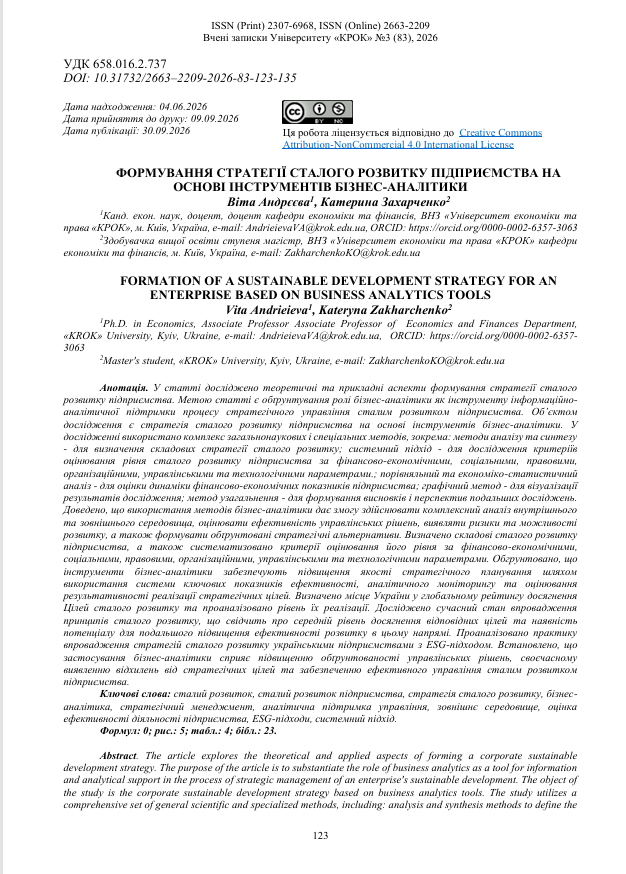
The article explores the theoretical and applied aspects of forming a corporate sustainable development strategy. The purpose of the article is to substantiate the role of business analytics as a tool for information and analytical support in the process of strategic management of an enterprise's sustainable development. The object of the study is the corporate sustainable development strategy based on business analytics tools. The study utilizes a comprehensive set of general scientific and specialized methods, including: analysis and synthesis methods to define the components of the sustainable development strategy; a systems approach to study the evaluation criteria for the enterprise's sustainable development level across financial, economic, social, legal, organizational, managerial, and technological parameters; comparative and economic-statistical analysis to evaluate the dynamics of the enterprise's financial and economic indicators; a graphical method for visualizing the research results; and a generalization method to formulate conclusions and prospects for further research. It is proven that the use of business analytics methods enables a comprehensive analysis of the internal and external environment, allows for evaluating the effectiveness of managerial decisions, identifies risks and development opportunities, and helps formulate well-founded strategic alternatives. The components of corporate sustainable development have been identified, and the criteria for evaluating its level have been systematized according to financial, economic, social, legal, organizational, managerial, and technological parameters. It is substantiated that business analytics tools enhance the quality of strategic planning through the use of a key performance indicator (KPI) system, analytical monitoring, and the performance evaluation of strategic goals realization. Ukraine's position in the global Sustainable Development Goals (SDGs) achievement ranking is determined, and the level of their implementation is analyzed. The current state of implementing sustainable development principles is examined, indicating an average level of achieving the relevant goals and highlighting the potential for further efficiency improvement in this direction. The practice of implementing sustainable development strategies with an ESG approach by Ukrainian enterprises is analyzed. It is established that the application of business analytics contributes to increasing the validity of managerial decisions, timely detecting deviations from strategic goals, and ensuring effective management of corporate sustainable development.
Downloads
References
Тарасюк, О. В. (2025). Теоретичні засади формування концепції сталого розвитку та її практична реалізація на сучасному етапі розвитку суспільства. Економіка, управління та адміністрування, 1(111), 51–63. DOI: https://doi.org/10.26642/ema-2025-1(111)-51-63
Сабовчик, А., & Попович, А. (2024). Визначення поняття та цілі сталого розвитку. Науковий вісник Ужгородського національного університету. Серія: Право, 5(86), 415–422. DOI: https://doi.org/10.24144/2307-3322.2024.86.5.61
Гречко, А., & Очеретяна, О. (2020). Дослідження еволюції наукової думки в аспектах визначення сутності поняття «сталий розвиток підприємства». Підприємництво та інновації, 15, 37–41. DOI: https://doi.org/10.37320/2415-3583/15.6
Степаненко, Т. О. (2020). Теоретичні та методичні засади сталого розвитку підприємства. Вчені записки ТНУ ім. В. І. Вернадського. Серія: Економіка і управління, 6, 136–141. DOI: https://doi.org/10.32838/2523-4803/70-6-23
Токмакова, І. В., Курилович, В. Р., & Казаков, А. Г. (2023). Концептуальні положення забезпечення сталого розвитку підприємств. Вісник економіки транспорту і промисловості, 84, 99–107. DOI: https://doi.org/10.18664/btie.84.301543
Мануйлов, О. В. (2024). Формування стратегії сталого розвитку підприємств в умовах невизначеності. Український журнал прикладної економіки та техніки, 9(2), 60–64. DOI: https://doi.org/10.36887/2415-8453-2024-2-10
Огієнко, А. (2024). Сталий розвиток підприємства: сутність поняття, перспективи та перешкоди. Modeling the Development of the Economic Systems, 3, 222–228. DOI: https://doi.org/10.31891/mdes/2024-13-31
Veronika, K. (2024). Evolution of approaches to formation of the concept of sustainable development of the enterprise. Innovative Economy, 4, 90–97. https://doi.org/10.37332/2309-1533.2023.4.13
Kim, C. W., & Mauborgne, R. (2022). Blue ocean strategy. Harvard Business Review Press. https://www.ideou.com/blogs/inspiration/blue-ocean-strategy-pdf
Rakić, S., Pavlović, M., & Marjanovic, U. (2021). A precondition of sustainability: Industry 4.0 readiness. Sustainability, 13, 6641. https://www.researchgate.net/publication/352323122_A_Precondition_of_Sustainability_Industry_40_Readiness/citation/download
Петролюк, Ю., & Гребенюк, Н. (2024). Сталий розвиток як стратегічна перевага для підприємства. Економіка та суспільство, 68. https://doi.org/10.32782/2524-0072/2024-68-148
Sun, H., et al. (2020). Measuring environmental sustainability performance of South Asia. Journal of Cleaner Production, 251, 119000. https://doi.org/10.1016/j.jclepro.2020.120707
Онікієнко, Н. В. (2025). Управлінські стратегії для досягнення глобальних цілей сталого розвитку: роль менеджменту в реалізації глобальних ініціатив. Економічний простір, 197, 100–106. DOI: https://doi.org/10.30838/EP.197.100-106
Ткаченко, В., & Маховський, С. (2024). Актуалізація розробки стратегії сталого розвитку підприємства в умовах воєнного стану. Економіка та суспільство, 68. https://doi.org/10.32782/2524-0072/2024-68-90
SDG Index & Dashboards. (2025). Rankings. https://dashboards.sdgindex.org/rankings/
Метінвест. (2021). Звіт зі сталого розвитку. https://metinvestholding.com/ar2021/pdf/download_center/II.%20Sustainability%20report_UA.pdf
ДТЕК. (2020). Сталий розвиток та ESG-звітність компанії. https://dtek.com/sustainable-development/reportsesg/2020/
SoftServe. (2022). CSR report 2022. https://www.softserveinc.com/uk-ua/corporate-social-responsibility/csr-report-2022
Астарта-Київ. (2026). Звіти зі сталого розвитку та корпоративного управління. https://astartaholding.com
UN Women Ukraine. (2023). Аналіз найкращих практик приватного сектору щодо рівності та розвитку персоналу. https://ukraine.unwomen.org/sites/default/files/2023-08/best_practice_analysis_private_sector.pdf
BDO Україна. (2025). ESG-звіт за 2024 рік. https://www.bdo.ua/uk-ua/news-2/2025/esg-zvit-bdo-ukraine-2024
KPMG Україна. (2024). Звіт про сталий розвиток 2023–2024. https://kpmg.com/ua/uk/home/about/corporate-reporting/kpmg-zvit-pro-stalyy-rozvytok.html
Хенкель. (2025). Товариство з обмеженою відповідальністю з іноземними інвестиціями «Хенкель Баутехнік (Україна)». Фінансова звітність. https://www.henkel.ua/company/annual-financial-statement
Downloads
Published
How to Cite
Issue
Section
License

This work is licensed under a Creative Commons Attribution-NonCommercial 4.0 International License.