ДО ДАНО-ЕМПІРИЧНОЇ ОРГАНІЗАЦІЙНОЇ АДАПТАЦІЇ: ПОДОЛАННЯ ФРАГМЕНТАЦІЇ АДАПТАЦІЙНИХ МОЖЛИВОСТЕЙ У МОДЕЛЯХ AGILE-ТРАНСФОРМАЦІЇ
DOI:
https://doi.org/10.31732/2663-2209-2026-82-235-243Ключові слова:
Agile-трансформація, організаційна адаптація, Data-Empirical Agility Model (DEAM), безперервний збір та інтерпретація сигналів, фрагментація адаптаційних можливостейАнотація
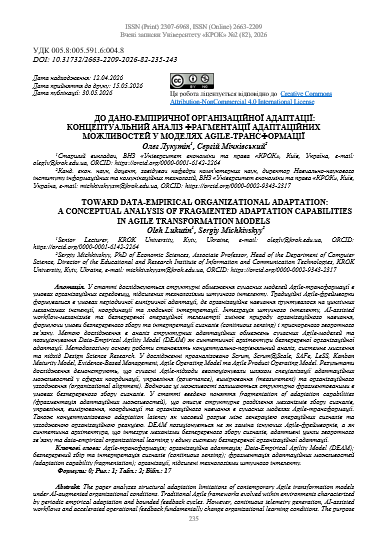
У статті досліджуються структурні обмеження сучасних моделей Agile-трансформації в умовах організаційних середовищ, підсилених технологіями штучного інтелекту. Традиційні Agile-фреймворки формувалися в умовах періодичної емпіричної адаптації, де організаційне навчання ґрунтувалося на циклічних механізмах інспекції, координації та людської інтерпретації. Інтеграція штучного інтелекту, AI-assisted workflow-механізмів та безперервної операційної телеметрії змінює природу організаційного навчання, формуючи умови безперервного збору та інтерпретації сигналів (continuous sensing) і прискореного зворотного зв’язку. Метою дослідження є аналіз структурних адаптаційних обмежень сучасних Agile-моделей та позиціонування Data-Empirical Agility Model (DEAM) як синтетичної архітектури безперервної організаційної адаптації. Методологічну основу роботи становлять концептуально-порівняльний аналіз, системне мислення та підхід Design Science Research. У дослідженні проаналізовано Scrum, Scrum@Scale, SAFe, LeSS, Kanban Maturity Model, Evidence-Based Management, Agile Operating Model та Agile Product Operating Model. Результати дослідження демонструють, що сучасні Agile-підходи еволюціонували шляхом спеціалізації адаптаційних можливостей у сферах координації, управління (governance), вимірювання (measurement) та організаційного узгодження (organizational alignment). Водночас ці можливості залишаються структурно фрагментованими в умовах безперервного збору сигналів. У статті введено поняття fragmentation of adaptation capabilities (фрагментація адаптаційних можливостей), що описує структурне розділення механізмів збору сигналів, управління, вимірювання, координації та організаційного навчання в сучасних моделях Agile-трансформації. Також концептуалізовано adaptation latency як часовий розрив між генерацією операційних сигналів та узгодженою організаційною реакцією. DEAM позиціонується не як заміна існуючих Agile-фреймворків, а як синтетична архітектура, що інтегрує механізми безперервного збору сигналів, адаптивні цикли зворотного зв’язку та data-empirical organizational learning у єдину систему безперервної організаційної адаптації.
Завантаження
Посилання
Beck, K., Beedle, M., van Bennekum, A., et al. (2001). Manifesto for Agile Software Development. Retrieved from https://agilemanifesto.org/
Schwaber, K., & Sutherland, J. (2020). The Scrum Guide: The Definitive Guide to Scrum. Scrum.org.
Senge, P. M. (2006). The Fifth Discipline: The Art and Practice of the Learning Organization. New York: Doubleday.
Snowden, D., & Boone, M. (2007). A leader’s framework for decision making. Harvard Business Review, 85(11), 68–76.
Meadows, D. H. (2008). Thinking in Systems: A Primer. White River Junction: Chelsea Green Publishing.
Larman, C., & Vodde, B. (2016). Large-Scale Scrum: More with LeSS. Boston: Addison-Wesley.
Jarrahi, M. H. (2018). Artificial intelligence and the future of work: Human-AI symbiosis in organizational decision making. Business Horizons, 61(4), 577–586.
Brynjolfsson, E., & McAfee, A. (2014). The Second Machine Age: Work, Progress, and Prosperity in a Time of Brilliant Technologies. New York: W.W. Norton & Company.
Lukutin, O., & Michkivskyy, S. (2025). From empirical to data-empirical agility: Designing AI-augmented learning systems in Agile organizations (Introducing the Data-Empirical Agility Model — DEAM). Scientific Notes of KROK University, 4(80), 191–204. https://doi.org/10.31732/2663-2209-2026-81-261-270
Scrum@Scale. (2024). The Scrum@Scale Guide. Retrieved from https://www.scrumatscale.com/scrum-at-scale-guide/
Knaster, R., & Leffingwell, D. (2020). SAFe® 5.0 Distilled: Achieving Business Agility with the Scaled Agile Framework. Boston: Addison-Wesley.
Anderson, D. J., & Carmichael, A. (2019). Kanban Maturity Model: Evolving Fit-for-Purpose Organizations. Seattle: Lean Kanban University Press.
Scrum.org. (2024). Evidence-Based Management Guide. Retrieved from https://www.scrum.org/resources/evidence-based-management-guide
Scrum.org. (2023). Agile Product Operating Model (APOM). Retrieved from https://www.scrum.org/resources/agile-product-operating-model
Denning, S. (2018). The Age of Agile: How Smart Companies Are Transforming the Way Work Gets Done. New York: AMACOM.
Davenport, T., & Ronanki, R. (2018). Artificial intelligence for the real world. Harvard Business Review, 96(1), 108–116.
McKinsey & Company. (2024). Reimagining the Value Proposition of Tech Services for Agentic AI. Retrieved from https://www.mckinsey.com/industries/technology-media-and-telecommunications/our-insights/reimagining-the-value-proposition-of-tech-services-for-agentic-ai
Downloads
Опубліковано
Як цитувати
Номер
Розділ
Ліцензія

Ця робота ліцензується відповідно до Creative Commons Attribution-NonCommercial 4.0 International License.