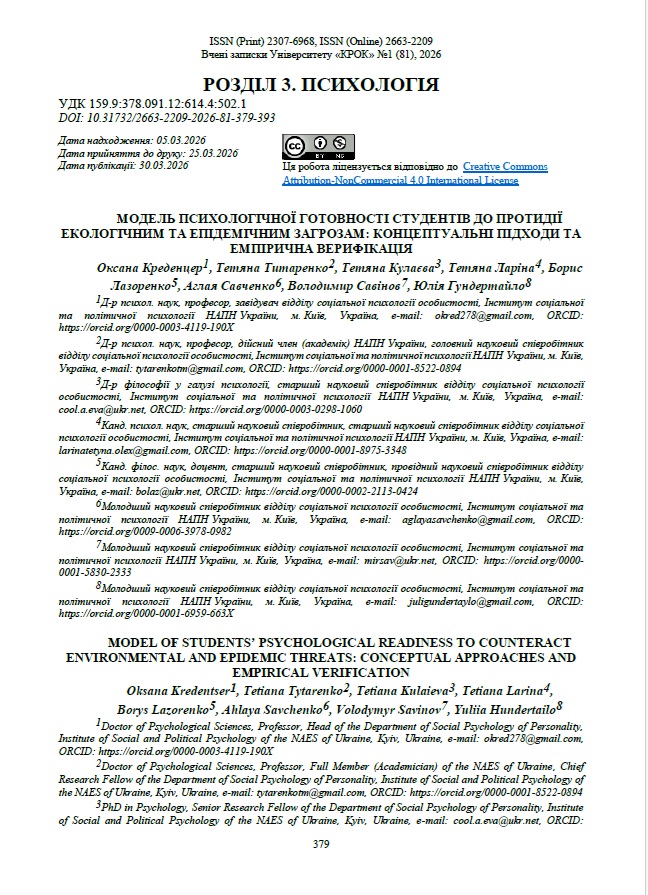
МОДЕЛЬ ПСИХОЛОГІЧНОЇ ГОТОВНОСТІ СТУДЕНТІВ ДО ПРОТИДІЇ ЕКОЛОГІЧНИМ ТА ЕПІДЕМІЧНИМ ЗАГРОЗАМ: КОНЦЕПТУАЛЬНІ ПІДХОДИ ТА ЕМПІРИЧНА ВЕРИФІКАЦІЯ
DOI:
https://doi.org/10.31732/2663-2209-2026-81-379-393Ключові слова:
психологічна готовність особистості, студентська молодь, екологічні та епідемічні загрози, екологічна мотивація, посттравматичні когніції, проактивність, психологічний добробут, здоров’я особистостіАнотація
У статті обґрунтовано актуальність дослідження психологічної готовності студентської молоді до протидії екологічним та епідемічним загрозам, що зумовлена зростанням їх масштабів, складності та впливу на життєдіяльність особистості в умовах соціальної нестабільності та глобальних викликів. Наголошено на необхідності комплексного вивчення психологічних механізмів, ресурсів і чинників, які забезпечують ефективну адаптацію та активну поведінку молоді в ситуаціях ризику. Метою дослідження є розробка теоретичної моделі психологічної готовності студентів до протидії екологічним та епідемічним загрозам та її емпірична верифікація. У дослідженні використано комплекс психодіагностичних методик, спрямованих на вивчення мотиваційного, когнітивного, емоційного, диспозиційного та операційного компонентів готовності. Емпіричне дослідження проведено на вибірці студентської молоді (n = 502) із застосуванням методів описової статистики та експлораторного факторного аналізу. У результаті дослідження розроблено структурну модель психологічної готовності, що включає п’ять взаємопов’язаних компонентів. Емпірично встановлено п’ятифакторну структуру готовності, яка охоплює екологічну мотивацію, тривожно-когнітивні реакції, позитивне мислення та ресурсний спосіб життя, психологічний добробут і проактивність, а також світоглядну гнучкість. Визначено, що ключову роль у забезпеченні готовності відіграють смисложиттєві орієнтації, позитивне мислення та альтруїстичні мотиви. Виявлено часткову невідповідність теоретичної та емпіричної моделей, зокрема відсутність операційного компоненту як самостійного фактору. Практичне значення результатів полягає у можливості їх використання для розробки освітніх і психологічних програм підвищення готовності студентської молоді до дій в умовах загроз. Перспективи подальших досліджень пов’язані з уточненням операційного компоненту готовності, розробкою інтервенційних моделей та вивченням динаміки психологічної готовності в умовах тривалих криз.
Завантаження
Посилання
Дворник М. С. (Ред.) (2025). Здоровий спосіб життя в умовах війни: соціально-психологічний підхід : монографія / кол. авт. Національна академія педагогічних наук України, Інститут соціальної та політичної психології. Кропивницький: Імекс-ЛТД, URI: https://lib.iitta.gov.ua/id/eprint/746928
Духневич, В. М. (Ред.), Довгань, Н. О., Поліщук, С. А., Сіверс, З. Ф., & Цукур, О. Г. (2023). Готовність до надзвичайної ситуації: виміри конструктивності : практичний посібник. Кропивницький : Імекс-ЛТД.
Карамушка Л. М. (Ред.), Креденцер О. В., Терещенко К. В., Лагодзінська В. І., Івкін В. М., Клименко Н. Г., & Ковальчук О. С. (2024). Технології забезпечення психічного здоров’я та благополуччя освітнього персоналу в умовах війни та післявоєнного відновлення : монографія.
Корольчук, М. С., & Крайнюк, В. М. (2006). Соціально-психологічне забезпечення діяльності в звичайних та екстремальних умовах. Ніка-центр.
Скребець, В. О., & Шлімакова, І. І. (2014). Екологічна психологія: підручник. Видавничий дім «Слово».
Слюсаревський, М. М. (Ред.), Найдьонова, Л. А. (Ред.), & Вознесенська, О. Л. (Ред.) (2020). Досвід переживання пандемії COVID-19: дистанційні психологічні дослідження, дистанційна психологічна підтримка: матеріали онлайн-семінарів. ІСПП НАПН України.
Кряж, І. В., & Баєва, К. О. (2020). Роль екологічної світоглядної позиції в подоланні проблем, спричинених глобальними змінами навколишнього середовища. Вісник Харківського національного університету імені В. Н. Каразіна. Серія Психологія , (69), 64–73. https://doi.org/10.26565/2225-7756-2020-69-09
Льовочкіна, А. М. (2011). Психологічні засади формування еколого-орієнтованої свідомості: монографія. Житомир : Вид-во ЖДУ ім. І. Франка.
Юрченко, Л., Хорошев, О., Логовський, І., & Ващук, Т. (2023). Соціально-психологічна реабілітація в екологічній площині. Проблеми екстремальної та кризової психології, 2(6), 171–181.
Швалб, Ю. М. (Ред.), Варава, Л. А., Вернік, О. Л., Дячок, О. М., Кирпенко, Т. М., & Павленко, О. В. (2024). Особливості особистісних стратегій життєдіяльності в умовах невизначеності середовища: монографія. Київ: Інститут психології імені Г. С. Костюка НАПН України.
Павлік, Ю. (2019). Екологічний ризик як складна соціальна ситуація: динаміка конструювання проблеми. Наукові студії соціальної та політичної психології , 25(1), 158–165.
Bonnett, M. (2019). Towards an ecologization of education. The Journal of Environmental Education, 50(4–6), 251–258. https://doi.org/10.1080/00958964.2019.1687409
Bonnett, M. (2023). Environmental consciousness, nature and the philosophy of education: matters arising. Environmental Education Research, 29(10), 1377–1385. https://doi.org/10.1080/13504622.2023.2225807
Foster, J. (2011). Sustainability and the learning virtues. Journal of Curriculum Studies, 43(3), 383–402. https://doi.org/10.1080/00220272.2010.521260
Hahn, F. (2024). More Trouble for a Troubled Geist: Finding Certainty in the Uncertain through Creative Unknowing. The European Legacy, 29(3–4), 350–360. https://doi.org/10.1080/10848770.2024.2312673
Wang, X., Fang, M., Yang, C.-C., & Lai, P.-L. (2025). Environmental awareness and travel intention based on the protection motivation and social learning theories. Current Psychology: A Journal for Diverse Perspectives on Diverse Psychological Issues, 44(6), 5173–5186. https://doi.org/10.1007/s12144-025-07506-7
Downloads
Опубліковано
Як цитувати
Номер
Розділ
Ліцензія

Ця робота ліцензується відповідно до Creative Commons Attribution-NonCommercial 4.0 International License.