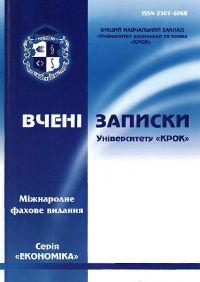
Peer-review process
The «Science notes of KROK University» follows the principle of double-blind peer review, which is internationally recognized and complies with the standards of publication ethics, particularly the recommendations of COPE (Committee on Publication Ethics). This means that neither the reviewers nor the authors know each other's identities, ensuring transparency, impartiality, and objectivity in the evaluation of submitted articles.
1. Submission of the Article and Preliminary Check
When an author submits an article through the online submission system, the editorial team performs a preliminary check to ensure it meets the journal's requirements. Articles must meet the following criteria:
- The topic must be relevant and correspond to the journal's profile (economics, international economic relations, finance, management, etc.).
- The article must adhere to the required structure, citation style, and bibliographic standards.
- If violations such as plagiarism or poor-quality writing are detected, the article may be rejected at this stage.
2. Selection of Reviewers
After the preliminary check, the article is sent for review. The review process involves two types of reviewers:
- Internal Reviewer: a scholar who is a staff member of the institution that publishes the journal. The internal reviewer assesses the article's alignment with the institution's scientific standards and the journal's requirements.
- External Reviewer: an independent expert from another academic institution or country, who provides an external and impartial evaluation of the article. The external reviewer ensures that the work meets international academic standards.
Each article is reviewed by two independent reviewers, ensuring a balanced and objective evaluation.
3. Review Process
Reviewers assess articles based on several key criteria:
- Originality: whether the article presents new and innovative ideas, contributing to the field of research.
- Relevance: whether the topic of the article is significant for current scientific and practical activities and contributes to the development of the field.
- Methodology: whether the research methods are appropriate and well-founded in addressing the goals and objectives of the study.
- Results: whether the results are valid and whether they support the conclusions of the author.
- Justification of Conclusions: whether the conclusions logically follow from the results and whether they are substantiated.
- Scientific Standards: whether the article adheres to the general standards of academic integrity (e.g., no plagiarism, proper citation of sources, clarity, and accuracy of writing).
The reviews are expected within 14 working days after the article is received. If needed, the reviewer can request additional information from the author.
4. Evaluation of Reviews and Decision Making
After receiving the reviews, the editorial team makes a decision about the article. There are three possible outcomes:
- Acceptance: if both reviewers provide positive feedback without significant remarks, the article may be accepted for publication immediately.
- Acceptance with Revisions: if the article requires additional changes or clarifications. The author is provided with specific recommendations for improvement.
- Rejection: if the reviewers identify significant flaws or the article does not meet the journal's standards.
The decision regarding publication is made by the editorial team based on the reviews. If there are discrepancies between the reviews, the editorial team may request a third review for a final decision.
5. Revision and Resubmission
In case the article is accepted with revisions, the author is provided with detailed feedback for necessary changes. After making the changes, the article is resubmitted for further review. If the reviewers confirm that the revisions meet the requirements, the article is accepted for publication.
If the author disagrees with the revisions or refuses to make the changes, the article may be rejected.
6. Appeal of the Review and Editorial Decision
Authors have the right to appeal the review if they believe it was unfair or incorrect. The appeal must be submitted in writing to the editorial team, which will review the author's arguments. If the reviewer and author cannot reach an agreement, the editorial team may involve a third party to make the final decision.
7. Publication Process After Review
After receiving the final positive decision for publication, the editorial team prepares the article for print. This includes formatting the article, checking for plagiarism, and final verification of scientific accuracy and compliance with the journal's requirements. The article is published in the next issue after final approval.
8. Adherence to Publication Ethics
The review and publication process in the journal fully complies with the recommendations of COPE regarding transparency, impartiality, and academic integrity. All reviews and comments are documented and stored in the editorial archives for further verification and resolution of any disputes.