HUNGARY’S NEW ECONOMIC POLICY: PÉTER MAGYAR, EUROPEAN INTEGRATION, AND POST-ORBÁN ECONOMIC RECOVERY
DOI:
https://doi.org/10.31732/2663-2209-2026-83-62-70Keywords:
Hungary, Péter Magyar, Viktor Orbán, economic policy, Tisza Party, economic reforms, Central Europe, European integrationAbstract
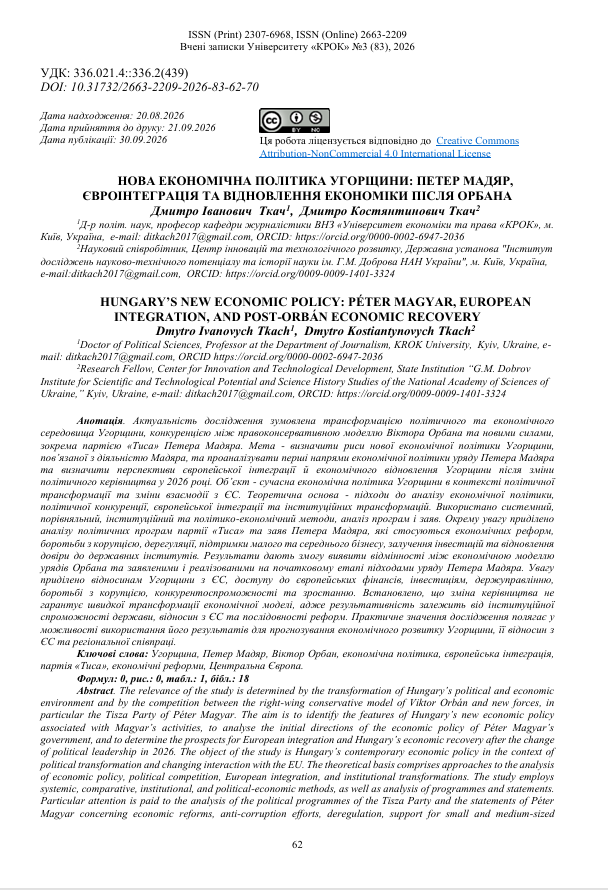
The relevance of the study stems from the transformation of Hungary’s political and economic environment, the growing competition between Viktor Orbán’s conservative model and emerging political forces, and the need to identify possible directions for the country’s economic development amid a potential change of political course. Particular attention is given to Péter Magyar and the Tisza Party, which position themselves as an alternative to the existing system of governance and link political change with deeper European integration and economic modernisation. The aim of the study is to identify the main features of Hungary’s emerging economic policy associated with Péter Magyar’s political movement and to assess possible directions of European integration and economic recovery after the Orbán era. The object of the study is Hungary’s contemporary economic policy in the context of political transformation and changes in its relations with the European Union. The theoretical framework draws on approaches to the analysis of economic policy, political competition, European integration and institutional transformation. The study applies systemic, comparative, institutional and political-economic methods, together with an analysis of political programmes and public statements. The findings identify potential differences between the economic model developed under Orbán’s governments and the approaches proposed by Péter Magyar. Particular attention is paid to Hungary’s relations with the EU, access to European financial resources, investment policy, public administration, anti-corruption measures, competitiveness and economic growth. The study demonstrates that a change in political leadership alone cannot guarantee a rapid transformation of the economic model, as the effectiveness of reforms will depend on state institutional capacity, the nature of relations with the EU and the consistency of economic policy. The practical significance of the study lies in identifying possible scenarios for Hungary’s economic policy and assessing their potential implications for European economic integration, regional cooperation and the economic development of Central Europe.
Downloads
References
Holzner, M. (2026). The illiberal economy: The long-term development of the Hungarian economy under Viktor Orbán (wiiw Policy Note/Policy Report No. 107). Vienna Institute for International Economic Studies. https://wiiw.ac.at/the-illiberal-economy-the-long-term-development-of-the-hungarian-economy-under-viktor-orban-ps-25.html
Bertelsmann Stiftung. (2026). BTI 2026 Hungary country report. Bertelsmann Transformation Index. https://bti-project.org/en/reports/country-report/HUN.
Salimi, S., Tatay, T., Kazinczy, E., & Amini, M. (2026). Fiscal and Monetary Dominance in a Small Open Economy: A Markov-Switching VAR Approach to Hungarian Policy. Economies, 14(2), 42. https://doi.org/10.3390/economies14020042
European Commission. (2026). Economic forecast for Hungary. https://economy-finance.ec.europa.eu/economic-surveillance-eu-member-states/country-pages/hungary/economic-forecast-hungary_en
Pilkington, P. (2026, May). Hungary May Face Galloping Inflation and Weakened Currency Due to Global Energy Crisis. The European Conservative / Hungarian Institute of International Affairs (HIIA). Retrieved from https://europeanconservative.com/articles/news-corner/hungary-energy-crisis-hiia-analysis-inflation-weakened-forint/
International Viewpoint. (2026, April 16). Hungary 2026: An autopsy of sixteen years of illiberalism (Interview with Adam Novak). https://internationalviewpoint.org/Hungary-2026-An-Autopsy-of-Sixteen-Years-of-Illiberalism
A GKI konjunktúra indexe májusban négyéves csúcsára emelkedett.
https://researchgki.hu/2026/05/28/a-gki-konjunktura-indexe-majusban-negyeves-csucsara-emelkedett/
Ратушний, Д. М. (2024). Політичний режим Угорщини: від партократії до електоральної автократії та організованої клептократії. Журнал політології та міжнародних відносин, (2). https://doi.org/10.31558/2519-2949.2024.2.15
Fitch Ratings. Hungary Ratings Update // Fitch Ratings. - 2026. - URL: https://www.fitchratings.com/research/sovereigns/hungary-ratings-update
European Central Bank. (2026, June 24). Convergence Report, June 2026. Frankfurt am Main: ECB. Retrieved from https://www.ecb.europa.eu/press/other-publications/convergence/html/ecb.cr202606~30e75ae1c2.en.html
IMF. (2025). Hungary: 2025 Article IV Consultation - Press Release; Staff Report; and Statement by the Executive Director for Hungary. IMF Staff Country Reports, 025(250). DOI: 10.5089/9798229020619.002. https://www.imf.org/en/ publications/cr/issues/2025/08/29/hungary-2025-article-iv-consultation-press-release-staff-report-and-statement-by-the-570029
Ionta, N. (2026). Brussels cools hopes for Magyar breakthrough. Euractiv. Retrieved from https://www.euractiv.com/news/rapporteur-brussels-cools-hopes-for-magyar-breakthrough/
Andrii Vodianyi. Fitch cuts Hungary’s outlook to negative amid pre-election fiscal spending https://finance.liga.net/en/ekonomika/news/fitch-cuts-hungarys-outlook-to-negative-amid-pre-election-fiscal-spending
Hungary's Orban flags fourth year of 5% deficit as election spending bites. https://www.marketscreener.com/news/hungary-s-deficit-to-be-around-5-of-gdp-this-year-and-next-orban-says-ce7e5ad8de80f722?utm_source =copy&utm_medium=social&utm_campaign=share
Hungary 2026 Country Report. - Brussels: EC, 2026. - URL: https://ec.europa.eu/info/publications/hungary-2026-country-report_en
Péter Magyar’s First 100 Days: Political & Policy Overview. https://areterapa.com/peter-magyars-first-100-days-political-policy-overview/
UNN Agency. (2026, March 9). Hungarian Government Records Record Budget Deficit Due to Orbán's Pre-Election Spending. https://unn.ua/news/uriad-uhorshchyny-zafiksuvav-rekordnyi-defitsyt-biudzhetu-cherez-peredvyborchi-vytraty-orbana
Cseke, Király. 2026. A propaganda beszántásával kezdene, az euró bevezetésének határáig jutna első ciklusában a Tisza. https://telex.hu/belfold/2026/02/07/tisza-part-teljes-program-vagyonado-euro-egeszsegugy-gyermekvedelem-propagandastop
Downloads
Published
How to Cite
Issue
Section
License

This work is licensed under a Creative Commons Attribution-NonCommercial 4.0 International License.