TRANSFORMATION OF UKRAINE'S BALANCE OF PAYMENTS UNDER FULL-SCALE WAR: MECHANISMS FOR ENSURING MACRO-FINANCIAL STABILITY
DOI:
https://doi.org/10.31732/2663-2209-2026-83-51-61Keywords:
balance of payments, war economy, macro-financial stability, trade balance, international financial assistance, , international reserves, external financing, currency liberalizationAbstract
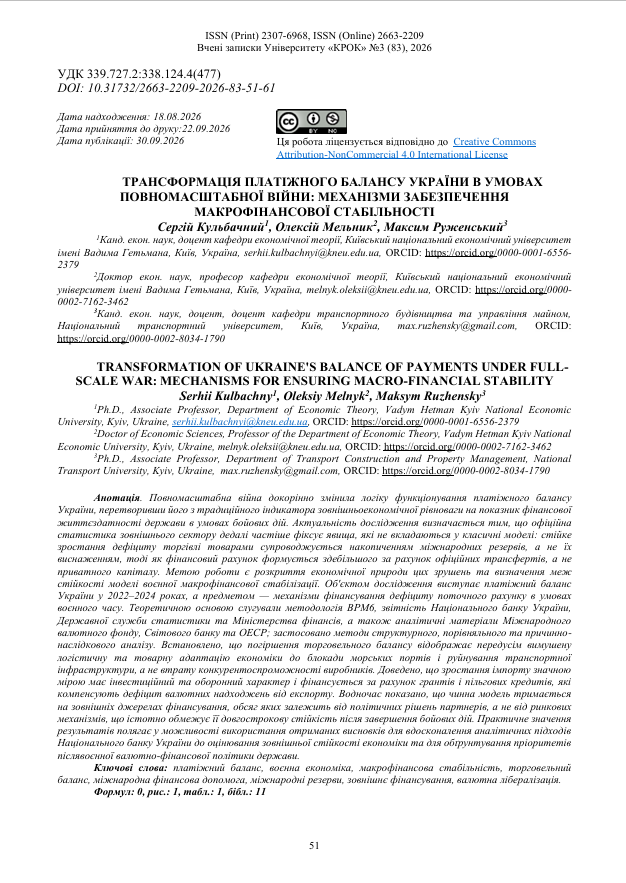
The full-scale war has fundamentally changed the logic underlying Ukraine's balance of payments, turning it from a conventional indicator of external equilibrium into a measure of the state's financial viability under wartime conditions. The relevance of the study stems from the fact that official external-sector statistics increasingly record phenomena that classical models cannot explain: a persistent widening of the goods-trade deficit coincides with the accumulation, rather than depletion, of international reserves, while the financial account is shaped mainly by official transfers instead of private capital. The purpose of the study is to uncover the economic nature of these shifts and to identify the limits of sustainability of the wartime macro-financial stabilization model. The object of the research is Ukraine's balance of payments in 2022–2024, while the subject is the mechanisms of financing the current-account deficit under wartime conditions. The theoretical basis comprises the BPM6 methodology, reporting by the National Bank of Ukraine, the State Statistics Service and the Ministry of Finance, together with analytical materials of the International Monetary Fund, the World Bank and the OECD; methods of structural, comparative and causal analysis were applied. The deterioration of the trade balance is shown to reflect primarily forced logistical and commodity adaptation to the blockade of seaports and the destruction of transport infrastructure rather than a loss of producer competitiveness. Import growth is demonstrated to be largely investment- and defense-driven and financed through grants and concessional loans that offset the shortfall in export earnings. At the same time, the current model is shown to rest on external financing whose volume depends on partners' political decisions rather than market mechanisms, which substantially constrains its long-term sustainability once hostilities end. The practical significance of the results lies in their applicability for refining the National Bank of Ukraine's analytical approaches to assessing external sustainability and for substantiating the priorities of the state's post-war monetary and financial policy.
Downloads
References
International Monetary Fund. (2009). Balance of payments and international investment position manual (6th ed.). https://www.imf.org/external/pubs/ft/bop/2007/bopman6.htm
International Monetary Fund. (2025). Ukraine: Seventh review under the Extended Arrangement under the Extended Fund Facility, requests for modification of a performance criterion, rephasing of access, and financing assurances review—Press release; staff report; and statement by the Alternate Executive Director for Ukraine (IMF Country Report No. 2025/078). https://doi.org/10.5089/9798229007122.002
OECD. (2022). The impacts and policy implications of Russia's aggression against Ukraine on agricultural markets (OECD Policy Responses on the Impacts of the War in Ukraine). OECD Publishing. https://doi.org/10.1787/0030a4cd-en
OECD. (2024). Agricultural policy monitoring and evaluation 2024: Innovation for sustainable productivity growth. OECD Publishing. https://doi.org/10.1787/74da57ed-en
UNCTAD. (2022). Maritime trade disrupted: The war in Ukraine and its effects on maritime trade logistics (UNCTAD/OSG/INF/2022/2). United Nations Conference on Trade and Development. https://unctad.org/publication/maritime-trade-disrupted-war-ukraine-and-its-effects-maritime-trade-logistics
World Bank, Government of Ukraine, European Commission, & United Nations. (2025). Ukraine fourth rapid damage and needs assessment (RDNA4): February 2022 – December 2024. World Bank. https://documents.worldbank.org/curated/en/099022025114040022/pdf/P180174-ca39eccd-ea67-4bd8-b537-ff73a675a0a8.pdf
Білоус, О. (2025, 25 квітня). Україна отримає рекордну фінансову допомогу: як це вплине на валютний ринок. РБК-Україна. https://www.rbc.ua/rus/news/ukrayina-otrimae-rekordnu-finansovu-dopomogu-1745583578.html
Державна служба статистики України. (2025, 14 лютого). Зовнішня торгівля України товарами за 2024 рік: експрес-випуск. https://stat.gov.ua/uk/news/zovnishnya-torhivlya-ukrayiny-tovaramy-za-2024-rik-ekspres-vypusk
Міністерство фінансів України. (2024, 30 грудня). У 2024 році Мінфін України залучив 41,7 млрд дол. США зовнішнього фінансування, із яких 30 % у грантовій формі. https://mof.gov.ua/uk/news/the_ministry_of_finance_of_ukraine_attracted_417_billion_in_external_financing_including_30_in_the_form_of_grants-4972
Національний банк України. (2024). Статистика зовнішнього сектору України: платіжний баланс, міжнародна інвестиційна позиція, прямі інвестиції, зовнішній борг та міжнародні резерви (статистичні дані за методологією BPM6). https://bank.gov.ua/ua/statistic/sector-external
Національний банк України. (2025). Статистика зовнішнього сектору: Платіжний баланс України (аналітична форма) за 2022–2024 роки. bank.gov.ua
Downloads
Published
How to Cite
Issue
Section
License

This work is licensed under a Creative Commons Attribution-NonCommercial 4.0 International License.