MODERN DIRECTIONS AND PRINCIPLES OF LOGISTICS SYSTEMS DEVELOPMENT OF PHARMACEUTICAL DISTRIBUTION ENTERPRISES
DOI:
https://doi.org/10.31732/2663-2209-2026-83-331-342Keywords:
logistics system, distributor, pharmaceuticals, management, development conceptsAbstract
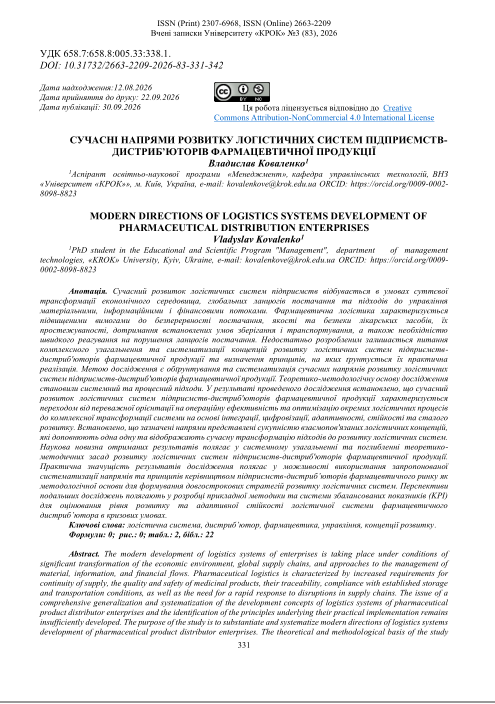
The modern development of logistics systems of enterprises is taking place under conditions of significant transformation of the economic environment, global supply chains, and approaches to the management of material, information, and financial flows. Pharmaceutical logistics is characterized by increased requirements for continuity of supply, the quality and safety of medicinal products, their traceability, compliance with established storage and transportation conditions, as well as the need for a rapid response to disruptions in supply chains. The issue of a comprehensive generalization and systematization of the development concepts of logistics systems of pharmaceutical product distributor enterprises and the identification of the principles underlying their practical implementation remains insufficiently developed. The purpose of the study is to substantiate and systematize modern directions of logistics systems development of pharmaceutical product distributor enterprises. The theoretical and methodological basis of the study comprised systemic and process approaches. The study established that the modern development of logistics systems of pharmaceutical product distributor enterprises is characterized by a transition from a predominant focus on operational efficiency and the optimization of individual logistics processes toward comprehensive system transformation based on integration, digitalization, adaptability, resilience, and sustainable development. It was established that these directions are represented by a set of interrelated logistics concepts that complement one another and reflect the contemporary transformation of approaches to logistics system development. The scientific novelty of the results obtained lies in the systematic generalization and deepening of the theoretical and methodological foundations of logistics systems development of pharmaceutical product distributor enterprises. Perspectives for further research include the development of a practical methodology and a balanced scorecard (KPI) system for assessing the level of development and adaptive resilience of a pharmaceutical distributor's logistics system under crisis conditions. The practical significance of the research results lies in the possibility of using the proposed systematization of directions and principles by the management of pharmaceutical market distributor enterprises as a methodological basis for formulating long-term logistics system development strategies.
Downloads
References
Васильців, Н. (2023). Трансформація та адаптація логістики до викликів в умовах воєнного стану. Економіка та суспільство, (55) https://doi.org/10.32782/2524-0072/2023-55-78
Ільченко, Н., & Становий, О. (2026). Formation of supply chain resilience in the pharmaceutical market. Економіка Та Суспільство, (83). https://doi.org/10.32782/2524-0072/2026-83-169
Міністерство охорони здоров’я України. (2025). Настанова «Лікарські засоби. Належна практика дистрибуції». СТ-Н МОЗУ 42-5.0:2025 (затверджено наказом МОЗ України від 01.05.2025 № 759). https://moz.gov.ua/storage/uploads/46397f29-2205-4797-8cd4-c9b7ba09e157/dn_759_01052025_dod.pdf
Сагайдак-Нікітюк, Р. В., & Чумаченко, Д. П., (2025). Особливості функціонування логістичних систем фармацевтичних підприємств у кризових ситуаціях. Вісник фармації, (1), 17-22. https://doi.org/10.24959/nphj.25.165
Al-Hourani, S., & Weraikat, D. (2025). A Systematic Review of Artificial intelligence (AI) and Machine Learning (ML) in Pharmaceutical Supply Chain (PSC) Resilience: Current trends and future directions. Sustainability, 17(14), 6591. https://doi.org/10.3390/su17146591
Alkema, V., Hryhoruk, P., Skhidnytska, H., & Sylkin, O. (2024). Resilience and strategic management: Ways to ensure economic and social security of Ukrainian enterprises during long-term warfare. Clio. Revista de Historia, Ciencias Humanas y Pensamiento Crítico, 5(9), 740-767. https://doi.org/10.5281/zenodo.14567109
Andres, B., Diaz-Madroñero, M., Soares, A. L., & Poler, R. (2024). Enabling technologies to support supply chain logistics 5.0. IEEE Access, 12, 43889-43906. https://doi.org/10.1109/access.2024.3374194
Bukowski, L., & Werbinska-Wojciechowska, S. (2026). Logistics 5.0 in the 5.0 ecosystem: Bridging structural readiness, functional capability, and sustainable system performance - a systematic review and conceptual framework. Sustainability, 18(11), 5630. https://doi.org/10.3390/su18115630
Cakir, O. E., Mukul, E., & Goker, N. (2026). Logistics 5.0: systematic literature review and future trends. Logistics Research, 1-20. https://doi.org/10.1108/lore-09-2025-0116
Chen, T., Chu, F., Zhang, J., & Sun, J. (2024). Sustainable collaborative strategy in pharmaceutical refrigerated logistics routing problem. International Journal of Production Research, 62 (14), 5036–5060. https://doi.org/10.1080/00207543.2023.2283566
Chiang, C., & Chang, C. (2026). Assessing risks in air cold chain logistics for time- and temperature-sensitive products: A case of Taiwan. Research in Transportation Business & Management, 65. https://doi.org/10.1016/j.rtbm.2025.101587
Chowdhury, R., & Sultana, R. (2024). Integrating artificial intelligence and advanced computing models to reduce logistics delays in pharmaceutical distribution. American Journal of Health and Medical Sciences, 05(03), 01-35. https://doi.org/10.63125/t1kx4448
Deng, X., Sun, A., Wang, Y., & Wang, L. (2026). Logistics service optimization for pharmaceutical enterprises under direct supply mode: a multiobjective approach. SPIE-Intl Soc Optical Eng, 129. https://doi.org/10.1117/12.3102142
Dienes, B. B., Qorri, D., & Felföldi, J. (2024). Pharma supply chain resilience: A systematic review. Applied Studies in Agribusiness and Commerce, 18(1). https://doi.org/10.19041/apstract/2024/1/8
European Commission. (2013). Guidelines of 5 November 2013 on Good Distribution Practice of medicinal products for human use (2013/C 343/01). Official Journal of the European Union, C 343, 1-14. https://eur-lex.europa.eu/legal-content/EN/TXT/?uri=oj:JOC_2013_343_R_0001_01
Faryad, M., Din, G. M., Iram, S., Hussain, M., Liaqat, I., & Iqbal, M. A. (2025). Supply chain system based on pharmaceutical Industry 4.0 platform: State of the art. European Journal of Applied Science, Engineering and Technology, 3(3), 4-13. https://doi.org/10.59324/ejaset.2025.3(3).01
Lisna, A., Posilkina, O., & Litvinova, O. (2024). Digital logistics as a tool for minimizing logistics risks in the activities of pharmaceutical enterprises. Anali Mečnikìvsʹkogo Ìnstitutu, 2, 13-18. https://doi.org/10.5281/zenodo.11634418
Nagy, G., & Szentesi, S. (2024). Collaborative logistics: An innovative strategy to address future logistics challenges. Advanced Logistic Systems - Theory and Practice, 18(3), 83–95. https://doi.org/10.32971/als.2024.031
Nugroho, B. F., Nazaruddin, L. O., Syamil, A., Nurhasan, H. M., Fatma, E., Noor, M. M., Soeharsono, I. P. F. M., Sarasi, V., Fekete-Farkas, M., & Balázs, G. (2024). A pattern of collaborative logistics during multiple crises. International Journal of Disaster Risk Reduction, 108, 104499. https://doi.org/10.1016/j.ijdrr.2024.104499
Sun, X., Yu, H., & Solvang, W. D. (2022). Towards the smart and sustainable transformation of Reverse Logistics 4.0: a conceptualization and research agenda. Environmental Science and Pollution Research, 29(46), 69275-69293. https://doi.org/10.1007/s11356-022-22473-3
World Health Organization. (2020). Good storage and distribution practices for medical products. WHO Technical Report Series, No. 1025, Annex 7. https://www.who.int/publications/m/item/trs-1025-annex-7
Yoseph, G. K., & Sunitiyoso, Y. (2025). Navigating supply chain risk in the pharmaceutical industry: a bibliographic mapping and systematic review using global supply chain risk framework. Journal of Global Operations and Strategic Sourcing, 18(4), 670–701. https://doi.org/10.1108/jgoss-06-2024-0050
Downloads
Published
How to Cite
Issue
Section
License

This work is licensed under a Creative Commons Attribution-NonCommercial 4.0 International License.