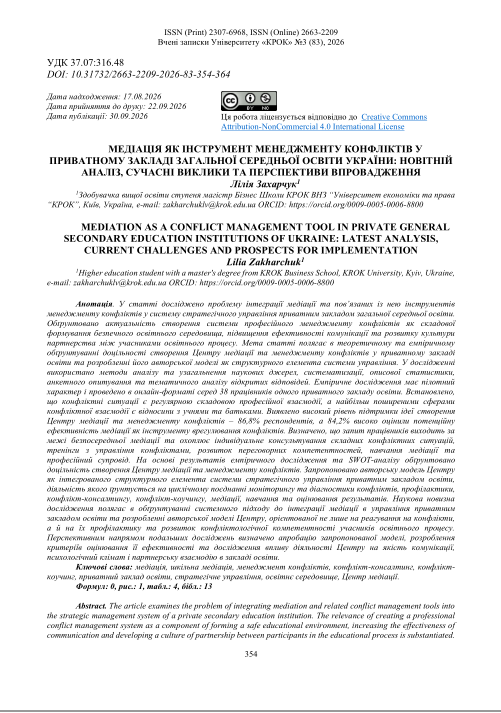
MEDIATION AS A CONFLICT MANAGEMENT TOOL IN PRIVATE GENERAL SECONDARY EDUCATION INSTITUTIONS OF UKRAINE: LATEST ANALYSIS, CURRENT CHALLENGES AND PROSPECTS FOR IMPLEMENTATION
DOI:
https://doi.org/10.31732/2663-2209-2026-83-354-364Keywords:
mediation, school mediation, conflict management, conflict consulting, , conflict coaching, private educational institution, strategic management, educational environment, Mediation CenterAbstract
The article examines the problem of integrating mediation and related conflict management tools into the strategic management system of a private secondary education institution. The relevance of creating a professional conflict management system as a component of forming a safe educational environment, increasing the effectiveness of communication and developing a culture of partnership between participants in the educational process is substantiated. The purpose of the article is to theoretically and empirically substantiate the feasibility of creating a Center for Mediation and Conflict Management in a private educational institution and to develop its author's model as a structural element of the management system. The study used methods of analysis and generalization of scientific sources, systematization, descriptive statistics, questionnaire survey and thematic analysis of open responses. The empirical study was conducted in an online format among 38 employees of a private educational institution. It was found that conflict situations are a regular component of professional interaction, and the most common areas of conflict interaction are relationships with students and parents. A high level of support for the idea of creating a Center for Mediation and Conflict Management was revealed - 86.8% of respondents, and 84.2% highly appreciated the potential effectiveness of mediation as a tool for conflict resolution. It has been determined that the request of employees goes beyond direct mediation and includes individual counseling of complex conflict situations, conflict management training, development of negotiation skills, mediation training, and professional support. Based on the results of empirical research and SWOT analysis, the feasibility of creating a Center for Mediation and Conflict Management is substantiated. The author's model of the Center as an integrated structural element of the strategic management system of a private educational institution is proposed, the activities of which are based on a cyclical combination of conflict monitoring and diagnostics, prevention, conflict consulting, conflict coaching, mediation, training and evaluation of results. The scientific novelty of the study lies in the substantiation of a systemic approach to the integration of mediation into the management of a private educational institution and the development of an author's model of the Center, focused not only on responding to conflicts, but also on their prevention and the development of conflictological competence of participants in the educational process. A promising direction for further research is the testing of the proposed model, the development of criteria for assessing its effectiveness, and the study of the impact of the Center's activities on the quality of communication, psychological climate, and partnership interaction in an educational institution.
Downloads
References
Коваль, Р., Нікітчук, А., & Горова, А. (2009). Шкільна служба розв’язання конфліктів: досвід впровадження. Видавець Захаренко В. О. https://www.calameo.com/read/004110410c1a0da7ff886
Косьміна, М. М., & Лютий, В. П. (2022). Програми шкільної медіації в Україні. Грааль науки, 22, 77–81. https://doi.org/10.36074/grail-of-science.25.11.2022.12
Мальцева, О. І. (2021). Служба медіації в школі: досвід зарубіжних країн та України. Вісник Луганського національного університету імені Тараса Шевченка. Педагогічні науки, 6(344), ч. 1, 188–196.
Миргород-Карпова, В. В., & Мурач, Д. В. (2022). Освітня медіація в Україні: проблеми та шляхи їх подолання. Нове українське право, 1, 137–145. https://doi.org/10.51989/NUL.2022.1.21
Яремко, О., & Дзюбак, С. (2025). Медіація як спосіб врегулювання конфліктів в освітньому середовищі. Актуальні проблеми правознавства, 2, 150–156.
Burrell, N. A., Zirbel, C. S., & Allen, M. (2003). Evaluating peer mediation outcomes in educational settings: A meta-analytic review. Conflict Resolution Quarterly, 21(1), 7–26. https://doi.org/10.1002/crq.46
Ibarrola-García, S. (2024). Peer relationships: School mediation benefits for sustainable peace. Pastoral Care in Education, 42(3), 290–317. https://doi.org/10.1080/02643944.2023.2244500
Lodi, E., Perrella, L., Lepri, G. L., Scarpa, M. L., & Patrizi, P. (2022). Use of restorative justice and restorative practices at school: A systematic literature review. International Journal of Environmental Research and Public Health, 19(1), 96. https://doi.org/10.3390/ijerph19010096
OpenDataBot. (2026). Булінг у школах: статистика та аналітика. https://opendatabot.ua/analytics/bulling-in-schools-2026-05
Pişkin, M. (2010). Examination of peer bullying among primary and middle school children in Ankara. Education and Science, 35(156), 175–189. https://doi.org/10.15390/ES.2010.869
Tabin, M. (2019). Peer to peer mediation at school: Search for a program for a primary school in Valais. A systematic review based on the “Evidence-Based Practice” criteria. Swiss Journal of Educational Research, 41(1), 36–53. https://doi.org/10.24452/sjer.41.1.5
UNICEF & Safe to Learn. (2026). Safe learners in a digital world: Adapting the Safe to Learn tools to address technology-facilitated violence in and around schools. https://www.unicef.org/documents/safe-learners-digital-world
Valdés, R., Valdés, A., & García, A. (2017). Mediation as a process for the management of conflict and the improvement of coexistence in educational centres: A study based on the perceptions of secondary school students. Procedia - Social and Behavioral Sciences, 237, 465–470. https://doi.org/10.1016/j.sbspro.2017.02.091
Downloads
Published
How to Cite
Issue
Section
License

This work is licensed under a Creative Commons Attribution-NonCommercial 4.0 International License.