THE ROLE OF COMMUNICATIVE COMPETENCE IN THE PROFESSIONAL ACTIVITY OF A MEDIATOR
DOI:
https://doi.org/10.31732/2663-2209-2026-83-292-301Keywords:
mediation, mediator, professional activity, conflict, communicative interaction, active listening, empathy, professional communication, communicative competenceAbstract
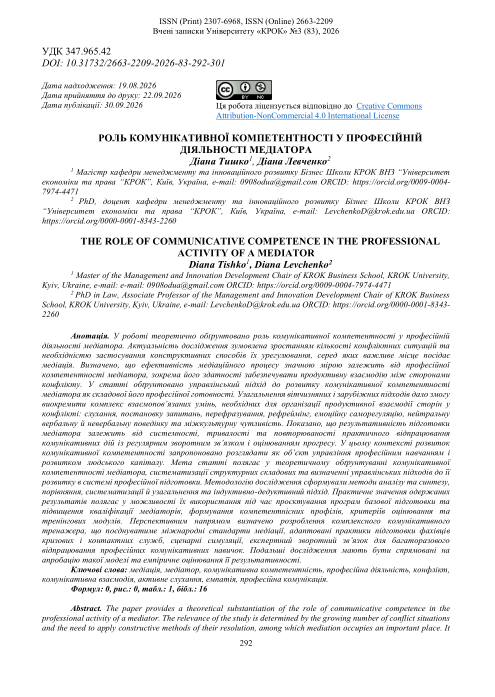
The paper provides a theoretical substantiation of the role of communicative competence in the professional activity of a mediator. The relevance of the study is determined by the growing number of conflict situations and the need to apply constructive methods of their resolution, among which mediation occupies an important place. It has been established that the effectiveness of the mediation process largely depends on the mediator’s professional competence, particularly on their ability to ensure productive interaction between the parties to a conflict. The article substantiates a managerial approach to the development of a mediator’s communicative competence as a component of their professional readiness. The generalization of domestic and international approaches made it possible to identify a set of interrelated skills required to organize productive interaction between the parties to a conflict: listening, questioning, paraphrasing, reframing, emotional self-regulation, neutral verbal and non-verbal behaviour, and intercultural sensitivity. It is demonstrated that the effectiveness of mediator training depends on the systematic, sustained, and repetitive practical application of communicative actions, accompanied by regular feedback and progress assessment. In this context, the development of communicative competence is proposed to be considered as an object of professional learning management and human capital development. The purpose of the article is to provide a theoretical substantiation of the mediator’s communicative competence, to systematize its structural components, and to determine managerial approaches to its development within the system of professional training. The research methodology comprised the methods of analysis and synthesis, comparison, systematization and generalization, as well as an inductive-deductive approach. The practical significance of the obtained results lies in the possibility of their application in designing basic training and advanced professional development programmes for mediators, developing competency profiles, assessment criteria, and training modules. A promising area for further development is the creation of a comprehensive communication simulator that would integrate international mediation standards, adapted practices for training specialists in crisis and contact services, scenario-based simulations, and expert feedback to enable repeated practice of professional communication skills. Further research should focus on testing such a model and empirically evaluating its effectiveness.
Downloads
References
Бляхарський, Я. С., Філюк, О. С., & Лазарева, А. О. (2024). Медіація як ефективний засіб вирішення спорів: досвід розвинених країн [Mediation as an effective means of resolving disputes: the experience of developed countries]. Академічні візії, (35). URL: https://academy-vision.org/index.php/av/article/view/1372 DOI: https://doi.org/10.5281/zenodo.13859380
Дубровинський, Г. Р., & Сорочак, Ю. Р. (2021). Розвиток комунікативної компетентності медіаторів [Development of communicative competence of mediators]. Соціогуманітарний вимір сучасних трансформацій: збірник матеріалів Всеукраїнської науково-практичної конференції, (1), 64–67. URL: https://reicst.com.ua/asp/article/view/conf_gum_2021_21
Коваленко, В. В., & Марценюк, Д. В. (2020). Комунікативна компетентність як складова професійної компетентності соціального працівника [Communicative competence as a component of the professional competence of a social worker]. Молодий вчений, 4 (80), 75–77. DOI: https://doi.org/10.32839/2304-5809/2020-4-80-17
Перцова, І. В. (2025). Специфічні особливості комунікативної компетентності майбутніх лікарів [Specific features of the communicative competence of future doctors]. International Science Journal of Education & Linguistics, (4), 16–22. DOI: https://doi.org/10.46299/j.isjel.20250405.02
Про медіацію: Закон України від 16 листопада 2021 року № 1875-IX [On Mediation: Law of Ukraine dated November 16, 2021 No. 1875-IX]. (2022). Відомості Верховної Ради, (7), ст. 51. URL: https://zakon.rada.gov.ua/laws/show/1875-20#Text
Ткачова, Н. О., & Ткачов, А.С., & Байдала В. В., & Чирва, Я.О. (2025). Роль комунікативної компетентності у формуванні професійного іміджу педагога [The role of communicative competence in the formation of a teacher's professional image]. Інноваційна педагогіка, (85), 154–158. DOI: https://doi.org/10.32782/ip/85.2.28
Тютюн, О. В. (2026). Медіатор теж впливає. Риторичні прийоми, переговорні тактики і межі професійного впливу [The mediator also has influence. Rhetorical techniques, negotiation tactics and the limits of professional influence]. URL: https://cmg.org.ua/info/mediator-tezh-vplyvaie-rytorychni-pryiomy-perehovorni-taktyky-i-mezhi-profesiinoho-vplyvu
Урусова, О. Г. (2016). Діалогова активність як інструмент комунікативної поведінки медіатора [Dialogic activity as a tool of the mediator's communicative behavior]. Науковий вісник Миколаївського національного університету імені В. О. Сухомлинського, (1), С. 207–213. URL: https://nbuv.gov.ua/UJRN/Nvmdups_2016_1_38
Bogdanoski, T. (2009). The importance and challenge of active listening in mediation. Australasian Dispute Resolution Journal, 20(4), 201–206. URL: https://papers.ssrn.com/sol3/papers.cfm?abstract_id=1552671
Donohue, W. A., Allen, M., & Burrell, N. (1988). Mediator communicative competence. Communication Monographs, 55(1), 104–119. DOI: https://doi.org/10.1080/03637758809376160
IMI Certified Mediators – Standards (2026). International Mediation Institute. URL: https://imimediation.org/docs/imi-mediators/professional-standards/competency-criteria
Fischer-Lokou, J., Lamy, L., Guéguen, N., & Dubarry, A. (2016). Effects of active listening, reformulation, and imitation on mediator success: Preliminary results. Psychological Reports, 118(3), 994–1010. DOI: https://doi.org/10.1177/0033294116646159
Ngcobo, M. T. (2024). Navigating the emotional landscape of mediation: An exploration of the role of emotions in conflict resolution and the strategies for effective management. Conflict Resolution Quarterly, 41(3), 327–335. DOI: https://doi.org/10.1002/crq.21409
Phillips, B. (1999). Reformulating dispute narratives through active listening. Mediation Quarterly, 17(2), 161–180. DOI: https://doi.org/10.1002/crq.3890170207
Plis, J. (2020). Kompetencje komunikacyjne mediatora. Acta Iuridica Resoviensia, 28(110), 195–209. DOI: https://doi.org/10.15584/znurprawo.2020.28.14
Resolution Institute. (2026). A guide to the advanced mediation accreditation assessment process. Resolution Institute. URL: https://resolution.institute/common/Uploaded%20files/Resolution%20Institute/2026/Guide%20for%20advanced%20accreditation%20assessment-NZ_2026.pdf
Downloads
Published
How to Cite
Issue
Section
License

This work is licensed under a Creative Commons Attribution-NonCommercial 4.0 International License.