MOTIVATION METHODS FOR VIRTUAL PROJECT TEAM MEMBERS IN THE CONTEXT OF DIGITALIZATION
DOI:
https://doi.org/10.31732/2663-2209-2026-83-205-213Keywords:
motivation, virtual teams, project management, digitalization, gamification, remote workAbstract
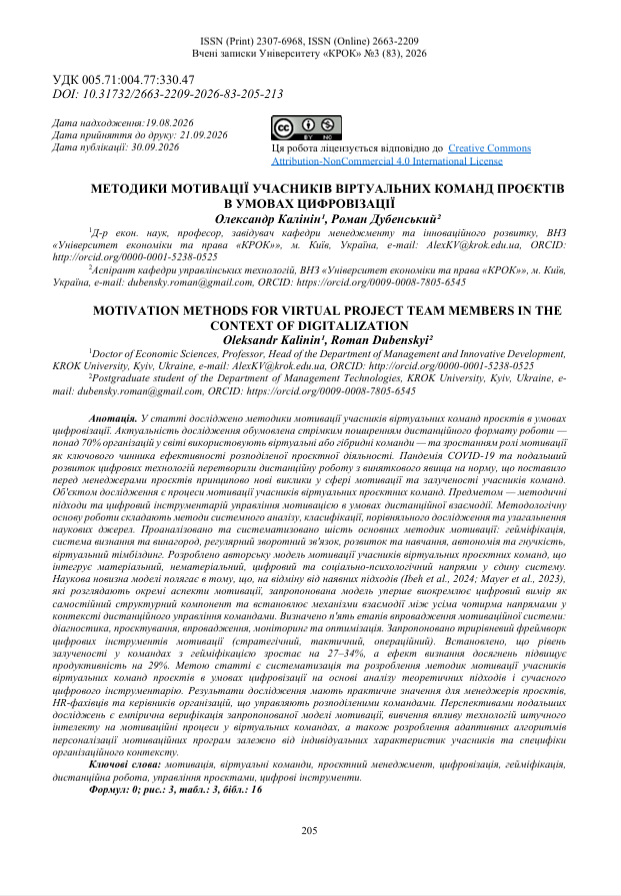
This article examines motivation methods for virtual project team members in the context of digitalization. The relevance of the study is driven by the rapid expansion of remote work and the growing significance of virtual teams in modern project management. The theoretical foundations of motivation for remote workers have been analyzed, and approaches to classifying motivation methods — material, non-material, digital, and socio-psychological — have been systematized. A motivation model for virtual project team members has been developed, accounting for the specifics of the digital environment and the use of modern technological platforms. The stages of implementing a motivation system in virtual project teams have been defined: diagnostics, design, implementation, monitoring, and optimization. A framework of digital motivation tools at the strategic, tactical, and operational levels has been proposed. It has been established that effective motivation in virtual teams is based on the combination of gamification, achievement recognition systems, regular feedback, autonomy, and professional development, implemented through digital platforms. The research results have practical significance for project managers, HR professionals, and organizational leaders working with distributed teams. Prospects for further research include the empirical verification of the proposed model, studying the impact of artificial intelligence on motivational processes, and developing adaptive algorithms for personalizing motivation programs.
Downloads
References
Deloitte. (2024). 2024 global human capital trends. https://www2.deloitte.com/us/en/insights/focus/human-capital-trends.html
Gallup. (2024). State of the global workplace: 2024 report. https://www.gallup.com/workplace/349484/state-of-the-global-workplace.aspx
Garro-Abarca, V., Palos-Sanchez, P., & Aguayo-Camacho, M. (2021). Virtual teams in times of pandemic: Factors that influence performance. Frontiers in Psychology, 12, Article 624637. https://doi.org/10.3389/fpsyg.2021.624637
Ibeh, F., Oyekunle, D., & Boohene, D. (2024). Exploring effective methods to boost virtual workers' morale for improved project performance. International Journal of Professional Business Review, 9(3), e04335. https://doi.org/10.26668/businessreview/2024.v9i3.4335
Kalinin, O., Gonchar, V., Zakharchenko, O., Darushyn, O., Maltsev, M., & Datsiuk, P. (2024). A Comprehensive Methodology for Evaluating Economic Security in the Digitalization of Investment Processes. Revista De Gestão Social E Ambiental, 18(5), e05441. https://doi.org/10.24857/rgsa.v18n5-026
Link, M., Murawski, M., & Bühler, J. (2024). Lost in translation: Managing digital projects with virtual teams – challenges, opportunities, and required digital intelligence skills. Lecture Notes in Computer Science, 14907, 215–230. https://doi.org/10.1007/978-3-031-72234-9_18
Mayer, C., Sivatheerthan, T., Mütze-Niewöhner, S., & Nitsch, V. (2023). Sharing leadership behaviors in virtual teams: Effects on team member satisfaction and productivity. Team Performance Management, 29(1/2), 90–112. https://doi.org/10.1108/TPM-02-2022-0014
Pandey, A., Baral, R., & Godugu, S. (2024). Navigating the digital era: the role of virtual teams in organizational transformation. Asia Pacific Journal of Innovation and Entrepreneurship, 18(2), 98–120. https://doi.org/10.1108/APJIE-08-2024-0166
Project Management Institute. (2024). Pulse of the profession: The future of project work. https://www.pmi.org/learning/thought-leadership/pulse/pulse-of-the-profession-2024thought-leadership/pulse/pulse-of-the-profession-2024
Pura, J. (2022). Linking motivation and employee engagement through gamification in remote working. International Journal of Academe and Industry Research, 3(1), 52–69. https://doi.org/10.53378/352857
Ruželė, D., Stankevičienė, A., & Koreivaitė, G. (2025). The impact of remote work on job satisfaction, engagement and individual work performance in the banking sector. Evidence-based HRM, 13(5), 896–911. https://doi.org/10.1108/EBHRM-04-2024-0114
Shikusinde, K., Auala, S., Imene, S., & Nghifikepunye, H. (2025). Remote work: The impact of communication, technology and work-life balance on employee motivation. SA Journal of Human Resource Management, 23, a3171. https://doi.org/10.4102/sajhrm.v23i0.3171
Swart, K., Bond-Barnard, T., & Chugh, R. (2022). Challenges and critical success factors of digital communication, collaboration and knowledge sharing in project management virtual teams. International Journal of Information Systems and Project Management, 10(4), 59–75. https://doi.org/10.12821/ijispm100404
Варіс, І., Кравчук, О., & Кир'янова, О. (2023). Напрями оптимізації віртуального командного менеджменту в сучасному бізнес-середовищі. Економіка та суспільство, (48). https://doi.org/10.32782/2524-0072/2023-48-4
Гуменна, О. В., & Синиця, М. А. (2023). Менеджмент віртуальних команд: поведінкові аспекти. Наукові записки НаУКМА. Економічні науки, 8(1), 40–46. https://doi.org/10.18523/2519-4739.2023.8.1.40-46
Кравчук, О. І., Варіс, І. О., & Кир'янова, О. В. (2021). Управління цифровими комунікаціями у віртуальних командах. In Improving living standards in a globalized world: opportunities and challenges (pp. 494–505). Opole.
Downloads
Published
How to Cite
Issue
Section
License

This work is licensed under a Creative Commons Attribution-NonCommercial 4.0 International License.