TRANSFORMATION OF MODERN MANAGEMENT SCHOOLS IN ENTERPRISE MANAGEMENT UNDER THE CONDITIONS OF ECONOMIC DIGITALIZATION
DOI:
https://doi.org/10.31732/2663-2209-2026-83-266-273Keywords:
management schools, management, digitalization of the economy, digital transformation, enterprise management, management efficiencyAbstract
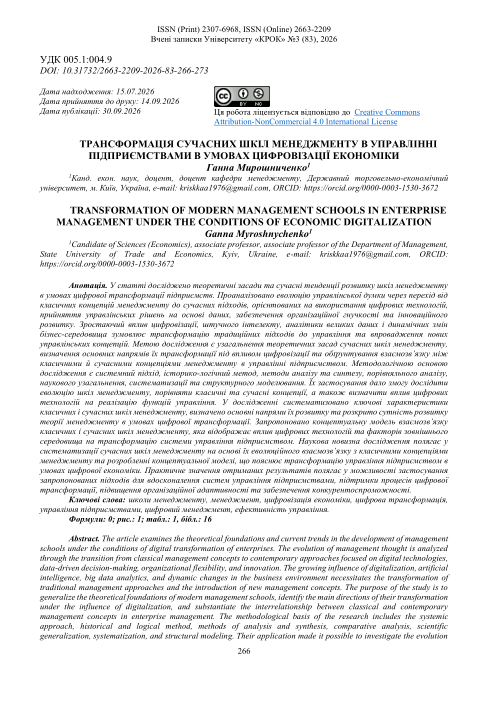
The article examines the theoretical foundations and current trends in the development of management schools under the conditions of digital transformation of enterprises. The evolution of management thought is analyzed through the transition from classical management concepts to contemporary approaches focused on digital technologies, data-driven decision-making, organizational flexibility, and innovation. The growing influence of digitalization, artificial intelligence, big data analytics, and dynamic changes in the business environment necessitates the transformation of traditional management approaches and the introduction of new management concepts. The purpose of the study is to generalize the theoretical foundations of modern management schools, identify the main directions of their transformation under the influence of digitalization, and substantiate the interrelationship between classical and contemporary management concepts in enterprise management. The methodological basis of the research includes the systemic approach, historical and logical method, methods of analysis and synthesis, comparative analysis, scientific generalization, systematization, and structural modeling. Their application made it possible to investigate the evolution of management schools, compare classical and contemporary concepts, and determine the impact of digital technologies on management functions. The study systematizes the key characteristics of classical and modern management schools, identifies the main directions of their development, and reveals the continuity of management theory under the conditions of digital transformation. A conceptual model of the interrelationship between classical and contemporary management schools is proposed, reflecting the influence of digital technologies and external environmental factors on the transformation of enterprise management. The scientific novelty of the research lies in the systematization of modern management schools based on their evolutionary relationship with classical management concepts and in the development of a conceptual model explaining the transformation of enterprise management in the digital economy. The practical significance of the obtained results is determined by the possibility of applying the proposed approaches to improve enterprise management systems, support digital transformation, and enhance organizational adaptability and competitiveness.
Downloads
References
Taylor F. W. (1911). The Principles of Scientific Management. New York: Harper & Brothers. 144 p.
Fayol H. (1916). Administration Industrielle et Générale. Paris: Dunod. 174 p.
Weber M. (1922). Economy and Society: An Outline of Interpretive Sociology. Berkeley: University of California Press. 1469 p.
Mayo E. (1933). The Human Problems of an Industrial Civilization. New York: Macmillan. 194 p.
Drucker P. F. (1973). Management: Tasks, Responsibilities, Practices. New York: Harper & Row. 839 p.
Ansoff H. I. (1965). Corporate Strategy. New York: McGraw-Hill. 241 p.
Porter M. E. (1980). Competitive Strategy: Techniques for Analyzing Industries and Competitors. New York: Free Press. 396 p.
Mintzberg H. (1994). The Rise and Fall of Strategic Planning. New York: Free Press. 458 p.
Han X., Hu Y., Wang L., Zhou R. (2024). Enterprise Digital Management: Research Review, Current Status and Prospects. Management System Engineering, 3(1). DOI: https://doi.org/10.1007/s44176-024-00032-z
Wessel L., Baiyere A., Ologeanu-Taddei R., Cha J., Jensen T. (2021). Unpacking the Difference Between Digital Transformation and IT-Enabled Organizational Transformation. Journal of the Association for Information Systems, 22(1), 102–129. DOI: https://doi.org/10.17705/1jais.00655
Naslund D., Kale R. (2020). Is Agile the Latest Management Fad? A Review of Success Factors of Agile Transformations. International Journal of Quality and Service Sciences, 12(4), 489-504. DOI: https://doi.org/10.1108/IJQSS-12-2019-0142
Dacre N. (2023). Agile Meets Digital: A Systematic Literature Review on the Interplay Between Agile Project Management and Digital Transformation. University of Southampton. URL: https://eprints.soton.ac.uk/476132/
Muhaemin M., Budiardjo E. K., Santoso H., Putra P. O. H. (2026). Agile Enterprise Architecture in the Context of Digital Transformation: A Critical Review. Journal of Online Informatics, 10(3). URL: https://joiv.org/index.php/joiv/article/viewFile/4666/1577
Костін І. Д. (2025). Аналіз ефективності використання Agile-методологій в управлінні цифровою трансформацією організацій. Наукові записки Львівського університету бізнесу та права. № 42. URL: https://nzlubp.org.ua/index.php/journal/article/view/1876
Muha R., Sedera D., Bui V. (2022). A Systematic Review of Digital Transformation Literature (2013–2021). arXiv. URL: https://arxiv.org/abs/2212.03867
OpenAI. (2025). ChatGPT (версія від 21 серпня 2025р.) Велика мовна модель. URL: https://chatgpt.com
Downloads
Published
How to Cite
Issue
Section
License

This work is licensed under a Creative Commons Attribution-NonCommercial 4.0 International License.