DIGITAL AND ECOLOGICAL TRANSFORMATION AS A FACTOR OF STRENGTHENING THE COMPETITIVE POSITIONS OF ENTERPRISES
DOI:
https://doi.org/10.31732/2663-2209-2026-83-225-232Keywords:
digital transformation, ecological transformation, integral assessment, ESG, sustainable development, strategic management, enterprise competitiveness, environmental certification, digital-ecological maturityAbstract
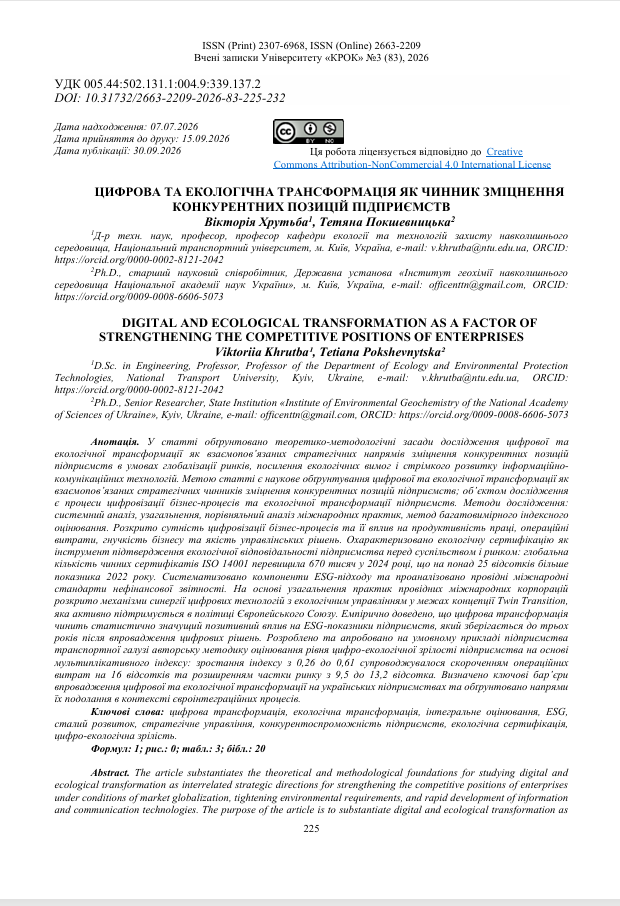
The article substantiates the theoretical and methodological foundations for studying digital and ecological transformation as interrelated strategic directions for strengthening the competitive positions of enterprises under conditions of market globalization, tightening environmental requirements, and rapid development of information and communication technologies. The purpose of the article is to substantiate digital and ecological transformation as interrelated strategic factors of enterprise competitiveness; the object of research is the processes of digitalization and ecological transformation of enterprises. Research methods: systemic analysis, generalization, comparative analysis of international practices, multidimensional index assessment. The essence of digitalization of business processes and its impact on productivity, operating costs, business flexibility, and managerial decision quality is revealed. Environmental certification is characterized: the global number of valid ISO 14001 certificates exceeded 670 thousand in 2024, more than 25 percent above the 2022 figure. ESG components and leading non-financial reporting standards are systematized. Based on international corporate practices, mechanisms of synergy between digital technologies and environmental management within the Twin Transition concept are revealed. It is empirically shown that digital transformation exerts a statistically significant positive effect on enterprise ESG performance, persisting up to three years after implementation. The author’s methodology for assessing digital-ecological maturity based on a multiplicative index is developed and tested on a conditional transport-sector enterprise example: growth of the index from 0.26 to 0.61 was accompanied by a 16 percent reduction in operating costs and market share growth from 9.5 to 13.2 percent. Key barriers to implementation at Ukrainian enterprises are identified and directions for overcoming them are substantiated.
Downloads
References
Будякова, О. Ю., Конченко, Д. Р. (2024). Сучасні тенденції визначення принципів ESG у корпоративному сталому розвитку. Науковий вісник Міжнародного гуманітарного університету, (60), 4–11. doi:10.32782/2413-2675/2024-60-1
Костенко, Ю. О., Пушкарь, І. В., Мельник, Ю. А. (2026). Інтеграція показників сталого розвитку ESG в систему управлінського обліку виробничих корпорацій. Актуальні питання економічних наук, (21). doi:10.5281/zenodo.19218823
Костякова, А. А. (2025). Перспективи та вплив впровадження звітності ESG на облік і звітність в Україні в контексті євроінтеграції. У Current issues of economics, accounting, finance, and law: theory and practice: матеріали міжнар. наук.-практ. конф. (с. 32–34). Scholarly Publisher ICSSH.
Костякова, А., Копоть, К. (2025). Корпоративне управління та сталий розвиток: теоретико-методологічні засади. Acta Academiae Beregsasiensis. Economics, (11), 114–125. doi:10.58423/2786-6742/2025-11-114-125
Лагодієнко, О. В. (2024). Впровадження корпоративних практик ESG: міжнародний досвід. Економічний простір, (193), 109–115. doi:10.30838/EP.193.109-115
Смєсова, В. Л., Чечель, Є. С. (2025). ESG-підхід як основа сталого розвитку міжнародних корпорацій. Економічний вісник Дніпровської політехніки, (4), 195–206. doi:10.33271/ebdut/92.195
European Commission. (2022). Directive (EU) 2022/2464 of the European Parliament and of the Council of 14 December 2022 as regards corporate sustainability reporting. Official Journal of the European Union, L 322.
European Commission. (2023a). Commission Delegated Regulation (EU) 2023/2772 supplementing Directive 2013/34/EU as regards European Sustainability Reporting Standards. Official Journal of the EU, L 321.
European Commission. (2023b). A Green Industrial Plan for the Net-Zero Age. COM(2023) 62 final.
European Environment Agency. (2025). Navigating Europe’s twin transition: Opportunities and challenges of digitalisation in the green transition. EEA Publications.
GRI. (2023). GRI Universal Standards 2021 (effective for reporting from 1 January 2023). Global Reporting Initiative.
Harvard Law School Forum on Corporate Governance. (2025). CEO and C-suite ESG priorities for 2025.
Hummel, K. (2024). An overview of corporate sustainability reporting. Taylor & Francis. doi:10.1080/17449480.2024.2312145
IFRS Foundation. (2023a). IFRS S1 – General requirements for disclosure of sustainability-related financial information.
IFRS Foundation. (2023b). IFRS S2 – Climate-related disclosures.
ISO. (2025). The ISO Survey 2024. International Organization for Standardization.
Jian, Z., Guanghua, X., & Xiaodong, L. (2025). Intersection of ESG performance and corporate innovation: A perspective of vertical linkages within the industrial chain. Frontiers in Sustainability, 6, Article 1642317. doi:10.3389/frsus.2025.1642317
Li, J., Ding, N., Park, S. B., & Zhang, Z. (2025). How does digital transformation impact ESG performance in uncertain environments? Sustainability, 17(10), Article 4597. doi:10.3390/su17104597
OECD. (2025). Behind ESG ratings: Unpacking sustainability metrics. OECD Publishing.
TNFD. (2023). TNFD recommendations v1.0. Taskforce on Nature-related Financial Disclosures.
Downloads
Published
How to Cite
Issue
Section
License

This work is licensed under a Creative Commons Attribution-NonCommercial 4.0 International License.