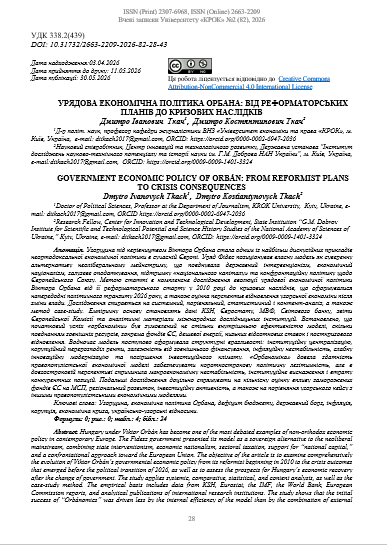
УРЯДОВА ЕКОНОМІЧНА ПОЛІТИКА ОРБАНА: ВІД РЕФОРМАТОРСЬКИХ ПЛАНІВ ДО КРИЗОВИХ НАСЛІДКІВ
DOI:
https://doi.org/10.31732/2663-2209-2026-82-28-43Ключові слова:
Угорщина, економічна політика Орбана, дефіцит бюджету, державний борг, інфляція, корупція, економічна криза, українсько-угорські відносиниАнотація
Угорщина під керівництвом Віктора Орбана стала одним із найбільш дискусійних прикладів неортодоксальної економічної політики в сучасній Європі. Уряд Фідес позиціонував власну модель як суверенну альтернативу неоліберальному мейнстриму, що поєднувала державний інтервенціонізм, економічний націоналізм, галузеве оподаткування, підтримку «національного капіталу» та конфронтаційну політику щодо Європейського Союзу. Метою статті є комплексне дослідження еволюції урядової економічної політики Віктора Орбана від її реформаторського старту у 2010 році до кризових наслідків, що сформувалися напередодні політичного транзиту 2026 року, а також оцінка перспектив відновлення угорської економіки після зміни влади. Дослідження спирається на системний, порівняльний, статистичний і контент-аналіз, а також метод case-study. Емпіричну основу становлять дані KSH, Євростату, МВФ, Світового банку, звіти Європейської Комісії та аналітичні матеріали міжнародних дослідницьких інституцій. Встановлено, що початковий успіх «орбаноміки» був зумовлений не стільки внутрішньою ефективністю моделі, скільки поєднанням зовнішніх ресурсів, зокрема фондів ЄС, дешевої енергії, низьких відсоткових ставок і посткризового відновлення. Водночас модель поступово сформувала структурні вразливості: інституційну централізацію, корупційний перерозподіл ренти, залежність від зовнішнього фінансування, інфляційну нестабільність, слабку інноваційну модернізацію та погіршення інвестиційного клімату. «Орбаноміка» довела здатність правопопулістської економічної моделі забезпечувати короткострокову політичну легітимність, але в довгостроковій перспективі спричинила макроекономічну нестабільність, інституційне виснаження і втрату конкурентних позицій. Подальші дослідження доцільно спрямувати на кількісну оцінку впливу заморожених фондів ЄС на МСП, регіональний розвиток, інвестиційну активність, а також на порівняння угорського кейсу з іншими правопопулістськими економічними моделями.
Завантаження
Посилання
Ágh, A. (2016). The decline of democracy in East-Central Europe: Hungary as the worst-case scenario. Problems of Post-Communism, 63(5–6), 261–274. https://www.researchgate.net/publication/290473837_The_Decline_of_Democracy_in_East-Central_Europe
Balkan Insight. (2025). Hungary’s “Eastern Opening” could be slammed shut by Trump. https://balkaninsight.com/
Centre for Eastern Studies. (2026, March 20). Stable stagnation: Hungary’s economic standing after 16 years of Orbán’s rule. OSW Commentary. https://www.osw.waw.pl/en/publikacje/osw-commentary/2026-03-20/stable-stagnation-hungarys-economic-standing-after-16-years
Centre for European Policy Studies. (2026). Orbán’s defeat opens the door to EU funds and to smarter rule of law conditionality. CEPS Policy Insights. https://www.ceps.eu/orbans-defeat-opens-the-door-to-eu-funds-and-to-smarter-rule-of-law-conditionality/
Derzhavna sluzhba statystyky Ukrainy. (2024). Zovnishnia torhivlia tovaramy Ukrainy, 2022–2023 [Foreign trade in goods of Ukraine, 2022–2023]. https://www.ukrstat.gov.ua
European Commission. (2024). European Rule of Law Mechanism: Input from Hungary for the 2024 Rule of Law Report. https://surl.li/bkkjsj
Eurostat. (2025, October 17). Annual inflation up to 2.2% in the euro area. https://ec.europa.eu/eurostat/web/products-euro-indicators/w/2-17102025-ap
Fitch Ratings. (2026). Major fiscal challenges ahead for Hungary’s incoming Tisza government. Intellinews. https://www.intellinews.com/major-fiscal-challenges-ahead-for-hungary-s-incoming-tisza-government-437399
GKI Economic Research Co. (2025, May 8). Without EU funds, Hungary’s economy would struggle to stay afloat. https://gki.hu/language/en/2025/05/08/without-eu-funds-hungarys-economy-would-struggle-to-stay-afloat/
Helme, P. (2026, April 14). The €35 billion Hungary lost while Orbán picked fights with Brussels. Euromaidan Press. https://euromaidanpress.com/2026/04/14/hungary-frozen-eu-funds-35-billion-explained-2026/
Hirnyk, K. (2026). Vybory v Uhorshchyni: Putin i Tramp prohraly, ale dlia Ukrainy ne vse tak pozytyvno, Politico [Elections in Hungary: Putin and Trump lost, but not everything is so positive for Ukraine, Politico]. UNIAN. https://www.unian.ua/world/vibori-v-ugorshchini-2026-roku-politico-nazvalo-golovnih-peremozhciv-ta-peremozhenih-13346979.html
Holzner, M. (2026). The illiberal economy: The long-term development of the Hungarian economy under Viktor Orbán(wiiw Policy Note / Policy Report No. 107). Vienna Institute for International Economic Studies. https://wiiw.ac.at/the-illiberal-economy-the-long-term-development-of-the-hungarian-economy-under-viktor-orban-ps-25.html
International Monetary Fund. (2025). World Economic Outlook database, April 2025. https://www.imf.org/en/publications/weo/weo-database/2025/april
Jones, M., & Szakacs, G. (2026, April 9). Analysis: Investors position for a post-Orban Hungary. Reuters. https://uk.finance.yahoo.com/news/analysis-investors-position-post-orban-060117048.html
Kasiian, V. (2025). Ekonomika Uhorshchyny v stahnatsii za piv roku do vyboriv: Zrostannia maizhe nemaie [Hungary’s economy is stagnating six months before the elections: There is almost no growth]. Liga.net. https://finance.liga.net/ua/ekonomika/news/ekonomika-uhorshchyny-v-stahnatsii-za-piv-roku-do-vyboriv-zrostannia-mayzhe-nemaie
KSH. (2024). Annual inflation data, 2022–2023. Hungarian Central Statistical Office. https://www.ksh.hu/?lang=en
KSH. (2025). Gross domestic product: Quarterly data, 2024. Hungarian Central Statistical Office. https://www.ksh.hu/?lang=en
Minfin. (2026, March 14). Ekonomika pered vyboramy: Rizke znetsinennia forynta ta “orban-premiia” [Economy before the elections: Sharp depreciation of the forint and the “Orban premium”]. https://minfin.com.ua/ua/2026/03/14/169953498/
Misetics, B. (2024). Orbán’s centaur state. Foundation for European Progressive Studies. https://feps-europe.eu/orbans-centaur-state/
OECD. (2025). International Migration Outlook 2025: Hungary. https://www.oecd.org/en/publications/international-migration-outlook-2025_ae26c893-en/full-report/hungary_0717facf.html
Ratushnyi, D. M. (2024). Politychnyi rezhym Uhorshchyny: Vid partokratii do elektoralnoi avtokratii ta orhanizovanoi kleptokratii [Hungary’s political regime: From partyocracy to electoral autocracy and organized kleptocracy]. Politychne zhyttia, 2, 119–126. https://doi.org/10.31558/2519-2949.2024.2.15
Ruy, D., & Friedman, A. (2026). Hungary after Orbán: The hard road back to democracy. Center for Strategic and International Studies. https://www.csis.org/
Suss, J. (2026, April 13). Orbánomics has failed: Hungarian economy lagging, corruption rampant. Financial Times.
Szalma, I., & Herke, B. (2025). Interconnections between anti-immigration and pronatalist family policy discourse in Hungary. HUN-REN Centre for Social Sciences. https://szociologia.tk.elte.hu/hu/szalma-i-herke-b-2025-interconnections-between-anti-immigration-and-pronatalist-family-policy-discourse-in-hungary
Downloads
Опубліковано
Як цитувати
Номер
Розділ
Ліцензія

Ця робота ліцензується відповідно до Creative Commons Attribution-NonCommercial 4.0 International License.