PROFESSIONAL PARADIGM AND THE “SELF-CONCEPT” OF A CAREER CONSULTANT IN THE CONTEXT OF GENERATION ALPHA’S DEMANDS
DOI:
https://doi.org/10.31732/2663-2209-2026-82-175-187Keywords:
career counseling, coaching, self-concept, Generation Alpha, professional identity, self-determination, facilitation, entrepreneurshipAbstract
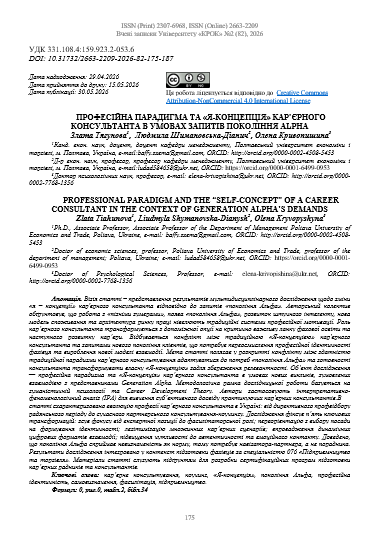
The article presents the results of a multidisciplinary study examining the transformation of the career consultant’s “self-concept” in response to the demands of Generation Alpha, against the backdrop of shifting consumption paradigms, the transition to a service-based economy, and global digitalization. The authors argue that the emergence of Generation Alpha, the rapid development of artificial intelligence, new consumption models, and the evolving architecture of the labor market are eroding traditional systems of professional motivation. Under these conditions, the role of the career consultant is transforming from a supplementary service into a critically important component of professional education and subsequent career development. The core problem lies in the mismatch between the traditional “self-concept” of the career consultant and the specific expectations of a new generation of clients, which necessitates a rethinking of professional identity and the development of new interaction models. The purpose of the article is to examine the tension between the capacity of the traditional paradigm of career counseling to adapt to the needs of Generation Alpha and the readiness of the consultant to transform their own “self-concept” in order to remain relevant. The object of the study is the professional paradigm and the “self-concept” of the career consultant in the context of interaction with representatives of Generation Alpha. The methodological framework is grounded in humanistic psychology and Career Development Theory. The study employs Interpretative Phenomenological Analysis (IPA) to explore the subjective experiences of 15 practicing career consultants. The sample was formed through purposive sampling, and data were collected via semi-structured in-depth interviews. The article briefly outlines the evolution of the career counseling profession in Ukraine, from directive vocational selection in the Soviet period to contemporary partnership-based counseling and coaching practices. The findings identify five key transformations: a shift from an expert role to a facilitative one; a reorientation from job selection to identity formation; the legitimization of multiple career trajectories; the adoption of dynamic digital interaction formats; and increased sensitivity to authenticity and emotional engagement. It is demonstrated that Generation Alpha perceives uncertainty as a norm and therefore requires a partner-navigator rather than a directive advisor. The results are integrated into the context of training specialists in Major 076 “Entrepreneurship and Trade”. The authors propose shifting the focus from selecting a specific position to developing meta-competencies, including entrepreneurial thinking, financial literacy, and adaptability in conditions of risk. The findings provide a foundation for the development of certification programs for career advisors and consultants.
Downloads
References
Барчі, В. (2023). Career orientation of a personality: Theoretical aspects. Вісник Національного університету оборони України, 1(71), 25–31. https://doi.org/10.33099/2617-6858-2023-71-1-25-31
Бех, І. Д. (2003). Виховання особистості (у 2 кн.). Київ: Либідь.
Комарницький, І. М., & Церклевич, В. С. (2020). Персонал-технологія коучингу в системі особистісно-професійного розвитку менеджерів ресторанного бізнесу. Інтернаука. Серія: Економічні науки, 10. https://doi.org/10.25313/2520-2294-2020-10-6380
Міщенко, М., & Шаповалюк, К. (2021). Становлення та розвиток профорієнтаційної роботи в Україні. Психологічний журнал. https://doi.org/10.31499/2617-2100.7.2021.234582
Никоненко, О., & Данкович, Н. (2024). Вплив кар’єрного коучингу на розвиток мотивації до успіху працівників. Вчені записки Університету «КРОК», 3(75), 259–268. https://doi.org/10.31732/2663-2209-2024-75-259-268
Тягунова, З. О., & Білінська, О. П. (2024). Сучасні підходи до віртуального бізнес-коучингу. Ефективна економіка, 11. https://doi.org/10.32702/2307-2105.2024.11.68
Хоружа, Л., Братко, М., & Гриневич, Л. (2024). Innovative trends in vocational teacher education: A career counselor for the New Ukrainian School. Continuing Professional Education: Theory and Practice, 3. https://doi.org/10.28925/2412-0774.2024.3.3
Шимановська-Діанич, Л., Лозова, О., & Коломієць, Б. (2025). Формування безпекоорієнтованого менеджменту сучасних закладів освіти на ґрунті використання нейроменеджменту як міждисциплінарного підходу. Вісник НТУ «ХПІ» (економічні науки), 2, 60–65. https://doi.org/10.20998/2519-4461.2025.2.60
Bandura, A. (1986). Social foundations of thought and action. Englewood Cliffs, NJ: Prentice-Hall. https://archive.org/details/socialfoundation00band
Brown, S. D., & Lent, R. W. (Eds.). (2013). Career development and counseling: Putting theory and research to work (2nd ed.). Hoboken, NJ: Wiley. https://www.wiley.com/en-us/Career+Development+and+Counseling%3A+Putting+Theory+and+Research+to+Work%2C+2nd+Edition-p-9781118063344
Guichard, J. (2005). Self-constructing. Journal of Vocational Behavior, 66(1), 1–13. https://doi.org/10.1016/j.jvb.2004.11.004
Guichard, J. (2009). Self-constructing. Journal of Vocational Behavior, 75(3), 251–258. https://www.sciencedirect.com/science/article/pii/S0001879109000615
Hirschi, A. (2012). The career resources model: An integrative framework for career counsellors. British Journal of Guidance & Counselling, 40(4), 369–383. https://www.tandfonline.com/doi/abs/10.1080/03069885.2012.700506
Holland, J. L. (1997). Making vocational choices: A theory of vocational personalities and work environments (3rd ed.). Odessa, FL: Psychological Assessment Resources. https://www.parinc.com/products/pkey/222
International Coach Federation. (2020). ICF core competencies. https://coachingfederation.org
Maslow, A. H. (1954). Motivation and personality. New York, NY: Harper & Row. https://archive.org/details/motivationperson00masl
Parsons, F. (1909). Choosing a vocation. Boston, MA: Houghton Mifflin. https://archive.org/details/choosingvocation00parsuoft
Porfeli, E. J., & Savickas, M. L. (2012). Career adapt-abilities scale (CAAS): Construction and validation. Journal of Vocational Behavior, 80(3), 661–673. https://doi.org/10.1016/j.jvb.2011.10.004
Savickas, M. L. (2013). The theory and practice of career construction. У S. D. Brown & R. W. Lent (Eds.), Career development and counseling (pp. 147–183). Hoboken, NJ: Wiley. https://onlinelibrary.wiley.com/doi/book/10.1002/9781118521370
Super, D. E. (1990). A life-span, life-space approach to career development. у D. Brown & L. Brooks (Eds.), Career choice and development (pp. 197–261). San Francisco, CA: Jossey-Bass. https://archive.org/details/careerchoicedeve0000unse
World Bank Open Data. World Development Indicators. Retrieved May 2026 https://data.worldbank.orghttps://data.worldbank.org
Young, R. A., & Valach, L. (2004). The construction of career through goal-directed action. Journal of Vocational Behavior, 64(3), 499–514. https://doi.org/10.1016/j.jvb.2003.12.012
Downloads
Published
How to Cite
Issue
Section
License

This work is licensed under a Creative Commons Attribution-NonCommercial 4.0 International License.