RISK MANAGEMENT METHODS IN SUPPLY CHAINS WITHIN THE ENTERPRISE CATEGORY MANAGEMENT SYSTEM
DOI:
https://doi.org/10.31732/2663-2209-2026-81-216-221Keywords:
risk management, supply chains, category management, supply risks, product category management, suppliers, logistics risks, risk management modelAbstract
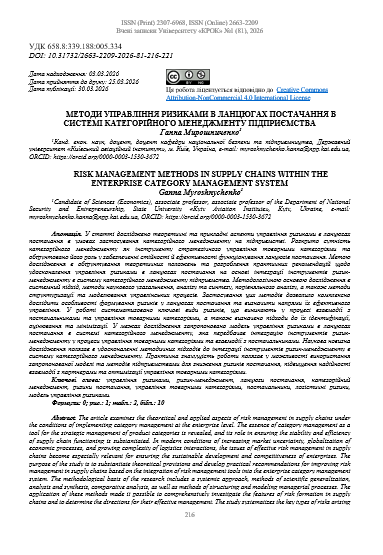
The article examines the theoretical and applied aspects of risk management in supply chains under the conditions of implementing category management at the enterprise level. The essence of category management as a tool for the strategic management of product categories is revealed, and its role in ensuring the stability and efficiency of supply chain functioning is substantiated. In modern conditions of increasing market uncertainty, globalization of economic processes, and growing complexity of logistics interactions, the issues of effective risk management in supply chains become especially relevant for ensuring the sustainable development and competitiveness of enterprises. The purpose of the study is to substantiate theoretical provisions and develop practical recommendations for improving risk management in supply chains based on the integration of risk management tools into the enterprise category management system. The methodological basis of the research includes a systemic approach, methods of scientific generalization, analysis and synthesis, comparative analysis, as well as methods of structuring and modeling managerial processes. The application of these methods made it possible to comprehensively investigate the features of risk formation in supply chains and to determine the directions for their effective management. The study systematizes the key types of risks arising in the process of interaction with suppliers and product category management, and also identifies approaches to their identification, assessment, and minimization. Within the framework of the research, a model of risk management in supply chains within the category management system is proposed. The model involves the integration of risk management tools into the processes of product category management and supplier interaction. The scientific novelty of the research lies in improving methodological approaches to integrating risk management tools into the category management system. The practical significance of the study is determined by the possibility of using the proposed model and methods by enterprises to reduce supply risks, increase the reliability of cooperation with partners, and optimize the management of product categories.
Downloads
References
Sharifi M. S., Naimzad A. A (2026). Systematic Literature Review on Supply Chain Risk Management. Journal of Social Sciences and Humanities. Vol. 3, No. 1. DOI: https://doi.org/10.62810/jssh.v3i1.134
Kharsun, L., Kavun-Moshkovska, O., Kotova, M., & Nechyporuk, A. (2022). Adaptation of risk management in the supply chains of e-commerce enterprises under the conditions of political instability . Eastern-European Journal of Enterprise Technologies, 5(13 (119), 6–20. DOI: https://doi.org/10.15587/1729-4061.2022.265649
Демченко Г. В. (2024) Стратегічне управління ризиками у глобальних ланцюгах постачання в умовах нестабільного середовища Проблеми і перспективи розвитку підприємництва : збірник наукових праць Харківського національного автомобільно-дорожнього університету. № 2 (33). C. 38- 50. URL: https://repository.hneu.edu.ua/jspui/bitstream/123456789/34851/1/Демченко_оформл.pdf
Khaleghi, M., Sheykhivand, S., Khaleghi, N., & Danishvar, S. (2026). An Intelligent Multi-Task Supply Chain Model Based on Bio-Inspired Networks. Biomimetics, 11(2), 123. https://doi.org/10.3390/biomimetics11020123
Christopher M.(2016) Logistics and Supply Chain Management. 5th ed. London: Pearson Education. 328 p.
Chopra S., Meindl P. (2019). Supply Chain Management: Strategy, Planning, and Operation. 7th ed. Boston: Pearson Education. 528 p.
Tang, C. S. (2006). Perspectives in Supply Chain Risk Management. International Journal of Production Economics, 103, 451-488. DOI: http://dx.doi.org/10.1016/j.ijpe.2005.12.006
Berman B., Evans J. (2008). Retail Management: A Strategic Approach. 13th ed. Boston: Pearson Education. 682 p. URL: https://books.google.com.ua/books/about/Retail_Management.html?id=vVPIQgAACAAJ&redir_esc=y
Скіцько В. І. (2018) Управління ризиками в ланцюгу поставок Бізнес Інформ № 2. С. 304-313. URL: http://nbuv.gov.ua/UJRN/binf_2018_2_45
Fernie J., Sparks L.(2018) Logistics and Retail Management: Emerging Issues and New Challenges in the Retail Supply Chain. 5th ed. London: Kogan Page. 320 p.
Downloads
Published
How to Cite
Issue
Section
License

This work is licensed under a Creative Commons Attribution-NonCommercial 4.0 International License.