PTSD IN COMBATANTS WHO HAVE BEEN IN THE COMBAT ZONE FOR A LONG TIME: A RETROSPECTIVE ANALYSIS OF THE SOCIAL AND PSYCHOLOGICAL ASPECTS OF THE PROBLEM
DOI:
https://doi.org/10.31732/2663-2209-2025-80-403-413Keywords:
combatant, post-traumatic stress disorder,, combat stress, social isolation,, psychosocial support,, Afghan syndrome, psychological rehabilitation,Abstract
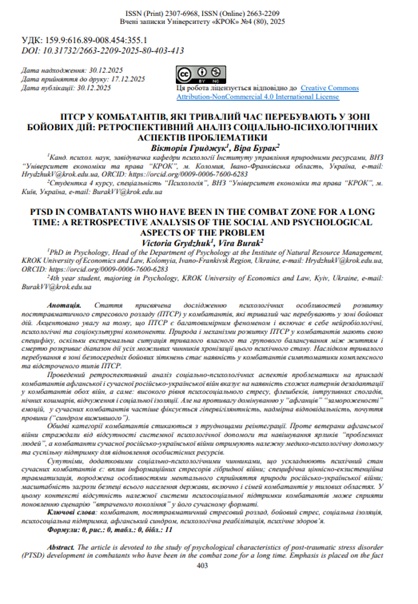
The article is devoted to the study of psychological characteristics of post-traumatic stress disorder (PTSD) development in combatants who have been in the combat zone for a long time. Emphasis is placed on the fact that PTSD is a multidimensional phenomenon and includes neurobiological, psychological, and sociocultural components.The nature and mechanisms of PTSD development in combatants are specific, since extreme situations involving prolonged individual and group balancing between life and death reveal the range of action of all possible factors contributing to the chronicity of this mental state. Prolonged exposure to direct combat results in combatants developing symptoms of complex and delayed PTSD.
A retrospective analysis of the socio-psychological aspects of the issue, using the example of combatants in the Afghan and modern Russian-Ukrainian wars, indicates the presence of similar patterns of maladjustment in combatants of both wars, namely: high levels of psychosocial stress, flashbacks, intrusive memories, nightmares, alienation, and social isolation. However, in contrast to the dominance of emotional “freezing” among “Afghans,” modern combatants more often exhibit hypervigilance, excessive responsibility, and feelings of guilt (“survivor syndrome”).
Both categories of combatants face difficulties in reintegration. However, veterans of the Afghan war suffered from a lack of systematic psychological assistance and were labeled as “problem people,” while combatants in the current Russian-Ukrainian war receive adequate medical and psychological assistance and public support to restore their personal resources.
Additional socio-psychological factors that complicate the mental state of modern combatants include: the impact of information stressors of hybrid warfare; specific value-existential trauma caused by the peculiarities of mental perception of the nature of the Russian-Ukrainian war; the scale of the threat to the security of the entire population of the state, including the families of combatants in the rear areas. In this context, the lack of an adequate system of psychosocial support for combatants may contribute to the recurrence of the “lost generation” scenario in its current form.
Downloads
References
Дьяків, О. (2022). Психологічна допомога військовим із ПТСР: вітчизняний досвід. Актуальні проблеми психології, 4(56), 112–120.
Іванова, Н. (2021). Особливості психотерапевтичної допомоги учасникам бойових дій з ПТСР в Україні. Актуальні проблеми психології: збірник наукових праць Інституту психології імені Г. С. Костюка НАПН України, Т. 12, 45, 201–213.
Сингаївська, І., & Сокур, І. (2025). Психологічна реабілітація воїнів після повернення у цивільне життя. Вчені записки Університету «КРОК», 3(79), 421–428. https://doi.org/10.31732/2663-2209-2025-79-421-428
Шестопалова, Л., & Лісовенко, Л. (2018). Психологічні наслідки бойових дій: досвід України та міжнародні підходи. Психологічний журнал, (4), 38–47.
Юр’єва, Л., Носов, С., Мамчук, О., Николенко, О., Огоренко, В., Дукельський, О., Шустерман, Т., & Єрчакова, Н. (2017). Діагностика, корекція і профілактика кризових станів в учасників воєнних конфліктів. Київ. 204.
Bisson, J., Cosgrove, S., Lewis, C., & Roberts, N. (2015). Post-traumatic stress disorder. BMJ, 351, h6161. Retrieved from: https://doi.org/10.1136/bmj.h6161.
Hoge, C., Auchterlonie, J., & Milliken, C. (2006). Mental Health Problems, Use of Mental Health Services, and Attrition From Military Service After Returning From Deployment to Iraq or Afghanistan. JAMA, 295(9), 1023–1032. Retrieved from: https://doi.org/10.1136/bmj.h6161?utm_source=chatgpt.com.
Kessler, R., Sonnega, A., Bromet, E., Hughes, M., & Nelson, C. (1995). Posttraumatic stress disorder in the National Comorbidity Survey. Archives of General Psychiatry, 52(12), 1048–1060. Retrieved from: https://doi.org/10.1001/jama.295.9.1023?utm_source=chatgpt.com.
Yehuda, R., & McFarlane, A. (1995). Conflict between current knowledge about posttraumatic stress disorder and its original conceptual basis. American Journal of Psychiatry, 152(12), 1705–1713. Retrieved from: https://doi.org/10.1176/ajp.152.12.1705.
Koenen, K., Ratanatharathorn, A., McLaughlin, K., Bromet, E., Stein, D., & Kessler, R. (2017). Posttraumatic stress disorder in the World Mental Health Surveys. Psychological Medicine, 47(13), 2260–2274. Retrieved from: https://doi.org/10.1017/S0033291717000708.
Van der Kolk, B. (2014). The Body Keeps the Score: Brain, Mind, and Body in the Healing of Trauma. New York: Viking.
Downloads
Published
How to Cite
Issue
Section
License

This work is licensed under a Creative Commons Attribution-NonCommercial 4.0 International License.