THE USE OF COPING STRATEGIES BY YOUNG WOMEN DURING WAR: SOCIO-DEMOGRAPHIC CHARACTERISTICS
DOI:
https://doi.org/10.31732/2663-2209-2025-80-447-452Keywords:
young women, coping strategies, adaptive coping, conditionally adaptive coping, maladaptive coping, socio-demographic characteristicsAbstract
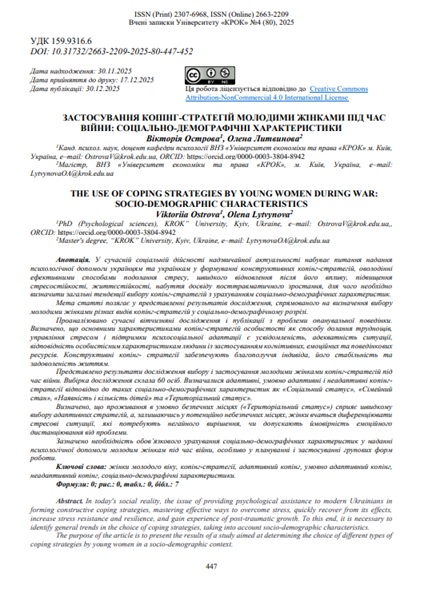
In today's social reality, the issue of providing psychological assistance to modern Ukrainians in forming constructive coping strategies, mastering effective ways to overcome stress, quickly recover from its effects, increase stress resistance and resilience, and gain experience of post-traumatic growth. To this end, it is necessary to identify general trends in the choice of coping strategies, taking into account socio-demographic characteristics.
The purpose of the article is to present the results of a study aimed at determining the choice of different types of coping strategies by young women in a socio-demographic context.
Contemporary domestic studies and publications on the problem of coping behavior are analyzed. It has been determined that the main characteristics of personal coping strategies as a way of overcoming difficulties, managing stress, and supporting psychosocial adaptation are awareness, adequacy to the situation, and correspondence to personal characteristics with the use of cognitive, emotional, and behavioral resources. Constructive coping strategies ensure the well-being of the individual, their stability, and satisfaction with life.
The results of a study on the choice and application of coping strategies by young women during the war are presented. The study sample consisted of 60 people. Adaptive, conditionally adaptive, and maladaptive coping strategies were identified according to such socio-demographic characteristics as “social status,” “marital status,” “presence and number of children,” and “territorial status.”
It has been determined that living in relatively safe places (“Territorial Status”) contributes to the rapid selection of adaptive strategies, while remaining in potentially dangerous places, women learn to differentiate between stressful situations that require immediate resolution and those that allow for emotional distancing from the problem.
The need to take socio-demographic characteristics into account when providing psychological assistance to young women during wartime, especially when planning and implementing group work, has been noted.
Downloads
References
Андрущенко, І. Г. (2018). Психологічні особливості впливу копінг-стратегій на саморозвиток особистості юнацького віку. Наукові записки Національного університету «Острозька академія». Серія «Психологія» : збірник наукових праць. 6, 4–8.
Волошок, О.В., & Прус, С.Р. (2021). Поведінкові прояви копінг-стратегій у осіб юнацького віку. Молодий вчений, 1, 146–151.
Гуляс, І. А. (2015). Копінг-стратегії у контексті життєвих досягнень особистості. Scienceand Education a New Dimension. Pedagogy and Psychology, 40, 72–75.
Дубчак, Г. М. (2016). Аналіз стратегій копінг-поведінки майбутніх фахівців соціономічних професій. Науковий вісник Херсонського державного університету. Серія «Психологічні науки», 1(2), 28–39.
Кривошей, К. Ю., Бужинська, С. М., & Міхалець, І. В. (2023). Копінг-стратегії особистості як чинники стресостійкості в людей дорослого віку під час війни. Габітус, 51, 153–157.
Оксютович, М., & Мельничук, Д. (2023). Конструктивні стратегії поведінки особистості у психогенних кризових ситуаціях. Вчені записки Університету «КРОК», 1(69), 253–260.
Сингаївська, І., & Страмоусова, І. (2024). Чинники життєстійкості жінок під час війни. Вчені записки Університету «КРОК», 3(75), 231–245.
Downloads
Published
How to Cite
Issue
Section
License

This work is licensed under a Creative Commons Attribution-NonCommercial 4.0 International License.