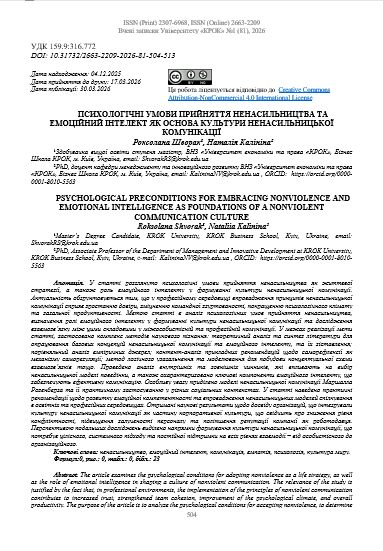
ПСИХОЛОГІЧНІ УМОВИ ПРИЙНЯТТЯ НЕНАСИЛЬНИЦТВА ТА ЕМОЦІЙНИЙ ІНТЕЛЕКТ ЯК ОСНОВА КУЛЬТУРИ НЕНАСИЛЬНИЦБКОЇ КОМУНІКАЦІЇ
DOI:
https://doi.org/10.31732/2663-2209-2026-81-504-513Ключові слова:
ненасильництво, емоційний інтелект, комунікація, емпатія, психологія, культура мируАнотація
У статті розглянуто психологічні умови прийняття ненасильництва як життєвої стратегії, а також роль емоційного інтелекту у формуванні культури ненасильницької комунікації. Актуальність обгрунтовується тим, що у професійному середовищі впровадження принципів ненасильницької комунікації сприяє зростанню довіри, зміцненню командної згуртованості, покращенню психологічного клімату та загальної продуктивності. Метою статті є аналіз психологічних умов прийняття ненасильництва, визначення ролі емоційного інтелекту у формуванні культури ненасильницької комунікації та дослідження взаємозв’язку між цими складовими у міжособистісній та професійній комунікації. У межах реалізації мети статті, застосовано комплекс методів наукового пізнання: теоретичний аналіз та синтез літератури для опрацювання базових концепцій ненасильницької комунікації та емоційного інтелекту, та їх зіставлення; порівняльний аналіз емпіричних джерел; контент-аналіз прикладних рекомендацій щодо саморефлексії як механізму саморегуляції; метод логічного узагальнення та моделювання для побудови концептуальної схеми взаємозв’язків тощо. Проведено аналіз внутрішніх та зовнішніх чинників, які впливають на вибір ненасильницької моделі поведінки, а також охарактеризовано ключові компоненти емоційного інтелекту, що забезпечують ефективну комунікацію. Особливу увагу приділено моделі ненасильницької комунікації Маршалла Розенберга та її практичному застосуванню у різних соціальних контекстах. У статті наведено практичні рекомендації щодо розвитку емоційної компетентності та впровадження ненасильницьких моделей спілкування в освітніх та професійних середовищах. Отримані наукові результати щодо досвіду організацій, що інтегрували культуру ненасильницької комунікації як частину корпоративної культури, що свідчить про зниження рівня конфліктності, підвищення залученості персоналу та поліпшення репутації компанії як роботодавця. Перспективою подальших досліджень виділено напрямки формування культури ненасильницької комунікації, що потребує цілісного, системного підходу та постійної підтримки на всіх рівнях взаємодії – від особистісного до організаційного.
Завантаження
Посилання
Внутрішня мотивація: що це таке. (2025). Український психологічний ХАБ. https://www.psykholoh.com/post/внутрішня-мотивація-це
Емпатія як ключ до здорових відносин. (2025) HowAreU. https://howareu.com/materials/empatiia-iak-kliuch-do-zdorovykh-vidnosyn
Николенко, О. (2020) Що таке емпатія та як навчитися чуйності у важкі часи. Suspilne Media. https://suspilne.media/23111-so-take-empatia-ta-ak-navcitis-cujnosti-u-vazki-casi
Чайка, Г. В. (2025) Толерантність до невизначеності як особистісний ресурс: огляд найсучасніших досліджень. Вчені записки ТНУ ім. В. І. Вернадського. Серія: Психологія. Том 36(75), 3. https://psych.vernadskyjournals.in.ua/journal/3_2025/10.pdf
Arnera, James & Boldi, Marc-Olivier & Cherubini, Mauro. (2022). Contemporary self-reflective practices: A large-scale survey. Acta Psychologica. 230. 103768. 10.1016/j.actpsy.2022.103768.
Carden, S., et al. (2022). Conducting daily self-reflection can deepen your self-awareness. PositivePsychology.com. https://positivepsychology.com/introspection-self-reflection
Connor, J., & Wentworth, R. (2012). The communication effectiveness of nonviolent communication within organizations. International Journal of Business Communication. https://doi.org/10.1177/0021943612446933
Day One App. (2022). Self-reflection exercises: Set aside 15–30 minutes each day for quiet introspection. Day One Blog. https://dayoneapp.com/blog/self-reflection
Emotional Intelligence Statistics. (2024). Jobera. https://jobera.com/emotional-intelligence-statistics
Fernández-Abascal, E. G., & Martín-Díaz, M. D. (2019). Relations between emotional intelligence, empathy and non-verbal sensitivity. Frontiers in Psychology, 10, Article 1066. https://doi.org/10.3389/fpsyg.2019.01066
Goleman, D. (2018). Emotional intelligence. KM-Books.
Martins, A., Ramalho, N., & Morin, E. (2010). A comprehensive meta-analysis of emotional intelligence and job performance. Journal of Organizational Behavior. https://pmc.ncbi.nlm.nih.gov/articles/PMC12111255
Mavroveli, S., & Sánchez-Ruiz, M. J. (2011). Trait emotional intelligence influences on academic achievement and peer relations. British Journal of Educational Psychology, 81(1), 112–134. https://pmc.ncbi.nlm.nih.gov/articles/PMC4361820
Mindeguia, R., Aritzeta, A., Garmendia, A., & Olarza, A. (2025). From intention to perception: Emotional processes as a link between intended and perceived leadership styles. Frontiers in Psychology, 16, Article 1526797. https://doi.org/10.3389/fpsyg.2025.1526797
Petrides, K. V., et al. (2022). Trait emotional intelligence and personality. Personality and Individual Differences. https://doi.org/10.1016/j.paid.2022.111795
Rosenberg, M. B. (2015). Nonviolent communication: A language of life (3rd ed.). PuddleDancer Press.
Schutte, N. S., et al. (2017). Emotional intelligence and interpersonal relations. TarjomeFa. https://tarjomefa.com/wp-content/uploads/2017/08/7591-English-TarjomeFa.pdf
Schutte, N. S., Malouff, J. M., Bobik, C., et al. (2007). Emotional intelligence and interpersonal relations. The Journal of Social Psychology, 147(1), 41–59. https://doi.org/10.3200/SOCP.147.1.41-59
Silva, C., et al. (2023). Emotional intelligence and life satisfaction in victims and non-victims of violence. Med. Sci. Forum, 22(1), 47; https://doi.org/10.3390/msf2023022047
Statistics About Emotional Intelligence. (2025). Luxwisp. https://www.luxwisp.com/statistics-about-emotional-intelligence
The impact of emotional intelligence training on management effectiveness. (2025). PsicoSmart. https://psico-smart.com/en/blogs/blog-the-impact-of-emotional-intelligence-training-on-management-effectiveness-169548
The role of emotional intelligence in shaping positive organizational climate and retaining talent. (2025). PsicoSmart. https://blogs.psicosmart.net/blog-the-role-of-emotional-intelligence-in-change-management-can-it-transform-organizational-climate-223957
Xue, J., Wang, H., Chen, M., Ding, X., & Zhu, M. (2022). Signifying the relationship between psychological factors and turnover intention: The mediating role of work-related stress and moderating role of job satisfaction. Frontiers in Psychology, 13, Article 847948. https://doi.org/10.3389/fpsyg.2022.847948
Downloads
Опубліковано
Як цитувати
Номер
Розділ
Ліцензія

Ця робота ліцензується відповідно до Creative Commons Attribution-NonCommercial 4.0 International License.