СТРАТЕГІЇ ЕКОНОМІЧНОГО РОЗВИТКУ ІТ-КОМПАНІЙ У КОНТЕКСТІ СТРУКТУРНИХ ПЕРЕТВОРЕНЬ
DOI:
https://doi.org/10.31732/2663-2209-2025-80-71-80Ключові слова:
ІТ-компанії, економічний розвиток, структурні перетворення, аутсорсинг, продуктова модель, Defence Tech, венчурний капітал, AI/ML, конкурентоспроможністьАнотація
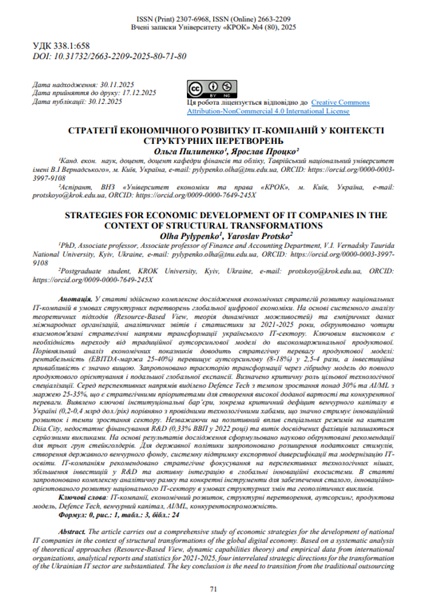
У статті здійснено комплексне дослідження економічних стратегій розвитку національних ІТ-компаній в умовах структурних перетворень глобальної цифрової економіки. На основі системного аналізу теоретичних підходів (Resource-Based View, теорія динамічних можливостей) та емпіричних даних міжнародних організацій, аналітичних звітів і статистики за 2021-2025 роки, обґрунтовано чотири взаємопов'язані стратегічні напрями трансформації українського ІТ-сектору. Ключовим висновком є необхідність переходу від традиційної аутсорсингової моделі до високомаржинальної продуктової. Порівняльний аналіз економічних показників доводить стратегічну перевагу продуктової моделі: рентабельність (EBITDA-маржа 25-40%) перевищує аутсорсингову (8-18%) у 2,5-4 рази, а інвестиційна привабливість є значно вищою. Запропоновано траєкторію трансформації через гібридну модель до повного продуктового орієнтування і подальшої глобальної експансії. Визначено критичну роль цільової технологічної спеціалізації. Серед перспективних напрямів виділено Defence Tech з темпом зростання понад 30% та AI/ML з маржею 25-35%, що є стратегічними пріоритетами для створення високої доданої вартості та конкурентної переваги. Виявлено ключові інституціональні бар’єри, зокрема критичний дефіцит венчурного капіталу в Україні (0,2-0,4 млрд дол./рік) порівняно з провідними технологічними хабами, що значно стримує інноваційний розвиток і темпи зростання сектору. Незважаючи на позитивний вплив спеціальних режимів на кшталт Diia.City, недостатнє фінансування R&D (0,33% ВВП у 2022 році) та витік досвідчених фахівців залишаються серйозними викликами. На основі результатів дослідження сформульовано науково обґрунтовані рекомендації для трьох груп стейкголдерів. Для державної політики запропоновано розширення податкових стимулів, створення державного венчурного фонду, системну підтримку експортної диверсифікації та модернізацію ІТ-освіти. ІТ-компаніям рекомендовано стратегічне фокусування на перспективних технологічних нішах, збільшення інвестицій у R&D та активну інтеграцію в глобальні інноваційні екосистеми. В статті запропоновано комплексну аналітичну рамку та конкретні інструменти для забезпечення сталого, інноваційно-орієнтованого розвитку національного ІТ-сектору в умовах структурних змін та геополітичних викликів.
Завантаження
Посилання
World Bank. (2024). Digital Progress and Trends Report 2023. URL: https://documents1.worldbank.org/curated/en/099031924192524293/pdf/P180107173682d0431bf651fded74199f10.pdf
Cirera, X., & Maloney, W.F. (2017). The innovation paradox: Developing-country capabilities and the unrealized promise of technological catch-up. Washington, D.C.: World Bank Group. URL: http://documents.worldbank.org/curated/en/322521507638821474
Barney, J. B. (1991). Firm resources and sustained competitive advantage. Journal of Management, 17, 99-120. URL: https://josephmahoney.web.illinois.edu/BA545_Fall%202022/Barney%20(1991).pdf
Teece, D.J., Pisano, G., & Shuen, A. (1997). Dynamic Capabilities and Strategic Management. Strategic Management Journal, 18(7), 509-533. URL: https://josephmahoney.web.illinois.edu/BA545_Fall%202022/Teece,%20Pisano%20and%20Shuen%20(1997).pdf
Castellani, D., & Zanfei, A. (2006). Multinational firms, innovation and productivity. In Multinational Firms, Innovation and Productivity. Edward Elgar Publishing.
Singh, H., & Montgomery, C.A. (1987). Corporate Acquisition Strategies and Economic Performance. Strategic Management Journal, 8(4), 377-386. URL: https://www.jstor.org/stable/2486020
Tkachyk, L., Rubakha, M., Paitra, N., Demchyshak, N., & Oznamets V. (2023). Research of IT business in Ukraine: trends, forecasts, and development strategies. Financial and credit activity: problems of theory and practice, 52, 353-368. DOI: https://doi.org/10.55643/fcaptp.5.52.2023.4128
Melnyk, T., & Zavhorodnya, E. (2022). The IT sector of Ukraine on the world market: 2022. Foreign trade: economics, finance, law, 125(6), 17-36. DOI: https://doi.org/10.31617/3.2022(125)02
Войтко, С.В. (2018). Бізнес-модель Індустрії-4.0 у розвитку приладобудування України. Ela.kpi.ua. URL: https://ela.kpi.ua/items/0be8d101-2b564f1f-bc06-ac0d39549bae
Скоробогатова, Н.Є. (2019). Концептуальні засади формування сталого розвитку суспільства в контексті індустрії 4.0. Економічний вісник Національного технічного університету України «Київський політехнічний інститут», 16. Crown Business. DOI: https://doi.org/10.20535/2307-5651.16.2019.182748
Пилипенко, О., & Процко, Я. (2024). Економічний розвиток українських IT компаній в умовах Industry 4.0. Вчені записки Університету «КРОК», 2(74), 22-30. DOI: https://doi.org/10.31732/2663-2209-2024-74-22-30
Lolin, V. (2024). The role of technical innovation in strengthening IT operations: a case study from Ukrainian enterprises. ECONOMIC BULLETIN of Cherkasy State Technological University, 25(2(73), 65-80. DOI: https://doi.org/10.24025/2306-4420.73(2).2024.321514
Wadhwa, V., Freeman, R.B., & Rissing, B.A. (2008). Education and Tech Entrepreneurship. DOI: http://dx.doi.org/10.2139/ssrn.1127248
Stroiko, T., Voloshyna-Sidei, V., & Druz, Y. (2023). Formation of business ecosystems as a basis for the development of the IT industry. Baltic Journal of Economic Studies, 9(1), 177-183. DOI: https://doi.org/10.30525/2256-0742/2023-9-1-177-183
Ukrainian Defence Tech Market Overview (2024). DataDriven Research & Consulting. URL: https://datadriven.group/blog/ukrainian-defence-tech-market-overview
Umantsiv, Y., Rudenko, I., Оzhelevskaya, T., Shcherbakova, T., & Khrustalova, V. (2025). Competitiveness of the it business in Ukraine: current state and pathways for enhancement. Financial and credit activity: problems of theory and practice, 1(60), 387-400. DOI: https://doi.org/10.55643/fcaptp.1.60.2025.4479
OECD Digital Economy Outlook 2024. DOI: https://doi.org/10.1787/f0b5c251-en
Річний звіт 2024. IT Ukraine Association. URL: https://itukraine.org.ua/report/richnij-zvit-asotsiatsiyi-it-ukraine-2024-full/
A new future of work: The race to deploy AI and raise skills in Europe and beyond. (2024). McKinsey Global Institute. URL: https://www.mckinsey.com/mgi/our-research/a-new-future-of-work-the-race-to-deploy-ai-and-raise-skills-in-europe-and-beyond
PitchBook IT Services Valuation Report 2023. URL: https://pitchbook.com/news/reports/q4-2023-enterprise-saas-report
McKinsey Technology Trends Outlook 2023. URL: https://www.mckinsey.com/capabilities/tech-and-ai/our-insights/the-top-trends-in-tech-2023
2024 technology industry outlook. Deloitte. URL: https://www.deloitte.com/global/en/Industries/tmt/analysis/technology-industry-outlook.html
Collins, Ch., & Kauppaymuthoo, K.J. (2023). Artificial Intelligence Adoption in Software Development. Lund University. URL: https://lup.lub.lu.se/luur/download?func=downloadFile&recordOId=9123274&fileOId=9123420
Eurostat. URL: https://ec.europa.eu/eurostat
Downloads
Опубліковано
Як цитувати
Номер
Розділ
Ліцензія

Ця робота ліцензується відповідно до Creative Commons Attribution-NonCommercial 4.0 International License.