PRINCIPLES OF MANAGEMENT OF INNOVATIVE DEVELOPMENT OF ENTERPRISES IN THE CONTEXT OF EUROPEAN INTEGRATION
DOI:
https://doi.org/10.31732/2663-2209-2025-80-289-296Keywords:
management, innovations, innovative development, management of innovative development of enterprises, European integration, management principlesAbstract
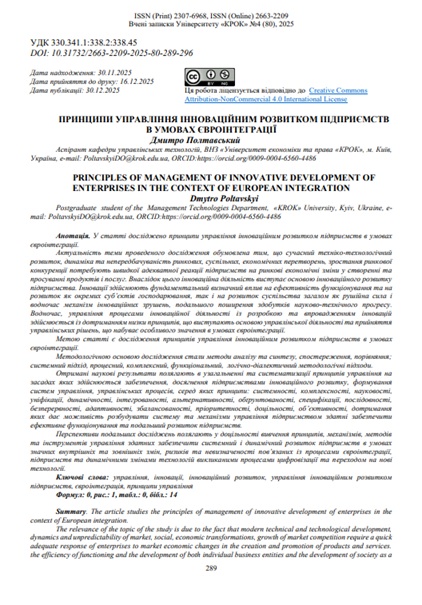
The article studies the principles of management of innovative development of enterprises in the context of European integration.
The relevance of the topic of the study is due to the fact that modern technical and technological development, dynamics and unpredictability of market, social, economic transformations, growth of market competition require a quick adequate response of enterprises to market economic changes in the creation and promotion of products and services. the efficiency of functioning and the development of both individual business entities and the development of society as a whole as a driving force and at the same time a mechanism for innovative changes, further dissemination of the achievements of scientific and technological progress. At the same time, the management of the processes of innovation activity with the development and implementation of innovations is carried out in compliance with a number of principles that serve as the basis for managerial activity and managerial decision-making, which is of particular importance in the context of European integration.
The article is aimed at studying the principles of management of innovative development of enterprises in the context of European integration.
The methodological basis of the study was the methods of analysis and synthesis, observation, comparison; system approach, process, complex, functional, logical-dialectical methodological approaches.
The obtained scientific results consist in generalization and systematization of management principles on the basis of which enterprises are ensured, achieved innovative development, formation of management systems, management processes, including the principles of: systematic, comprehensive, scientific, unified, dynamistic, integrated, alternative, valid, specification, consistency, continuity, adaptability, balance, priority, expediency, objectivity, compliance with which makes it possible to build a system and mechanisms of enterprise management are able to ensure the effective functioning and further development of enterprises.
Prospects for further research are the feasibility of studying the principles, mechanisms, methods and management tools that can ensure the systematic and dynamic development of enterprises in the context of significant internal and external changes, risks and uncertainties associated with the processes of European integration, enterprises and dynamic changes in technologies caused by the processes of digitalization and transition to new technologies.
Downloads
References
Геєць, В. (2005). Інноваційний шлях розвитку та економічне зростання. Інноваційна Україна. № 7. С. 38-42.
Касьянова Н. (2011). Управління розвитком підприємства на основі кумулятивного підходу: концепція, моделі та методи: монографія. Донецьк: Купріянов. 374 с.
Кириченко, О. (2021). Інвестиційно-інноваційне забезпечення промисловості України в умовах Четвертої промислової революції: монографія. К.: Університет КРОК. 368 c. https://dspace.krok.edu.ua/items/5559b91b-394d-45bb-b57b-1b5352fc1d80
Косцик, Р. (2013). Етапи процесу комерціалізації інноваційної продукції промислових підприємств. Вісник СумДУ. № 4. С. 150-154.
Орлик О. (2012). Теоретичне обґрунтування інновацій та їх ролі в торгівлі Інноваційна економіка. № 9. С. 221-224.
Поліщук Н. (2009). Теоретичні підходи до визначення сутності інновацій. Галицький економічний вісник. № 1. С. 20 – 23
Прокопенко, В. (2012). Соціально-економічна мотивація інноваційного розвитку регіону: монографія. Суми: Сумський державний університет. 576 с.
Саблук, П. (2010). Інноваційна діяльність в аграрній сфері: інституціональний аспект: монографія. К.: ННЦ ІАЕ. 704 с.
Снігур Х. (2011). Теоретичні засади економічного змісту інновацій. Управління розвитком. №21. С.129-132.
Стадник В., & Головчук Ю. (2020). СХХ Управління інноваціями на основі розвитку партнерських відносин підприємства: монографія. Кам’янець-Подільський: Друкарня Рута. 232 с.
Сухоруков А. (2001). Економіка та організація інноваційної діяльності Київ: Інститут муніципального менеджменту та бізнесу. 342 с.
Федулова Л. (2014). Концептуальні засади управління інноваційним розвитком підприємств. Маркетинг і менеджмент інновацій. №2. С. 122-135.
Череп, А. (2012). Оцінка ефективності інноваційно-інвестиційної діяльності підприємств лікеро-горілчаної промисловості: монографія. Запоріжжя: ЗНУ. 283 с.
Шкарлет С., & Ільчук В. (2015). Інноваційний розвиток підприємства. Чернігів: ЧНТУ. 307 с.
Downloads
Published
How to Cite
Issue
Section
License

This work is licensed under a Creative Commons Attribution-NonCommercial 4.0 International License.