MANAGING TEAM INTERACTION IN PROJECTS BASED ON PERSONALITY MODELS
DOI:
https://doi.org/10.31732/2663-2209-2025-80-273-281Keywords:
team management, interaction management, project management, personality models, epistemological spaceAbstract
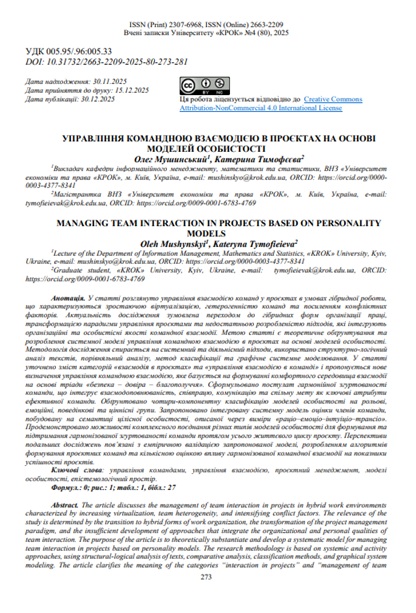
The article discusses the management of team interaction in projects in hybrid work environments characterized by increasing virtualization, team heterogeneity, and intensifying conflict factors. The relevance of the study is determined by the transition to hybrid forms of work organization, the transformation of the project management paradigm, and the insufficient development of approaches that integrate the organizational and personal qualities of team interaction. The purpose of the article is to theoretically substantiate and develop a systematic model for managing team interaction in projects based on personality models. The research methodology is based on systemic and activity approaches, using structural-logical analysis of texts, comparative analysis, classification methods, and graphical system modeling. The article clarifies the meaning of the categories “interaction in projects” and “management of team interaction” and proposes a new definition of team interaction management based on the formation of a comfortable environment for interaction based on the triad “safety – trust – well-being.” A postulate of harmonious team cohesion is formulated, integrating complementarity, cooperation, communication, and a common goal as key attributes of an effective team. A four-component classification of personality models into role, emotional, behavioral, and value groups is substantiated. An integrated systemic model for evaluating team members has been proposed, based on the semantics of a holistic personality, described through the dimensions of “rationale – emotion – intuition – trance.” The possibilities of a comprehensive combination of different types of personality models for forming and maintaining harmonized team cohesion throughout the project life cycle are demonstrated. Prospects for further research are related to the empirical validation of the proposed model, the development of algorithms for forming project teams, and a quantitative assessment of the impact of harmonized team interaction on project success indicators.
Downloads
References
Adizes, I. (1979). Organizational passages–Diagnosing and treating lifecycle problems of organizations. Organizational Dynamics, 8(1), 3–25. DOI: https://doi.org/10.1016/0090-2616(79)90001-9
Beck, D. E., & Cowan, C. C. (2014). Spiral Dynamics: Mastering Values, Leadership and Change. John Wiley & Sons.
Belbin, R. M. (2010). Management teams. DOI: https://doi.org/10.4324/9780080963594
Cojoacă, M. D. (2024). Exploring team cohesion in project management. Management & Marketing, 22(1), 89–101. DOI: https://doi.org/10.52846/mnmk.22.1.08
Fisher, H. (2009). Why him? why her?: Finding Real Love By Understanding Your Personality Type. Macmillan
Goldberg, L. R. (1990). An alternative “description of personality”: The Big-Five factor structure. Journal of Personality and Social Psychology, 59(6), 1216–1229. DOI: https://doi.org/10.1037/0022-3514.59.6.1216
Гринченко М. Пономарьов О. , Лобач О.. & Харченко А. (2022). Конфлікти в управлінні проєктами. Вісник Національного технічного університету «ХПІ». Серія: Стратегічне управління, управління портфелями, програмами та проектами, 1(5), 50-55. DOI: https://doi.org/10.20998/2413-3000.2022.5.6
Inglehart, R., & Welzel, C. P. (2005). Modernization, cultural change, and democracy the human development sequence. DOI: https://doi.org/10.1017/cbo9780511790881
Концевий, В., & Войтенко, О. (2025). Оцінка впливу учасників проєктних команд на систему комунікацій. Управління розвитком складних систем, (62), 79–87. DOI: https://doi.org/10.32347/2412-9933.2025.62.79-87
Lee, K., & Ashton, M. C. (2004). Psychometric Properties of the HEXACO Personality Inventory. Multivariate Behavioral Research, 39(2), 329–358. DOI: https://doi.org/10.1207/s15327906mbr3902_8
Lepeyko, T., & Zehetner, D. (2022). Contemporary approach to the generations transition and cooperation at modern working place. Ukrainian Journal of Applied Economics and Technology, 7(4), 33–39. DOI: https://doi.org/10.36887/2415-8453-2022-4-4
Marston, William Moulton, (2013). Emotions Of Normal People (1st ed.). Routledge. DOI: https://doi.org/10.4324/9781315010366
Медведєва, О. М. (2013). Ціннісно-орієнтоване управління взаємодією в проєктах: методологічні основи (автореф. дис. д-ра техн. наук, 05.13.22). Київ.
Медведєва, О. (2014). Епістемічні положення пізнання ціннісно-орієнтованого управління взаємодією в проектах: базові аксіоми й постулати, аксіологічні та онтологічні положення. Управління проектами та розвиток виробництва, (2), 152–167.
Мушинський, О. (2024). Особливості управління проєктними командами в гібридному середовищі. Економіка та суспільство, (60). DOI: https://doi.org/10.32782/2524-0072/2024-60-5
Мушинський, О. (2024). Розвиток лідерства в управлінні проєктними командами. Вчені записки Університету «КРОК», (4(76), 165–173. DOI: https://doi.org/10.31732/2663-2209-2024-76-165-173
Оліярник, В. В., & Романовський, О. О. (2023). Технологічні особливості командної роботи в управлінні проєктами. Ефективність державного управління, 3(76/77), 23–27. DOI: https://doi.org/10.36930/507603
Pletzer, J. L., & Abrahams, L. (2025). Personality and job performance: A review of trait models and recent trends. Current Opinion in Psychology, 65, 102054. DOI: https://doi.org/10.1016/j.copsyc.2025.102054
Project Management Institute. (2021). A guide to the project management body of knowledge (PMBOK® Guide) (7th ed.). Project Management Institute.
Rach, V., Osakwe, I., Medvedieva, O., Rossoshanskaya, O., & Borulko, N. (2019). Method for configuring the composition of a project team based on the criteria of subjective well-being. Eastern-European Journal of Enterprise Technologies, 2(3 (98), 48–59. DOI: https://doi.org/10.15587/1729-4061.2019.160651
Рач, В. А., & Борулько, Н. О. (2019). Епістемологічний простір м’якого управління проєктами: моделі та методи ідентифікації загальних ризиків. Управління проектами та розвиток виробництва, 4(72), 19–32.
Россошанська, О. В. (2016). Оцінювання економічної безпеки інформаційних технологійних проектно-орієнтованих підприємств: монографія. СНУ ім. В. Даля.
Россошанська, О. В. (2019). Стратегічний потенціал як фактор економічної безпеки соціально-економічних систем в контексті конвергенції економіки знань та цифрової економіки. Управління проектами та розвиток виробництва, 2(70), 97–112.
Ровенська, В., Латишева, О., & Смирнова, І. (2023). Групова динаміка та методи управління креативними та проєктними командами в сфері інформаційних технологій. Трансформаційна економіка, (3 (03), 32-39. DOI: https://doi.org/10.32347/2412-9933.2025.62.79-87
Schwartz, S. H. (1992). Universals in the Content and Structure of Values: Theoretical advances and empirical tests in 20 countries. In Advances in experimental social psychology (pp. 1–65). DOI: https://doi.org/10.1016/s0065-2601(08)60281-6
Сєдашова, О., & Федотова, Н. (2025). Конфлікти у XXI столітті в управлінні командою проєкту: психологічні аспекти. Вчені записки Університету «КРОК», (1(77), 309–316. DOI: https://doi.org/10.31732/2663-2209-2025-77-309-316
Weber, M., Runciman, W. G., & Matthews, E. (1978). The nature of social action. In Cambridge University Press eBooks (pp. 7–32). DOI: https://doi.org/10.1017/cbo9780511810831.005
Downloads
Published
How to Cite
Issue
Section
License

This work is licensed under a Creative Commons Attribution-NonCommercial 4.0 International License.