SOURCES OF BURNOUT OF CLINICAL MONITORS AND STAFF TURNOVER IN CONTRACT RESEARCH ORGANIZATIONS
DOI:
https://doi.org/10.31732/2663-2209-2025-80-320-326Keywords:
human resource management, professional burnout, staff turnover, matrix organizational structure, conflictsAbstract
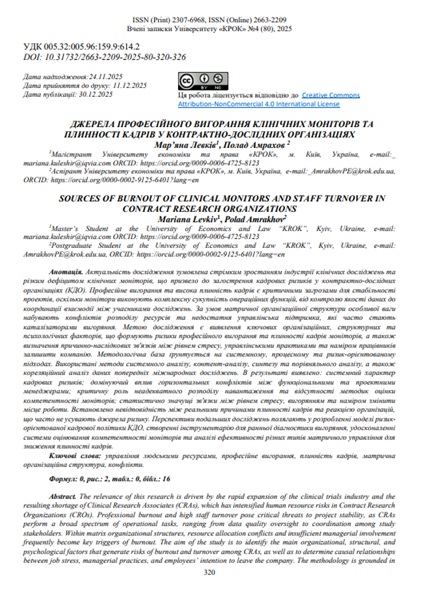
The relevance of this research is driven by the rapid expansion of the clinical trials industry and the resulting shortage of Clinical Research Associates (CRAs), which has intensified human resource risks in Contract Research Organizations (CROs). Professional burnout and high staff turnover pose critical threats to project stability, as CRAs perform a broad spectrum of operational tasks, ranging from data quality oversight to coordination among study stakeholders. Within matrix organizational structures, resource allocation conflicts and insufficient managerial involvement frequently become key triggers of burnout. The aim of the study is to identify the main organizational, structural, and psychological factors that generate risks of burnout and turnover among CRAs, as well as to determine causal relationships between job stress, managerial practices, and employees’ intention to leave the company. The methodology is grounded in systemic, process-based, and risk-oriented approaches. Methods applied include system analysis, content analysis, synthesis, comparative analysis, and correlation analysis of data from prior international studies. The results reveal: the systemic nature of human resource risks; the significant impact of horizontal conflicts between functional and project managers; the critical role of inadequate workload distribution and the absence of competency assessment tools; and statistically significant correlations between stress, burnout, and turnover intention. A mismatch was identified between the actual drivers of staff turnover and organizational responses, which often fail to address the root causes. Future research directions include developing a risk-based HR policy model for CROs, creating tools for early detection of CRA burnout, improving competency assessment frameworks, and evaluating the effectiveness of different matrix management models in reducing staff turnover.
Downloads
References
Бушуев, С. Д., Бушуева, Н. С., Бабаев, И. А. и др. (2010). Креативные технологии управления проектами и программами: Монография. К.: «Самит- Книга», 768 с.
Величко, Я.І. (2019). Класифікація кадрових ризиків підприємства. Економіка транспортного комплексу, 33, 119-137.
Данченко, О.Б., Бедрій, Д.І., Семко, І.Б. (2018). Концептуальна модель формування високоефективної команди наукового проекту. Вісник Національного технічного університету «ХПІ». Серія: Стратегічне управління, управління портфелями, програмами та проектами, 1(1277), 51-56.
Кириченко, О. С. (2023). Зростання ефективності управління персоналом як основа конкурентоспроможності та якості діяльності організації й її функціональних підрозділів. Вчені записки Університету «КРОК», 3(71), 47.
Леонов, О., & Леонова, Т. (2023). ТЕОРІЯ ОРГАНІЗАЦІЇ ТА ОРГАНІЗАЦІЙНІ СТРУКТУРИ СУЧАСНОГО КОРПОРАТИВНОГО УПРАВЛІННЯ. Економіка та суспільство, 54. https://doi.org/10.32782/2524-0072/2023-54-4
Сумець, О. М., Алькема, В. Г. (2025). Алгоритм створення проектного офісу організації. Успіхи і досягнення у науці, 1(11), 707-720.
Certa, A., Enea, M., Galante, G., & Manuela La Fata, C. (2009). Multi-objective human resources allocation in R&D projects planning. International Journal of Production Research, 47(13), 3503–3523. https://doi.org/10.1080/00207540701824233
Ford, R. C., & Randolph, W. A. (1992). Cross-Functional Structures: A Review and Integration of Matrix Organization and Project Management. Journal of Management, 18(2), 267–294. https://doi.org/10.1177/014920639201800204
Hill , M. (2022). Clinical Research Sites Share Cash & Workforce Shortage Concerns. Clinicalleader.com. https://www.clinicalleader.com/doc/clinical-research-sites-share-cash-workforce-shortage-concerns-0001
Kwon, E., & Kim, Y. (2024). Job Stress, Burnout, and Turnover Intention of Clinical Research Associates. https://doi.org/10.20944/preprints202409.1978.v1
Lamberti , M. J., & Dirks, А. (2022). An Examination of the Role of the Clinical Research Associate and Factors Impacting Performance and Experience. Applied Clinical Trials Online. https://www.appliedclinicaltrialsonline.com/view/an-examination-of-the-role-of-the-clinical-research-associate-and-factors-impacting-performance-and-experience
Larson, E. W., & Gobeli, D. H. (1987). Matrix Management: Contradictions and Insights. California Management Review, 29(4), 126–138. https://doi.org/10.2307/41162135
Mattila, M., Hallikainen, P., & Rossi, M. (2010). Challenges in implementing enterprise system functionalities in a matrix organization. 2010 Fourth International Conference on Research Challenges in Information Science (RCIS). https://doi.org/10.1109/rcis.2010.5507299
Moe Alsumidaie. (2018, May 22). CRA Skills Lacking in Critical Areas. Appliedclinicaltrialsonline.com; Applied Clinical Trials Online. https://www.appliedclinicaltrialsonline.com/view/cra-skills-lacking-critical-areas
Pharmaceutical CRO Market Size And Share Report, 2030. (2024). Grandviewresearch.com. https://www.grandviewresearch.com/industry-analysis/pharmaceutical-cro-market-report
Ughulu, J. (2023). Clinical Research Monitor Burnout - Root Causes, Corrective and Preventive Action. American Journal of Nursing Science, 12(3). https://doi.org/10.11648/j.ajns.20231203.12
Downloads
Published
How to Cite
Issue
Section
License

This work is licensed under a Creative Commons Attribution-NonCommercial 4.0 International License.