KEY PRINCIPLES OF PROJECT MANAGEMENT IN THE FIELD OF INFORMATION TECHNOLOGY
DOI:
https://doi.org/10.31732/2663-2209-2025-80-257-272Keywords:
project management, IT projects, artificial intelligence, machine learning, Agile, Waterfall, risk predictionAbstract
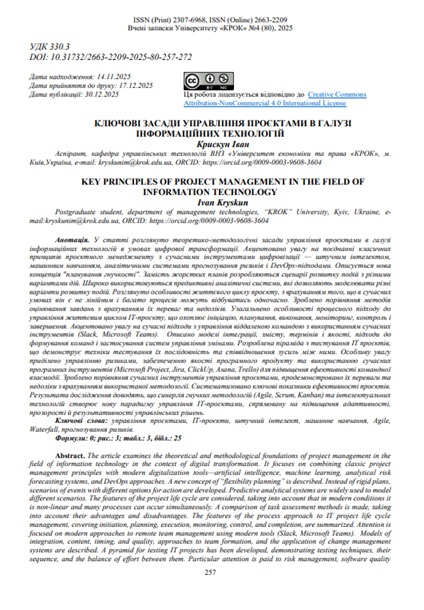
The article examines the theoretical and methodological foundations of project management in the field of information technology within the context of digital transformation. It emphasizes the integration of classical project management principles with modern digital tools such as artificial intelligence, machine learning, predictive analytics, and DevOps practices. The study generalizes the features of the process-oriented approach to the project life cycle, including initiation, planning, execution, monitoring, control, and closure. It explores project integration, scope, scheduling, and quality management, as well as team formation strategies and change management processes. Particular attention is devoted to risk management, software quality assurance, and the application of project management tools (Microsoft Project, Jira, ClickUp, Asana, Trello) that enhance team collaboration and operational efficiency. The results demonstrate that the synergy between agile methodologies (Agile, Scrum, Kanban) and intelligent technologies forms a new paradigm of IT project management aimed at increasing adaptability, transparency, and decision-making effectiveness.
Downloads
References
Онищенко І. І., Шарова О. С. (2013). "Модель життєвого циклу проєкту розробки тиражного програмного продукту та виведення його на ринок." Управление проєктами и развитие производства, 3 (47), 291-292.
Devi, T. Rajani, V. Shobha Reddy. (2012). "Work breakdown structure of the project." International Journal of Engineering Research and Applications, 2(2), 683–686.
Водолазкіна К. О. (2016). "Аналіз сумісної професійної компетентності команди проєкту." Управління розвитком складних систем, 28, 57-62.
Мігаль Д., Орлова-Курилова О. (2025). "AGILE-ПІДХІД ДО АДАПТАЦІЇ НОВИХ СПІВРОБІТНИКІВ: ПЕРЕВАГИ ТА ВИКЛИКИ". Вчені записки Університету «КРОК» №1 (77), 289-298
Cohn, M. (2009). Succeeding with Agile: Software development using Scrum (pp. 177–199). Addison-Wesley Professional.
Максимов А. (2025), "Аналіз стандартів управління ризиками та їх використання в ІТ-проєктах." Управління розвитком складних систем, 61, 66-75.
Грабіна, К. В., Шендрик, В. В., & Івашова, Н. В. (2023). Алгоритм методу управління ризиками та можливостями в ІТ-проєктах. Теоретичні та практичні аспекти розвитку науки та освіти: матеріали Х Міжнародної науково-практичної конференції (м. Львів, 9–10 січня 2024 р.), Львів: Львівський науковий форум, 157, 77–80.
Попова, А., & Васильцова, Н. (2024). Оцінювання успішності управління змінами в довгострокових ІТ-проєктах [Evaluation of change management success in long-term IT projects]. Proceedings of the XXVI International Scientific and Practical Conference “Theoretical and Practical Aspects of Modern Research” (June 5–7, 2024, Ottawa, Canada), International Scientific Unity, 285 p. ISBN 978-617-8427-18-4.
Фонар, Л. С., & Лотіс, О. С. (2024). Аналіз особливостей управління ризиками ІТ-проєктів в умовах вигорання. Вісник Херсонського національного технічного університету, 3(90), 309–314.
Станьковська, І. М., & Смага, Л. Р. (2024). Управління якістю програмного продукту ІТ-проєктів в умовах кризи. Вісник Прикарпатського національного університету імені Василя Стефаника, 1 (20), 247-255.
Заїка, С. О., & Грідін, О. В. (2016). Система управління якістю інноваційного проєкту. Вісник Харківського національного технічного університету сільського господарства імені Петра Василенка, 171, 113–123.
Vajjhala, N. R. (2012). Microsoft Project as a risk management tool. International Journal of Risk and Contingency Management (IJRCM), 1(2), 54–57.
AlHarbi, O., AlMalki, R., & AlYousef, N. (2023). Advancing project management methodologies: An in-depth analysis of Jira in managerial and developmental contexts. International Journal of Technology Innovation and Management (IJTIM), 3(2), 40–59.
Wang, J., Liu, X., Xu, L., Wu, H., & Li, X. (2020). Click-UP: Toward the software upgrade of click-based modular network function. IEEE Systems Journal, 15(1), 1160–1171.
Kamila, J. S., & Marzuq, M. F. (2024). Asana and Trello: A comparative assessment of project management capabilities. JOIV: International Journal on Informatics Visualization, 8(1), 207–212.
Проданчук, М. (2014). Інтегрована звітність – інструмент управління підприємством. Бухгалтерський облік і аудит, 2, 24–31.
van Lieshout, J. W. F. C., van der Velden, J. M., Blomme, R. J., & Peters, P. (2021). The interrelatedness of organizational ambidexterity, dynamic capabilities and open innovation: A conceptual model towards a competitive advantage. European Journal of Management Studies, 26, 39–62.
Kuzior, A., Sira, M., & Brożek, P. (2023). Use of artificial intelligence in terms of open innovation process and management. Sustainability, 15, 7205.
Du, J., Leten, B., & Vanhaverbeke, W. (2014). Managing open innovation projects with science-based and market-based partners. Research Policy, 43, 828–840.
McCray, G. E., Purvis, R. L., & McCray, C. G. (2002). Project management under uncertainty: The impact of heuristics and biases. Project Management Journal, 33, 49–57.
Pellizzoni, E., Trabucchi, D., & Buganza, T. (2019). When agility meets open innovation: Two approaches to manage inbound projects. Creativity and Innovation Management, 28, 464–476.
Kühl, N., Schemmer, M., Goutier, M., & Satzger, G. (2022). Artificial intelligence and machine learning. Electronic Markets, 32, 2235–2244.
Peres, R. S., Jia, X., Lee, J., Sun, K., Colombo, A. W., & Barata, J. (2020). Industrial artificial intelligence in Industry 4.0: Systematic review, challenges and outlook. IEEE Access, 8, 220121–220139.
Brem, A., Giones, F., & Werle, M. (2023). The AI digital revolution in innovation: A conceptual framework of artificial intelligence technologies for the management of innovation. IEEE Transactions on Engineering Management, 70, 770–776.
Corrales-Garay, D., Rodríguez-Sánchez, J.-L., & Montero-Navarro, A. (2024). Co-creating value with artificial intelligence: A bibliometric approach to the use of AI in open innovation ecosystems. IEEE Access, 12, 56860–56871.
Downloads
Published
How to Cite
Issue
Section
License

This work is licensed under a Creative Commons Attribution-NonCommercial 4.0 International License.