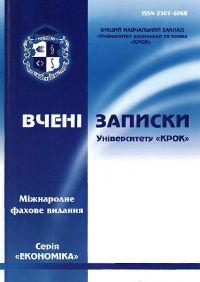
Open Access Policy
The «Science notes of KROK University» supports the principle of Open Access for publications. This means that all articles published in the journal are freely available to all users, without any financial barriers, through the Internet. We believe that scientific results should be accessible to the broader academic community, students, researchers, and interested parties, to foster the development of scientific research and knowledge.
1. Principles of Open Access
- Free access to articles: All articles published in the «Science notes of KROK University» are freely accessible for viewing and downloading through the Internet without the need for a subscription or payment.
- Copyright: Authors retain the copyright to their publications and have the right to use them in future academic works, with proper citation. Authors can publish their works in other scientific journals or platforms, provided the original source is properly acknowledged.
- Creative Commons Licensing (CC BY): Articles are published under the CC BY license, which allows free use, modification, and distribution of materials with proper attribution to the authors. This ensures academic freedom and ease of further use and adaptation of scientific research.
2. Support for Open Access Publications
- The Science notes of KROK University» provides the scientific community with uninterrupted access to publications, which contributes to increasing the scientific significance of research. Open access ensures the rapid dissemination of knowledge and fosters scientific exchange among researchers from different countries and organizations.
3. Use of Open Data
- FAIR Principles: We also support the FAIR principles for data accompanying articles: data must be Findable, Accessible, Interoperable, and Reusable. Data sets must be available through appropriate repositories with assigned DOIs (Digital Object Identifiers) for scientific identification and accessibility.
4. Access to Scientific Works
- Articles published in the journal are available on the open access platform of the journal and are also accessible for search and download in international databases and repositories.
- The journal does not restrict access to its publications under subscription or other paid access models.
5. Benefits of Open Access
- Speed of access: Open access allows scientists and researchers to quickly obtain the latest scientific results, which is critical for the advancement of science.
- Increased citations: Articles that are accessible to all users without restrictions are more likely to be cited, which contributes to increasing the scientific impact and popularity of research results.
This policy supports the principles of open access, allowing all users to freely access the journal’s publications and contributing to the development of global scientific communication.