PROSPECTS FOR UKRAINIAN HOTELS TO SWITCH TO THE «ZERO WASTE» MODEL
DOI:
https://doi.org/10.31732/2663-2209-2025-80-157-163Keywords:
Zero Waste, hotel business, waste management, circular economy, environmental management, sustainable development, ESG rating, resource efficiency, environmental impact, quantitative assessmentAbstract
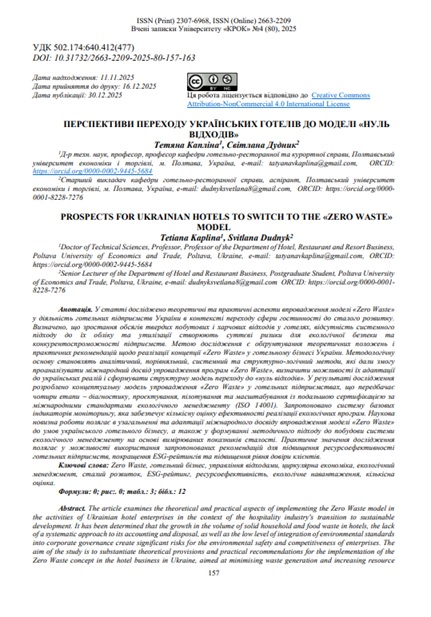
The article examines the theoretical and practical aspects of implementing the Zero Waste model in the activities of Ukrainian hotel enterprises in the context of the hospitality industry's transition to sustainable development. It has been determined that the growth in the volume of solid household and food waste in hotels, the lack of a systematic approach to its accounting and disposal, as well as the low level of integration of environmental standards into corporate governance create significant risks for the environmental safety and competitiveness of enterprises. The aim of the study is to substantiate theoretical provisions and practical recommendations for the implementation of the Zero Waste concept in the hotel business in Ukraine, aimed at minimising waste generation and increasing resource efficiency. The methodological basis consists of analytical, comparative, systematic and structural-logical methods, which made it possible to analyse international experience in implementing Zero Waste programmes (Hilton, Marriott, Accor, Scandic, IHG), identify opportunities for their adaptation to Ukrainian realities and form a structural model for the transition to zero waste. As a result of the research, a conceptual model for the implementation of Zero Waste in hotel enterprises was developed, which includes four stages: diagnosis, design, piloting and scaling, followed by certification according to international environmental management standards (ISO 14001, Green Key). A system of basic monitoring indicators (WGR, Diversion Rate, Food Waste Intensity) is proposed, which provides a quantitative assessment of the effectiveness of environmental programmes. The scientific novelty of the work lies in the generalisation and adaptation of international experience in implementing the Zero Waste model to the conditions of the Ukrainian hotel business, as well as in the formation of a methodological approach to building an environmental management system based on measurable sustainability indicators. The practical significance of the research lies in the possibility of using the proposed recommendations to increase the resource efficiency of hotel enterprises, reduce environmental impact, improve ESG ratings, and increase customer confidence.
Keywords: Zero Waste, hotel business, waste management, circular economy, environmental management, sustainable development, ESG rating, resource efficiency, environmental impact, quantitative assessment.
Downloads
References
ACCOR GROUP CIRCULAR ECONOMY POLICY. (2024). https://assets.group.accor.com/yrj0orc8tx24/4ShlxMwCXfMzSRAAu3JOR5/ef c179240cf0238e6419b11d2efef85a/Accor-Circular-Economy-Policy_2024.pdf
ANNUAL & SUSTAINABILITY REPORT. (2024). scandichotelsgroup.com. https://www.scandichotelsgroup.com/files/Reports/Annual_reports/2024/Scandic-annual-and-sustainability-report-2024-print.pdf
Cárdenas, M., Schivinski, B., et al. (2024). Circular practices in the hospitality sector regarding food waste. Journal of Cleaner Production, 472, 143452. https://doi.org/10.1016/j.jclepro.2024.143452
Delivering on our environmental and social objectives. Sustainability Report 2024. (2024). Hilton Foods. https://www.hiltonfoods.com/media/4gdcxox3/2024-sustainability-report.pdf
European Parliamentary Research Service. (2023). Waste Framework Directive: Towards a more sustainable use of natural resources (Briefing). Brussels. https://www.europarl.europa.eu/(2023)757572_EN.pdf
Green Key. (2025). About the Green Key eco-label. https://www.greenkey.global/
Juvan, E., et al. (2023). Waste production patterns in hotels and restaurants. Cleaner Waste Systems. https://www.sciencedirect.com/science/article/pii/S2666957923000058
Marriott International. (2024). 2024 Serve 360: ESG Progress Report. https://serve360.marriott.com/wp-content/ESGProgress.pdf
Nhubu, T., & Mbohwa, C. (2024). Inventory analysis and environmental life-cycle impact assessment of hotel food waste management for bio-circular economy development in Zimbabwe. Environmental Monitoring and Assessment. https://doi.org/10.1007/s10661-024-13314-6
Ni, X., Li, H., & Wang, D. (2025). How hotel eco-labels can be powerful nudges: An evaluability perspective. Tourism Management, 110, 105191. https://doi.org/10.1016/j.tourman.2025.105191
Pham Phu, S. T., Hoang, M. G., & Fujiwara, T. (2018). Analyzing solid waste management practices for the hotel industry. Global Journal of Environmental Science and Management, 4(1). https://doi.org/10.22034/gjesm.2018.04.01.003
Velaoras, K., Menegaki, A. N., Polyzos, S., & Gotzamani, K. (2025). The role of environmental certification in the hospitality industry: Assessing sustainability, consumer preferences, and economic impact. Sustainability, 17(2), 650. https://doi.org/10.3390/su17020650
Downloads
Published
How to Cite
Issue
Section
License

This work is licensed under a Creative Commons Attribution-NonCommercial 4.0 International License.