MICROECONOMIC DIAGNOSTICS OF ENTERPRISE PERFORMANCE
DOI:
https://doi.org/10.31732/2663-2209-2026-82-76-87Keywords:
enterprise performance, microeconomic diagnostics, performance assessment, balanced scorecard, benchmarking, ESG analysis, competitiveness, sustainable development, digitalizationAbstract
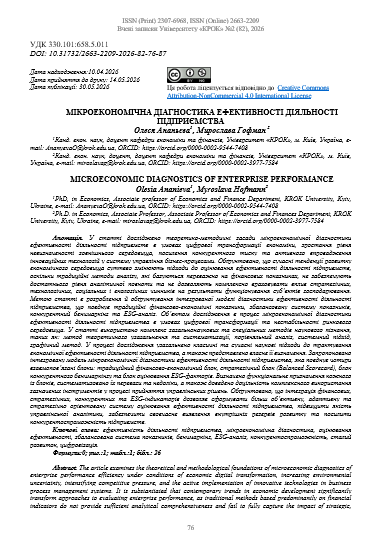
The article examines the theoretical and methodological foundations of microeconomic diagnostics of enterprise performance efficiency under conditions of economic digital transformation, increasing environmental uncertainty, intensifying competitive pressure, and the active implementation of innovative technologies in business process management systems. It is substantiated that contemporary trends in economic development significantly transform approaches to evaluating enterprise performance, as traditional methods based predominantly on financial indicators do not provide sufficient analytical comprehensiveness and fail to fully capture the impact of strategic, technological, social, and environmental factors on business outcomes. The purpose of the article is to develop and substantiate an integrated model for diagnosing of the enterprise performance, combining traditional financial and economic indicators, a balanced scorecard, competitive benchmarking and ESG analysis. The object of the study is the process of microeconomic diagnostics of the enterprise performance in the conditions of digital transformation and instability of the market environment. The article uses a complex of general scientific and special methods of scientific knowledge, such as: the method of theoretical generalization and systematization, comparative analysis, a systems approach, a graphical method. The study synthesizes classical and modern scientific approaches to interpreting the concept of enterprise efficiency, and own definition is also presented. The article proposes an integrated model of microeconomic diagnostics of enterprise efficiency, consisting of four interrelated components: the traditional financial and economic block, the strategic BSC block, the comparative benchmarking block, and the ESG assessment block. The functional role of each component is defined, their advantages and limitations are systematized, and the necessity of their integrated application in managerial decision-making processes is substantiated. It is concluded that the integration of financial, strategic, competitive, and ESG indicators enables the formation of a more objective, adaptive, and strategically oriented system for assessing enterprise performance efficiency. This approach enhances the quality of managerial analytics, ensures timely identification of internal development reserves, and strengthens the long-term competitiveness of enterprises.
Downloads
References
Drucker, P. F. (1967). The effective executive. Harper & Row. https://pdf-drive.to/dl/the-effective-executive-2?utm_source
Porter, M. E. (1985). Competitive advantage: Creating and sustaining superior performance. Free Press. https://dspace.vnbrims.org/items/aab9473c-f04e-4366-8168-9c57c39700e0
Samuelson, P. A. (1980). Economics (11th ed.). McGraw-Hill. https://openlibrary.org/books/OL4422211M/Economics
Farrell, M. J. (1957). The measurement of productive efficiency. Journal of the Royal Statistical Society: Series A (General), 120(3), 253–290. https://doi.org/10.2307/2343100
Ананьєва, О. О., & Гофман, М. О. (2021). Аналіз економіки підприємств у стані невизначеності: особливості інструментарію дослідження. In І. Ф. Радіонова (Ed.), Економіка невизначеності: зміст, оцінювання, регулювання (pp. 169–190). Університет «КРОК». https://dspace.krok.edu.ua/handle/krok/8705
Charnes, A., Cooper, W. W., & Rhodes, E. (1978). Measuring the Efficiency of Decision Making Units. European Journal of Operational Research, 2(6), 429–444. DOI: https://doi.org/10.1016/0377-2217(78)90138-8
Banker, R. D., Charnes, A., & Cooper, W. W. (1984). Some Models for Estimating Technical and Scale Inefficiencies in Data Envelopment Analysis. Management Science, 30(9), 1078–1092. DOI: https://doi.org/10.1287/mnsc.30.9.1078
Adnan, S., Zainal, N., Amin Noordin, B. A., Kamarudin, F., & Johari, J. (2024). Measuring technical efficiency of state-owned enterprises in Asia Pacific and European regions: a data envelopment analysis. Cogent Business & Management, 11(1). DOI: https://doi.org/10.1080/23311975.2024.2306657
Sаnchez-Robles, B., Herrador-Alcaide, T. C., & Hernández-Solís, M. (2022). Efficiency of European oil companies: аn empirical analysis. Energy Efficiency, 15, 63. https://doi.org/10.1007/s12053-022-10069-2
Ananieva, O., & Hofmann, M. (2022). The peculiarities of the research tools in the analysis of enterprise economics in a state of uncertainty. The economics of uncertainty: content, evaluation, and regulation: collective monograph / edited by Iryna Radionova. Tallinn: Scientific Center of Innovative Researches OU, 129-145. DOI: https://doi.org/10.36690/EUCER-129-145
Гофман, М., Пекна, Г., & Розломій, В. (2025). ЕКОНОМІЧНА ТЕОРІЯ АДАПТИВНОГО БІЗНЕС-ПЛАНУВАННЯ: МІКРОЕКОНОМІЧНИЙ АСПЕКТ. Вчені записки Університету «КРОК», (2(78), 65–72. DOI: https://doi.org/10.31732/2663-2209-2025-78-65-72
Пекна, Г., & ГОФМАН, М. (2025). МІКРОЕКОНОМІЧНІ ПОКАЗНИКИ ДІАГНОСТИКИ КОНКУРЕНТНОГО СЕРЕДОВИЩА НА РИНКУ НЕРУХОМОСТІ. Вчені записки Університету «КРОК», (1(77), 54–65. DOI: https://doi.org/10.31732/2663-2209-2025-77-54-65
Kaplan, R. S. & Norton, D. P. (1992). The Balanced Scorecard - Measures that Drive Performance. Harvard Business Review. URL: https://hbr.org/1992/01/the-balanced-scorecard-measures-that-drive-performance-2
Травінська, С., Дерун, І., & Михальська, О. (2023). ЗАСТОСУВАННЯ ЗБАЛАНСОВАНОЇ СИСТЕМИ ПОКАЗНИКІВ У СТРАТЕГІЧНОМУ УПРАВЛІННІ ТА АНАЛІЗІ: КЕЙС ПРОМИСЛОВОГО ПІДПРИЄМСТВА. Financial and Credit Activity Problems of Theory and Practice, 4(51), 103–117. DOI: https://doi.org/10.55643/fcaptp.4.51.2023.4103
Hong, P., Hong, S. W., Roh, J. J., & Park, K. (2012). Evolving benchmarking practices: a review for research perspectives. Benchmarking: An International Journal, 19(4/5), 444–462. DOI: https://doi.org/10.1108/14635771211258037
Шкуренко, О. (2020). Бенчмаркінг як сучасний інструмент розвитку потенціалу підприємства. Адаптивне управління: теорія і практика. Серія Економіка, 8(16). DOI: https://doi.org/10.33296/2707-0654-8(16)-13
Чубко, І. (2019). Кернел, ІМК, МХП, ЛНЗ і Cygnet стали першими учасниками бенчмарк-аналізу Agrohub BM URL: https://landlord.ua/news/kernel-imk-mkhp-lnz-i-cygnet-staly-pershymy-uchasnykamy-benchmark-analizu-agrohub-bm
Панасюк, Т. П. (2023). Методичні підходи аналізу ефективності господарської діяльності підприємства. Проблеми економіки та управління. URL: https://ape.fmm.kpi.ua/article/view/167626
Краєвська, А., & Шварц, І. (2023). КРИТЕРІЇ ЕФЕКТИВНОСТІ УПРАВЛІННЯ ПРОМИСЛОВИМИ ПІДПРИЄМСТВАМИ. Innovation and Sustainability, (3), 22–27. DOI: https://doi.org/10.31649/ins.2023.3.22.27
Кравченко, В. (2024). ЕФЕКТИВНІСТЬ ДІЯЛЬНОСТІ ПІДПРИЄМСТВА: ЗМІСТ, ВИДИ ТА РОЛЬ У СУЧАСНИХ УМОВАХ. Економіка та суспільство, (65). DOI: https://doi.org/10.32782/2524-0072/2024-65-93
Кривецький, І. (2022). ТЕОРЕТИЧНІ ТА МЕТОДИЧНІ АСПЕКТИ ЕФЕКТИВНОСТІ АГРАРНИХ ПІДПРИЄМСТВ. Економічний простір, (182), 149-153. DOI: https://doi.org/10.32782/2224-6282/182-24
Ананьєва, О., Білокриницький, О., & Фельтін, О. (2025). КОМПЛЕКСНА ДІАГНОСТИКА ЕФЕКТИВНОСТІ СИСТЕМИ УПРАВЛІННЯ КАПІТАЛОМ ПІДПРИЄМСТВА. Вчені записки Університету «КРОК», (4(80), 100–107. DOI: https://doi.org/10.31732/2663-2209-2025-80-100-107
Zheng, X., & Bu, Q. (2024). Enterprise ESG performance, digital transformation, and firm performance: Evidence from China. SAGE Open, 14(4). DOI: https://doi.org/10.1177/21582440241291680
OECD (2025). Behind ESG Ratings: Unpacking Sustainability Metrics. URL: https://www.oecd.org/content/dam/oecd/en/publications/reports/2025/02/behind-esg-ratings_4591b8bb/3f055f0c-en.pdf?utm
МХП (2025). Стратегія сталого розвитку МХП. URL: https://api.next.mhp.com.ua/images/2ef40/74d97/90162ec8f73.pdf
Ананьєва, О. О. (2025). Діагностика ефективності впровадження штучного інтелекту в діяльність підприємств ІТ-сектору. Вісник Академії праці, соціальних відносин і туризму, (5). DOI: https://doi.org/10.54929/3041-2390-2025-05-01-11
Downloads
Published
How to Cite
Issue
Section
License

This work is licensed under a Creative Commons Attribution-NonCommercial 4.0 International License.