AUSTRIAN TRADITION OF ECONOMIC ANALYSIS: PHILOSOPHICAL AND METHODOLOGICAL IMPERATIVES
DOI:
https://doi.org/10.31732/2663-2209-2019-56-25-33Keywords:
Austrian tradition of economic analysis, Austrian paradigm of economic theory, subjective approach, praxiology, philosophical and methodological imperatives, Austrian neoliberalism, Austrian subjective-psychological schoolAbstract
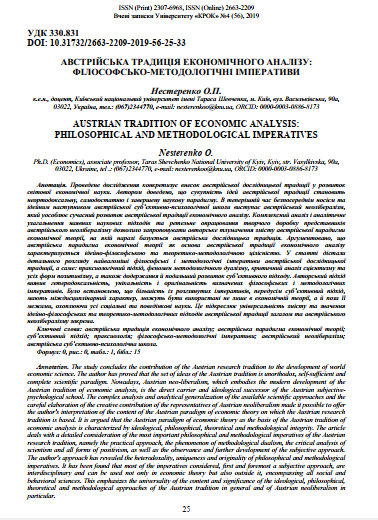
The study concludes the contribution of the Austrian research tradition to the development of world economic science. The author has proved that the set of ideas of the Austrian tradition is unorthodox, self-sufficient and complete scientific paradigm. Nowadays, Austrian neo-liberalism, which embodies the modern development of the Austrian tradition of economic analysis, is the direct carrier and ideological successor of the Austrian subjective-psychological school. The complex analysis and analytical generalization of the available scientific approaches and the careful elaboration of the creative contribution of the representatives of Austrian neoliberalism made it possible to offer the author's interpretation of the content of the Austrian paradigm of economic theory on which the Austrian research tradition is based. It is argued that the Austrian paradigm of economic theory as the basis of the Austrian tradition of economic analysis is characterized by ideological, philosophical, theoretical and methodological integrity. The article deals with a detailed consideration of the most important philosophical and methodological imperatives of the Austrian research tradition, namely the practical approach, the phenomenon of methodological dualism, the critical analysis of scientism and all forms of positivism, as well as the observance and further development of the subjective approach. The author's approach has revealed the heterodoxality, uniqueness and originality of philosophical and methodological imperatives. It has been found that most of the imperatives considered, first and foremost a subjective approach, are interdisciplinary and can be used not only in economic theory but also outside it, encompassing all social and behavioral sciences. This emphasizes the universality of the content and significance of the ideological, philosophical, theoretical and methodological approaches of the Austrian tradition in general and of Austrian neoliberalism in particular.
Downloads
References
Берри Н. Норман. Австрийская экономическая школа: расхождения с ортодоксией / Панорама экономической мысли конца ХХ столетия. Под ред. Д. Гринэуэя, М. Блини, И. Стюарта. В 2-х т. Пер. с англ. СПб. : Экон. шк., 2002. Т. 1. С. 81-105.
Кубедду Р. Политическая философия австрийской школы: К. Менгер, Л. Мизес, Ф. Хайек. Пер. с англ. М., Челябинск : ИРИСЭН, Мысль, Социум, 2008. 406 с.
Менгер К. Основания политической экономиию Австрийская школа в политической экономии. Москва : Экономика, 1992. С. 31-242.
Мизес Л. фон. Человеческая деятельность: трактат по экономической теории. Пер. с англ. Челябинск : Социум, 2005. 878 с.
Ротбард М. Власть и рынок: государство и экономика. Пер. с англ. Челябинск : Социум, 2010. 416 с.
Сото Х. Уэрта де. Австрийская экономическая школа: рынок и предпринимательское творчество. Пер. с англ. Челябинск : Социум, 2007. 202 с.
Хайек Ф. фон. Использование знания в обществе. Индивидуализм и экономический порядок. 2011. С. 93-110.
Хайек Ф. фон. Контрреволюция науки. Этюды о злоупотреблениях разумом. 2003. 288 с.
Хайек Ф. фон. Экономическая теория и знание. Индивидуализм и экономический порядок. 2011. С. 41-68.
Эбелинг Р. Роль австрийской школы в развитии мировой экономической мысли XX века. Экономика и математические методы. Т. 28. Вып. 3. 1992. С. 347-363.
Aimar T. The Economics of Ignorance and Coordination: Subjectivism and the Austrian School of Economics. Cheltenham, UK ; Northampton, MA : Edward Elgar, 2009. 302 р.
Austrian Economics in Transition: From Carl Menger to Friedrich Hayek, by H. Hagemann, T. Nishizawa and Y. Ikeda (eds). London, New York : Palgrave Macmillan. 2010. 339 р.
Caldwell B. Hayek’s Scientific Subjectivism. Economics and Philosophy. Vol. 10. № 2 (October 1994). Рp. 305-313.
Salerno J. T. The place of “Human Action” in the Development of Modern Economic Thought. The Quarterly Journal of Austrian Economics. Spring 1999. Vol. 2. № 1. Рр. 35-65.
Schulak E. M., Unterköfler H. The Austrian School of Economics: A History of Its Ideas, Ambassadors & Institutions. Auburn, AL : Ludwig von Mises Institute, 2011. 244 р.